

Another brief pause to look at how this journal is evolving: what’s working, what’s changing, and where we go from here. The last check-in was in November.
This one is more significant. Barnes2050 is a year old.
At launch the project’s goal was simple: to laugh, learn and make a difference.
Learning was not just navigating the road to 2050, but to gaining new skills and experiences. Tick.
Laughing meant enjoying the experience. Week in, week out. Again, tick. Not all 190 stories are well written or sufficiently thought through, especially the early ones. But creating them has been a delight. And it remains thrilling to see my emerging beliefs in this new space, codified in public.
Making a difference will take longer, as I will explain in a moment.
For now I am so pleased with everything that has happened, I’m committing another two years to the project.
If the first year was about foundations, the next is about testing the structural integrity: seeing if the thinking survives its first real contact with reality.
This update covers:
Strategic clarity
Strategic clarity
The positioning of Barnes2050 shifted significantly in February 2026. Before then I often described it as a micro-think tank. That was not entirely wrong. It still is not. But it turned out not to be the clearest or most useful description.
Over the winter, in talking about the project, I found myself returning to a simpler phrase: Barnes2050 is a futures project. It is focused on one distinctive place — Barnes, London — and one medium-term horizon: 2050, the UK government’s deadline for net zero. The question is easy enough to state, even if it is anything but easy to answer: how do we make sure Barnes — the place and its people — are thriving and climate-ready by then?
What is the best contribution I can make to finding that answer?
To use my skills and experience in public service, local journalism and technical innovation to surface and develop ideas for a better Barnes. This journal is the record of that process. It sits alongside and is complementary to other local media such as The Barnes Village Bugle and Barnes Community Association Plus, trying to do something rather different.
One other thing.
Over the year I have narrowed the geographical focus to make the project more manageable. First I decided to ditch part of Putney from the original scope, then Mortlake too. I am now left with Barnes, SW13. As a result, the project has been renamed Barnes2050. This better reflects the focus of efforts as well as being more comprehensible at first glance.
The name change will take about two months to roll out across this journal, YouTube and the various other social media accounts. During that time you may come across broken links. If you do, please email me and the fix to it or them will be prioritised. Thank you for your patience during this process.
Performance
Barnes2050 has two audiences. The first is the roughly 18,000 other residents of Barnes. I want to contribute, in however modest a way, to the conversation already underway about how best to maintain quality of life in an age increasingly shaped by climate pressures.
The second audience is smaller and more specific: the people whose decisions shape the place for everyone else. There are probably fewer than 150 of them. You find them in commerce and local government. They live in Barnes, Richmond borough and occasionally beyond that. They are Gen Z and Boomers. I want to get to know them, talk with them and, where possible, persuade them that some of the ideas developed here would help Barnes — people and place alike — prepare for 2050.
Given those ambitions, it is hardly surprising that there is little tangible progress to report at the end of year one. That was always the plan. I wanted first to build the knowledge base rather than draw attention to it. I wanted to start with the foundations. Arriving late to the subject, I felt I needed to earn some legitimacy through the slower work of learning.
I think that base now exists: 190-plus stories across nine themes. The journal can still feel sketchy in places. Some stories remain slight. But the intellectual scaffolding is now there, and the production processes filling it out are improving steadily.
Content settling
At the heart of this journal is storytelling. As Ursula K. Le Guin, said,
Words are events, they do things, change things.
They transform both speaker and hearer; they feed energy back and forth and amplify it. They feed understanding or emotion back and forth and amplify it.
A year of launching, learning and iterating has improved the stories told here. Here are three examples of how simplification has improved the the journal:
Navigation
The site now rests on the nine themes visible at the top of the home page.
An earlier version gave more prominence to Health, but the balance of stories made clear that I needed to put more weight on the built (infrastructure) and natural (landscape) environment.
Health has therefore been absorbed into Lifestyle.
Story types
The current structure is the third, and probably final, version.
There are now three broad types of story:
Observe — background, news and factual reporting: what we can see in Barnes today
Interpret — commentary and analysis: why it matters, and what it may signal about the future
Imagine — plausible futures, gathered under the Manifesto label. More on this in a moment
The aim now is to spend more time creating stories in that third category. These future-facing stories take longer, but they are more satisfying to produce, more useful to readers and, I hope, more likely to prove effective over
Formats
Three formats have proved especially useful in the last year:
‘That was the week that was’ is a weekly summary of news relevant to Barnes’ possible futures. It usefully caps the time spent on day-to-day news — the least important content type here — while helping me scan for signals of what may be coming.
LoveThis! format is designed to counterbalance the journal’s natural bias towards what needs fixing, by making space for appreciation of what already works
Lessons from .. has given my travels an extra dimension, whether in Sydney, Australia or Rotterdam,Netherlands. They help me see Barnes afresh.
Other formats are still being tested, including ones that lean more heavily on images and audio.
Manifesto section
This is the most important part of this journal. It has been re-organised into four distinct sections, as I explain here:
trends
visions - for example the Thames to Thames walk
principles
proposals - for example, ideas for a new park and pedestrian pop-up.
The first articles outlining some of the trends likely to shape Barnes in 2050 will be published shortly. So too will the first pieces on the principles that Barnes2050 believes should guide the making of a better Barnes. Until then, here is how the current ten proposals relate to the peninsula.
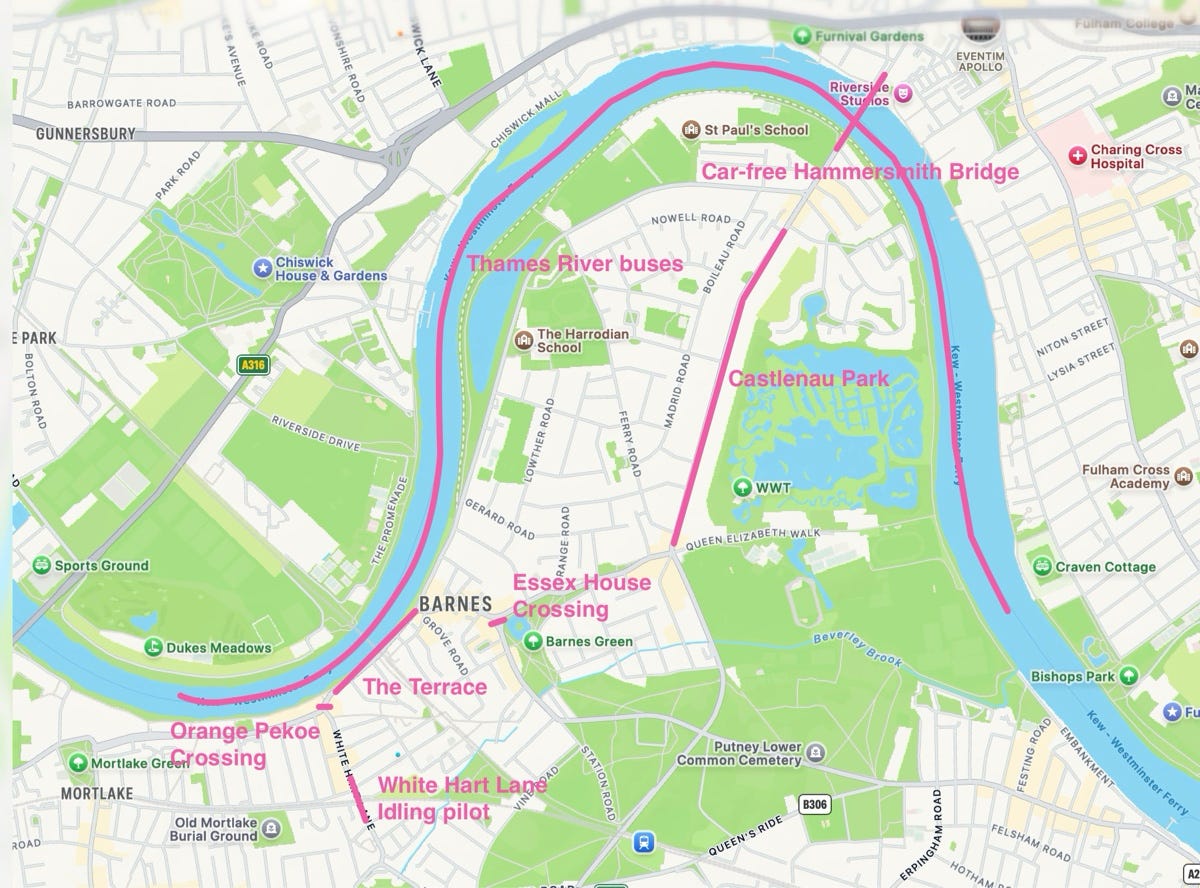
The full list of proposals is here. Here are six of the best.


Also worth calling out
Ai is embedded into my production process and now co-authors the occasional image, infographics, slide decks and my first Ai podcast. I don’t use Ai to develop the first or indeed second draft of stories. The process of writing is too important. It helps me work out what I think. More than that, I think the world is better served by authentic human voices, with all their opinions and idiosyncrasies.
You may have noticed some names are regularly emboldened. This reflects the important Barnes2050 places on decision-making. There is no frictionless path to 2050. Every serious choice involves trade-offs. In the end, people and organisations have to decide. If they are based in Richmond borough, you will find their names in bold.
The introduction of video is on hold. It was a step too far, too soon. Instead, expect more audio reporting in the short term, with video likely to follow in late 2026 or early 2027.
Some initiatives were dropped after testing. Topic boxes, for example, proved too onerous to maintain.
I am also going to reduce the frequency of these reports. They will appear every six months from here on, reflecting what should now be a slower rate of change.
2026 priorities
I will continue to publish regularly. At the moment I am working on proposals about better understanding local opinion, a celebration of the majestic postbox, and a piece about time itself: why is it still so hard, in 2026, to imagine life in 2050?
With the basics now in place, it is time to push on. Over the next twelve months I want to add three things: more engagement, online and in person; more audio and, later, video; and a broader effort involving contributors and collaborators rather than just me.
Audio, too - I am going back to my media roots: I started my career in BBC radio. I bring more audio into the journal: interviews, reports, clips. If things go to plan, I hope to introduce video next winter.
Showing up - More engagement with residents and experts, online and in person. I want to share my thinking on social media to see how it might be improved. I want to be in touch with subscribers more regularly, perhaps every few months to begin with. And I want to be out in Barnes, often with microphone in hand, hearing what you have to say about our future.
Partnerships - I am looking for contributors and collaborators to join the project. More people would mean more brains, more output and, not least, more fun. There will be more on this in the summer. Until then, if you are interested in being involved, do mail me. There is no obligation attached to that expression of interest. But I would happily stand you a coffee or something stronger.
One final thing. I checked. One candle on the cake flickering for 15 minutes releases between 1g and 8g of CO₂ depending on the sort of candle. For comparison, boiling a kettle releases between 15g and 30g of CO₂.
Light that candle.
Barnes2050 will never take the puritanical path of denial .. more on this in the autumn.
Updates to this page
This article was originally published on 16 April 2026.
It was updated on 17 April 2026. The new version included:
Stylistic improvements to the opening paragraph
Correcting grammatical errors and spelling mistakes
'This is the story of the most astonishing and destructive thing never to happen to London'

Welcome to Bridged2050: creating an even better Barnes during this climate crisis