

My working memory has been restacked. Not once but twice. And by Richmond council.
1976 has figured large in my life. That was the summer the twelve year old me gorged on village cricket for the first time. Day after day, from spring through late summer. Tanned, blonde hair. Plus one or two outstanding batting performances.
It turns out 2022 has become the new 1976. At least was my first impression listening to Richmond council’s most recent Sustainability Forum, an open meeting held several times a year that gives us a window into the council’s thinking on climate change.
There were so many stories from that livid summer when temperatures topped 40ºC. On 19 July 2022 the London Fire Brigade ran out of engines, on what the Brigade and Mayor called its busiest day since the Second World War.
Sitting in the York House audience, Twickenham I was recalibrating to this new historical index when I had to go again. 2026 replaced 2022.
Biking home, I realised both were right.
In 1976 the uncommon heat lasted months.
In 2022 the peak heat rocketed
In 2026, never as hot as four years earlier, five heatwaves did for us. By now 1976 was a lowly seventh for average summer mean temperatures.
Peaks and persistence of climate change became my way of understanding my life in climate.
Welcome to Barnes2050, a place-based futures project asking: how do we help Barnes - the place and its people - thrive and be climate-ready by 2050? If this is your first visit, you might want to start here.
Stories, stories, stories
David Shukman, former BBC Science Editor and now author of The Response, was the special guest. His book was being shared among Richmond councillors and their staff. He reminded me of the power of a compelling storyteller.
His stories, whatever the year, were vivid. The north London pensioner who nearly drowned in his own basement flat because of the rain. The firebreak that residents in east London didn’t want but which saved their homes. And his daughter-in-law’s difficult pregnancy through five heatwaves. Mother and baby survived
The UK Climate Change Committee (CCC) suggests we plan for 2°C and assess for 4°C which is why Shukman suggested there should be a National Emergency Shading Programme which should do everything we can that addresses risks to Schools, hospitals, homes of the the at risk.
We must do everything we can to stop the sunshine hitting the glass
He pointed to lots of cost solutions to this problem, echoing the CCC report in May, 2026.
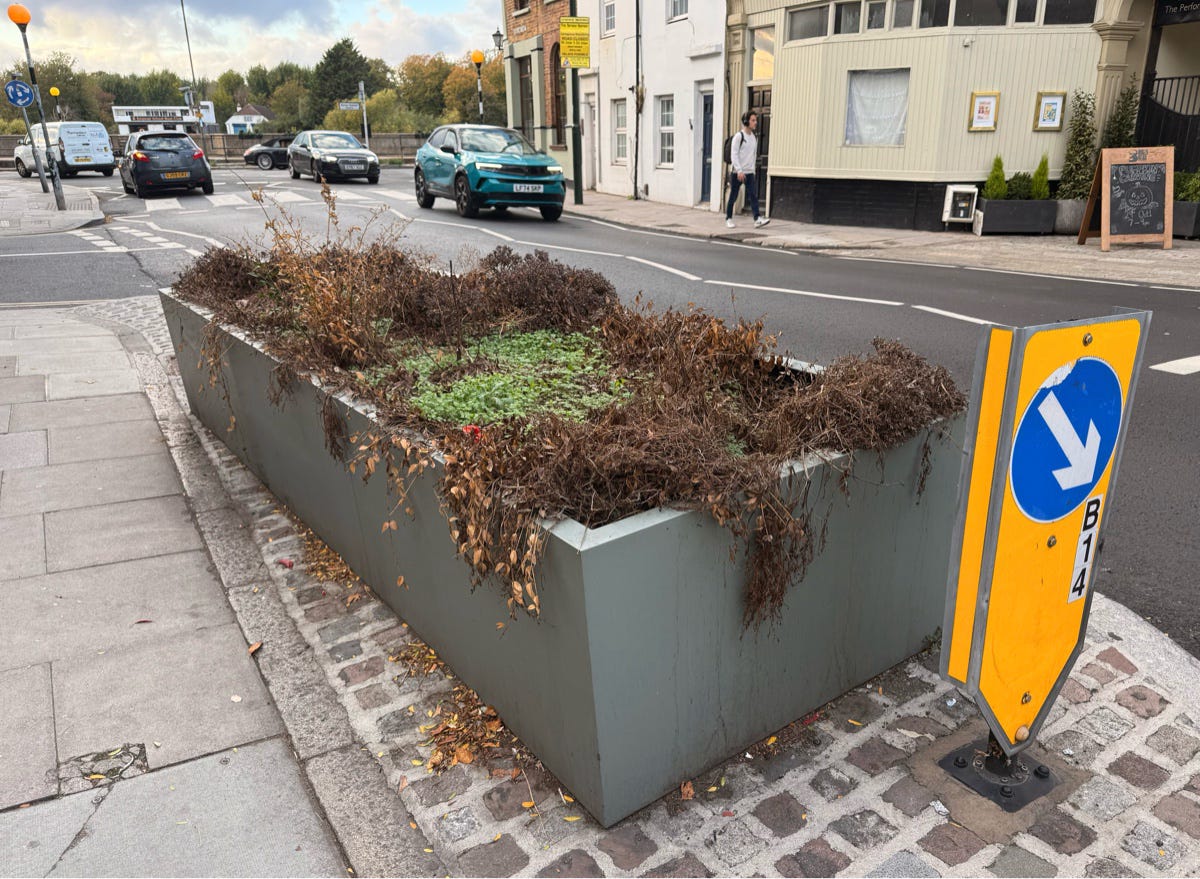
In a throwaway line he also said every rain-garden should have a prominent sign saying,
This saves lives and homes
Second that.
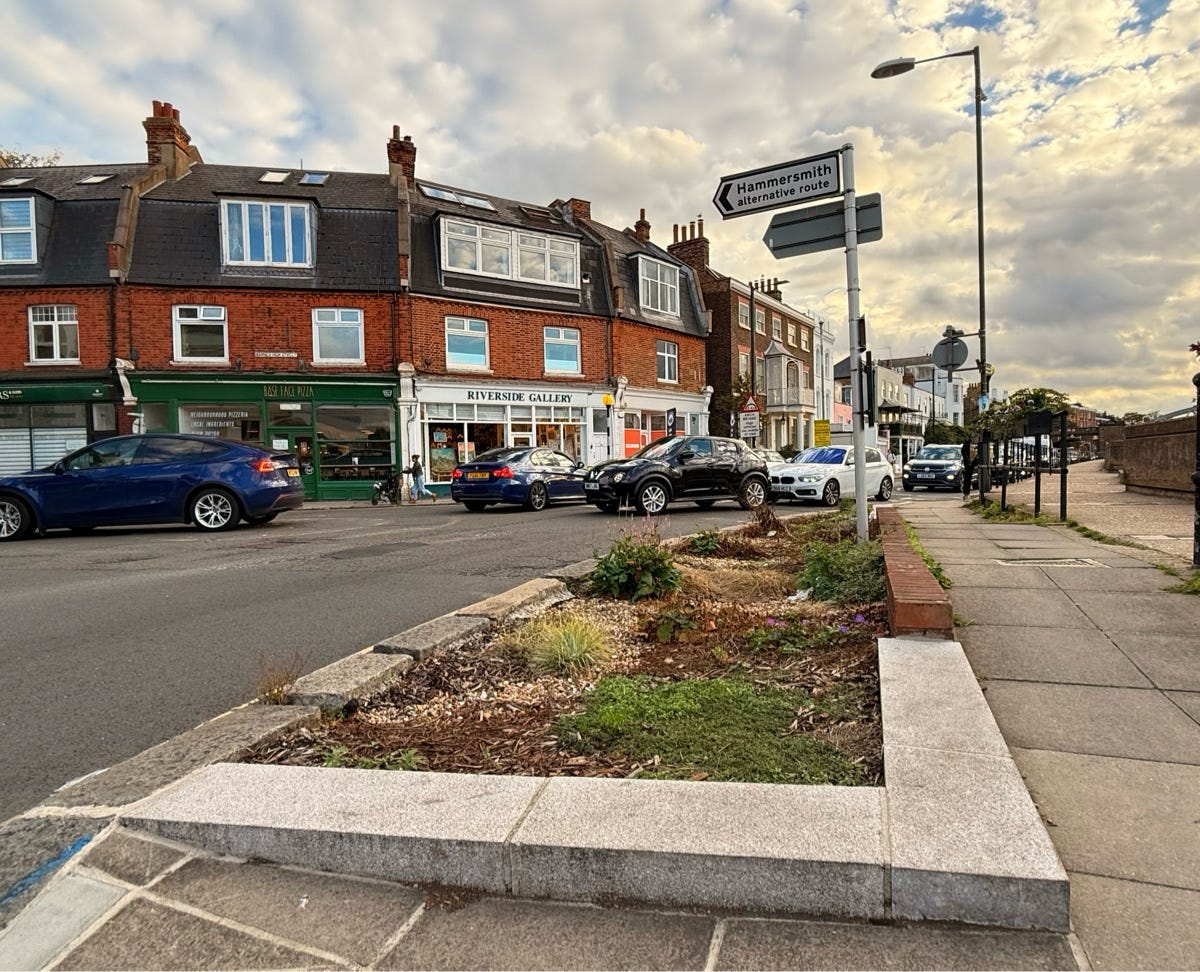
Whilst Richmond council are sorting the sign, they might think about the planting, too.
Data, data, data
Data not dogma is always a welcome sign. At the Forum, Richmond council went further. It made clear both extremes and averages mattered.
2022 was the summer of the extreme peak. England reached 40.3°C, the highest temperature ever recorded here.
2026 was the summer of the high average. Its mean temperature across June, July and August was 16.5°C, a record. It had five heatwaves and 40 days above 30°C, beating the previous record of 34. Its peak was lower than 2022’s.
The council also shared two of its principal sources of information:
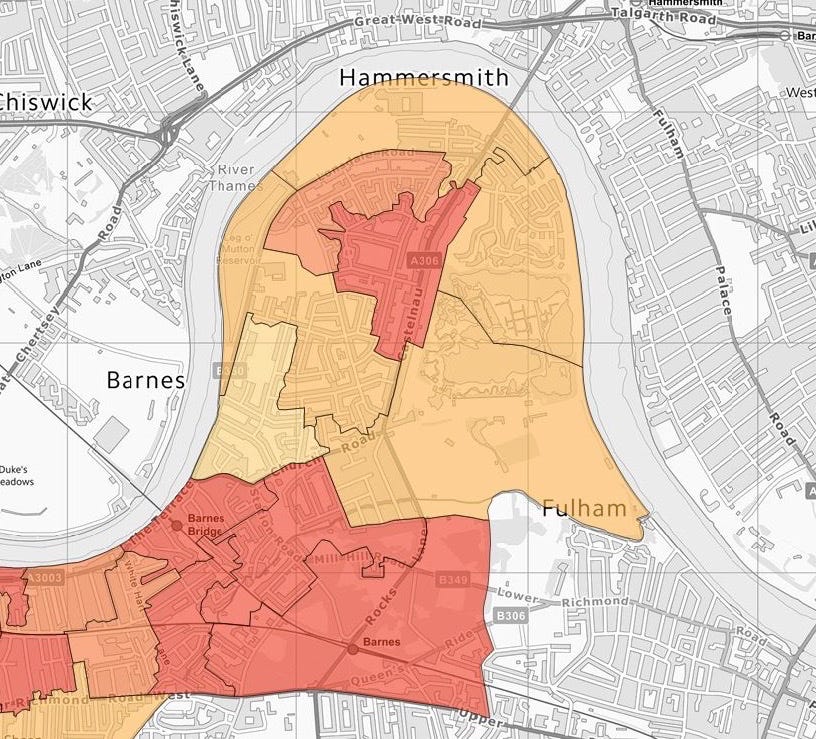
Climate and Air pollution risk map
DataRich
Each tells the same story. As one speaker put it,
.. climate risk is localised and unequal
This first image from the risk map shows the current risk of flooding: the darker the colour, the higher the risk. That linear park along Castelnau looks an even better idea.
This second image shows the risk of overheating
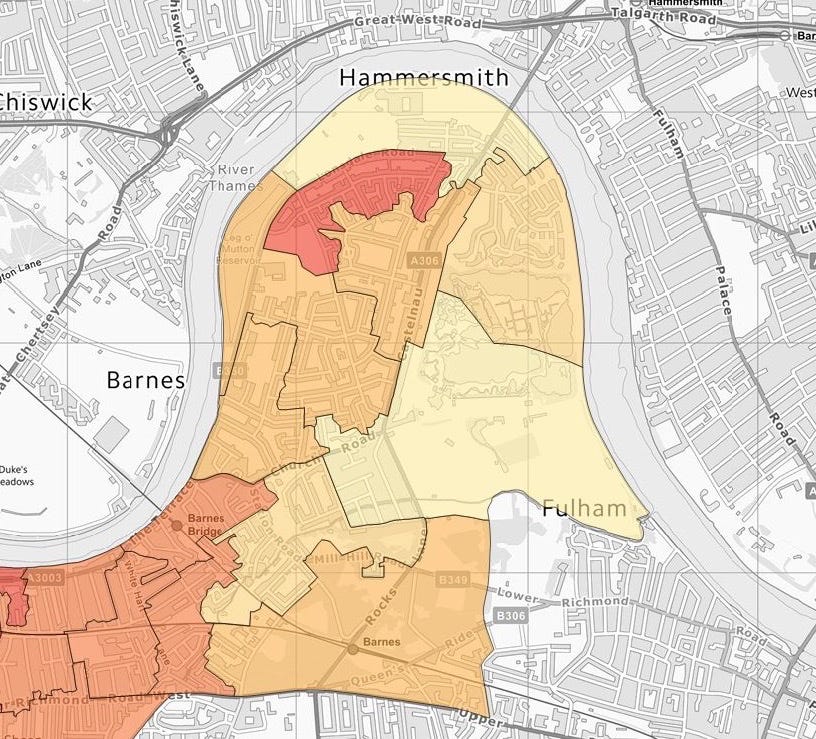
Clare O’Connor, Director Climate Policy & Communications explained these maps had been updated earlier this year and then used in earnest for the first time during the heatwaves.
They enabled the council to see where in the borough vulnerable lived, and target communications and support.
DataRich is the second data source about the borough.
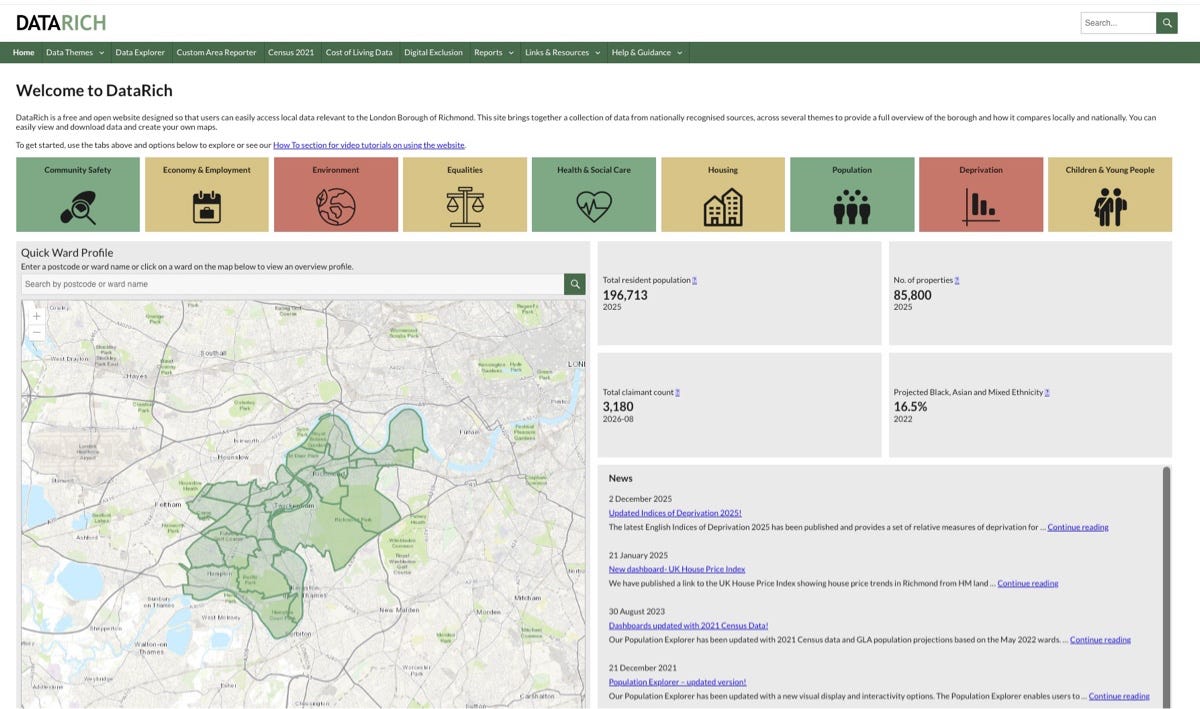
If you’ve not seen this before,
DataRich is a free and open website designed so that users can easily access local data relevant to the London Borough of Richmond.
This site brings together a collection of data from nationally recognised sources, across several themes to provide a full overview of the borough and how it compares locally and nationally.
You can easily view and download data and create your own maps.
If Shukman reminded us of the power of narrative, this dataset made just as strong a case. Numbers and narrative have informed Barnes2050 since its launch. That is why there’ll be more about these resources.
Why does someone die?
We’ll soon know how many excess deaths were the result of the 2026 heatwaves. Shukman said the numbers will be ‘horrific’.
The difficulty, as during Covid’s lockdowns, is knowing whether the heat caused a death. Often there were underlying health problems, and the heat amplified them.
I am conscious that my formulation of the risk is simplistic: water destroys property, heat kills people. It contains a germ of truth, but the layers of reality wrapped around it need acknowledging. Shukman’s pensioner nearly drowned in his own home.
Richmond’s blue pride and joy
Community BlueScape is a hugely important programme for Richmond council, one of the partners alongside Barnes Common and WWT.
It is easy to lose sight of how much it has achieved. From Kitson Road to Barnes Green, our landscape has been improvedL nature harnessed to protect us.
The council are keen to learn from the main initiatives. A formal programme review has started and will be complete in 2027 with the programme now in its last six months.
De-paving is harder than the slabs it wants to replace
It turns out stopping people paving over their front gardens is harder than it looks.
The law for front gardens in England is reasonably clear. Planning permission is needed when more than five square metres is covered with traditional impermeable surfacing that doesn’t drain to a permeable area.
Except even that first part is complicated - size, assessing material. That’s before you get to the different rules for back gardens and patios, let alone enforcement.
Given the threat to Barnes SW13 from river and rain, letting every front and back garden to become a small soakaway seems a simple step. Maybe how common they are, or not, is a useful indicator of widespread preparedness for the climate to come.
Richmond council has pulled together all its work on climate change. The presentation pack from this Forum is available to download below.

It is possible to quibble with the urgency, but Richmond council should be applauded for being clear about the direction of travel.
They take the climate emergency seriously.
They are trying a number of things and sharing what they know widely.
I was late to climate change, like most, but this feels materially different to 2016. I wonder whether, in ten years’ time, we will be talking about 2036 and 2032 the way we now talk about 2026 and 2022.
After all the Met Office said a summer like 2026 is now roughly a once-in-nine-years event, made around 130 times more likely by climate change. In a world 4°C warmer, a summer like 2026 would count as cool.
Explore more stories about our changing climate and what it could mean for Barnes and the rest of London by 2050.