

One down, one to go.
Gatwick Airport’s expansion has been approved. Attention now returns to Heathrow’s plans.
The deadline is approaching to have your say on the proposed third runway.

The UK government will consider the responses it receives before deciding whether the Heathrow Expansion National Policy Statement (HENPS) will be amended and then finalised. Parliament will also need to vote on the policy before it goes ahead.
The proposed third runway is only half the story, though.
There is a second review which could have just as large an impact on Barnes SW13. The third runway might ultimately be rejected, yet the redesign of London’s airspace could still leave the skies above Barnes busier than they are today.
In many ways, Barnes sits at the heart of what should be a national discussion. The runway debate asks whether Britain wants a bigger Heathrow. The airspace debate asks which communities will live beneath the aircraft.
Maybe that opening sentence should have read: one down, two to go.
Welcome to Barnes2050, a place-based futures project asking: how do we make sure Barnes - the place and its people - is thriving and climate-ready by 2050? If this is your first visit, you might want to start here.
Living beneath the western approach
Heathrow Airport is a wonder of planning and management.
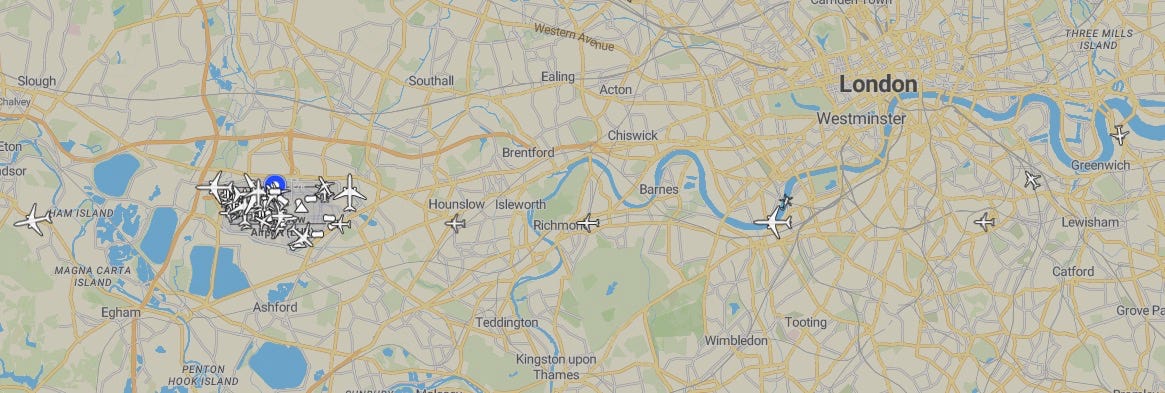
A day in the life of airspace around Heathrow Airport provides a vivid sense of the the scale of the challenge.
This short video, also from Heathrow Airport, explains how arrivals works. Ignore the monarchical slip and closing bromide.
Barnes is overflown mainly on western arrival days, with planes landing on Heathrow’s northern runway.
The weather determines the direction used on a given day. Aircraft normally land and take-off into wind. The prevailing westerlies over the UK mean Heathrow typically uses the western approach for 70% of the time. Easterly operations account for the remaining 30%.
Heathrow has two runways, northern and southern. During daytime westerly operations,
one is used for arrivals and the other for departures. They switch at 3pm, giving places such as Barnes a break of about nine hours from the main stream of arriving aircraft directly overhead.
The morning and afternoon pattern is reversed the following week.
Heathrow’s expansion plans
Rather than retell arguments that have been debated for years, this article focuses on what the proposals could mean for Barnes. Links below explain the case for and against expansion in more detail.
Let’s start with that third runway.
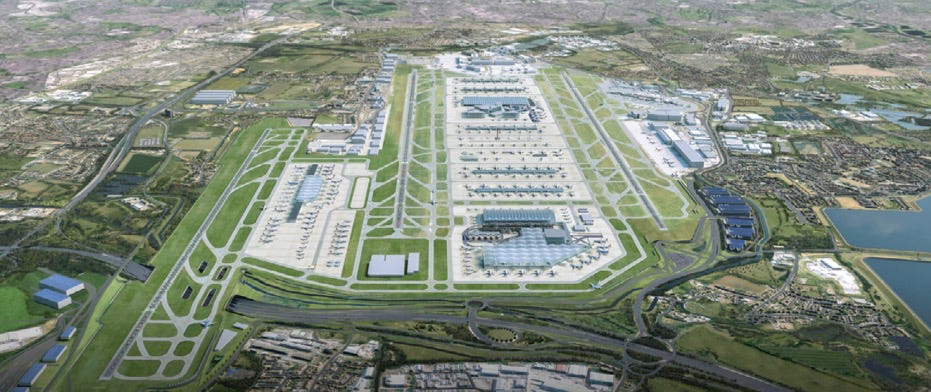
The airport’s owners, Heathrow Airport Limited (HAL), want to build a full-length, 3,500-metre runway, which would require the M25 motorway being moved.
HAL’s scheme is estimated to cost £33billion, including £1.5billion to move the M25, and is expected to be fully privately financed.
Annual passenger numbers at Heathrow are projected to rise by 79 per cent to 150 million, carried on as many as 756,000 flights a year. This means an 700 additional planes a day.
This explanation from Heathrow Airport is seven years old and was produced for an earlier consultation, but it remains a useful explanation of how expansion would work. Its age also says something about how long we have been discussing this.
Alternatively, BBC News explains the plans.
What it might mean for Barnes
If the expansion goes ahead Barnes will have more overhead flights - and noise - because of the increase in numbers.
The government says overall aircraft noise can be held to 2024 levels despite that significant increase in flights, although this analysis is based on indicative routes ahead of the formal airspace review.
Barnes will also have less respite.
The three-runway system would require a new alternation and respite regime.
The draft 2026 policy does not preserve today’s roughly half-day pattern. Instead it anticipates reduced or altered respite while requiring an applicant to set out a credible replacement scheme.
As Putney.News reports,
The Putney Society, which has read the document closely, puts the loss (of respite) at roughly half.
Your opinion still matters
Some commentators, including the Barnes Bugle, have suggested the Gatwick decision is a blow for those against the third runway at Heathrow.
Putney.News disagrees. It argues that our views still count, particularly if they are framed around evidence and specific parts of the draft policy.
If your instinct is that all this is settled and there is no point saying anything, the government has quietly told you otherwise.
In its own consultation papers it says it will give greater weight to responses built on argument and evidence than to simple statements of support or opposition, and greater weight again to responses that point at particular sections of the draft. It also says artificial intelligence may be used to analyse what comes in.
That leads Putney.News to a useful conclusion,
A thousand identical objections is one objection. A hundred different ones, each naming a different problem, is a hundred.
The rest is your own experience, and it is the part nobody else can write. What time the planes wake you. What you cannot do in the garden when the landings switch. Which park has been spoiled. That is evidence, and it is the kind the department has not got.
There is advice aplenty whether you are in favour or against this expansion. Fleur Anderson MP (Putney, Labour) who is opposed has created this guide.
You can use that to complete the UK Government survey.
Putney.News offers help of a different kind.
If you are still daunted by the official consultation process, it has produced a useful tool to help you build your response.
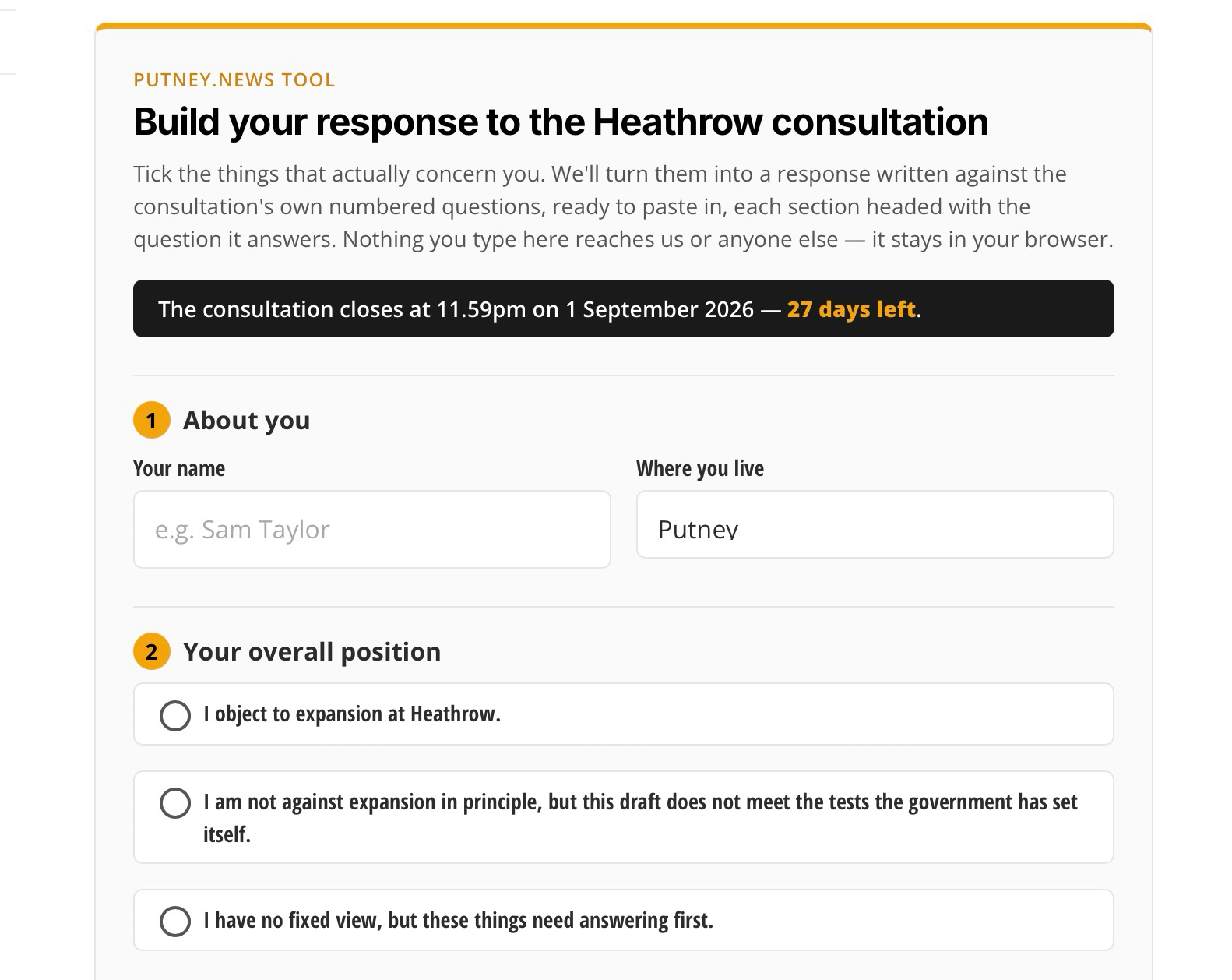
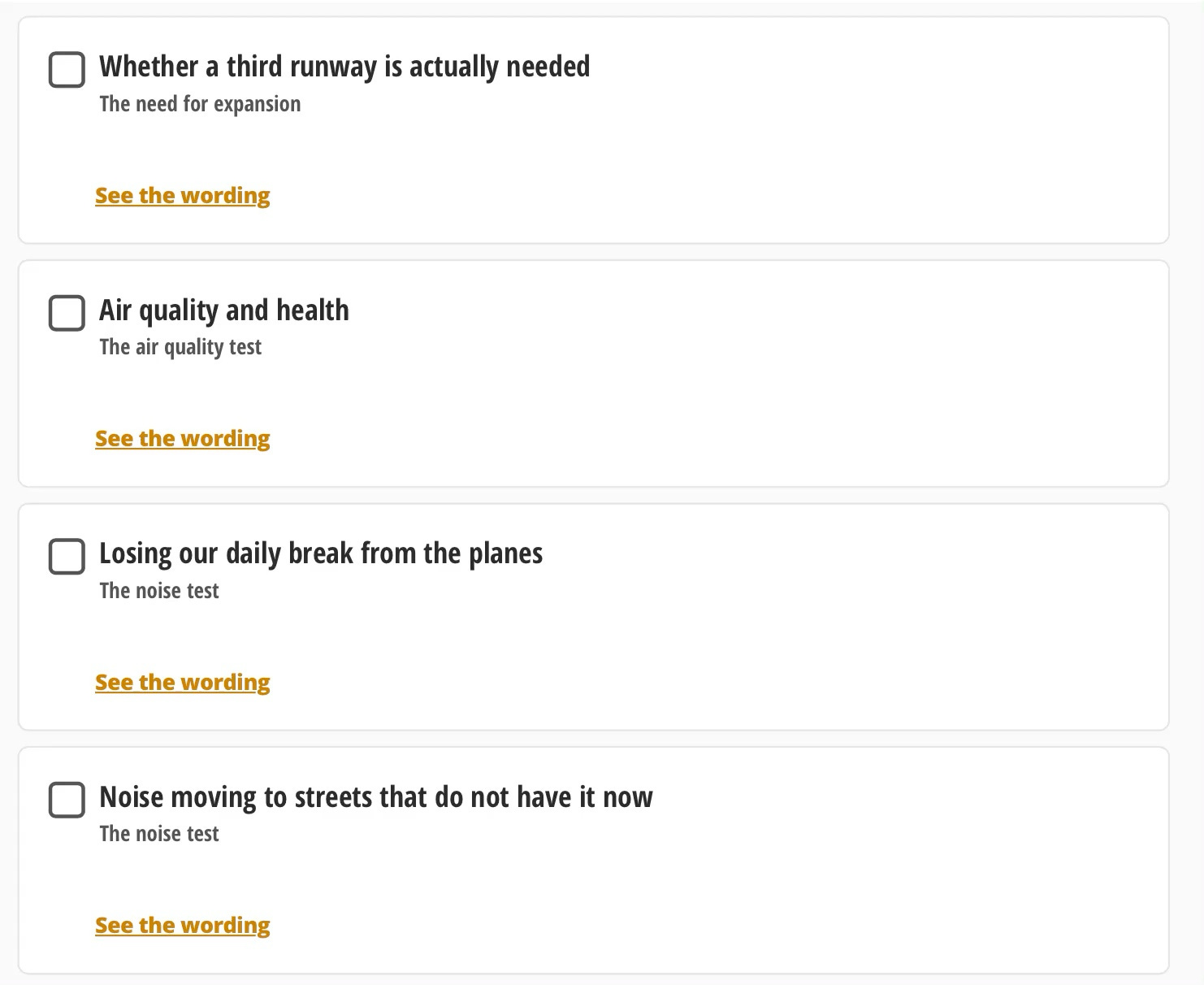
It can take as little as five minutes, although spending a little longer will make your response more useful. The potential issues with expansion are listed. You choose those that concern you most and explain why, in as few or as many words as you think necessary.
Airspace review
The third runway has attracted most of the headlines. Yet there is another process, largely unnoticed outside the aviation world, that could prove just as important for Barnes.
The UK Airspace Design Service (UKADS) is redesigning the UK’s flight paths as part of a wider programme to modernise air traffic management, including the airspace that would be needed to accommodate any Heathrow expansion. Its aim is to make the skies safer, more efficient and better able to cope with future demand.
The challenge for Barnes is that no one yet knows precisely where those redesigned routes will lie.
Airspace modernisation could make Barnes quieter, noisier or simply differently overflown. The detailed local consequences may not be known until after national decisions on Heathrow expansion have been taken. What we do know is that decisions made over the next few years could shape the character of our skies for decades.
The modernisation programme aims to increase capacity, resilience and efficiency through better coordinated routes, satellite-based navigation, continuous climb and descent, and less airborne holding.
All those variables means the impact on Barnes is not certain. Flight paths could become more concentrated over narrower corridors, or redistributed across different communities. Aircraft may be able to remain higher for longer on some routes. Periods of respite could be retained, shortened or reorganised.
Heathrow says its statutory public consultation on detailed flight-path options is not expected to begin until at least 2027, with implementation likely only in the late 2020s or early 2030s.
That means Barnes could be quieter, noisier or simply experience a different pattern of overflight in the 2030s. Today, neither the UK Government, Heathrow nor Richmond council can yet say with confidence which outcome will apply.
Any reduction in aircraft over Barnes would generally mean increased overflight elsewhere, although more efficient routing, higher flight profiles and shorter, more direct routes may reduce the total number of people significantly affected by aircraft noise.
This is why the runway debate asks whether Britain wants a bigger Heathrow. The airspace debate, when it starts, asks which communities will live beneath the aircraft.
Notes and thoughts
Barnes2050 remains opposed to the expansion of Heathrow Airport
Whatever your view, please share your opinion with the consultation
Remember also the second consultation, possibly in 2027 which might be more consequential
More details below.
We already live beneath one of Heathrow’s principal arrival routes and benefit from today’s runway alternation, which brings predictable periods of respite. Both could change. The expansion debate matters, but the redesign of the skies above Barnes may matter just as much, perhaps more.
If you want to understand the wider case against expansion, several local and London voices have already set it out well.
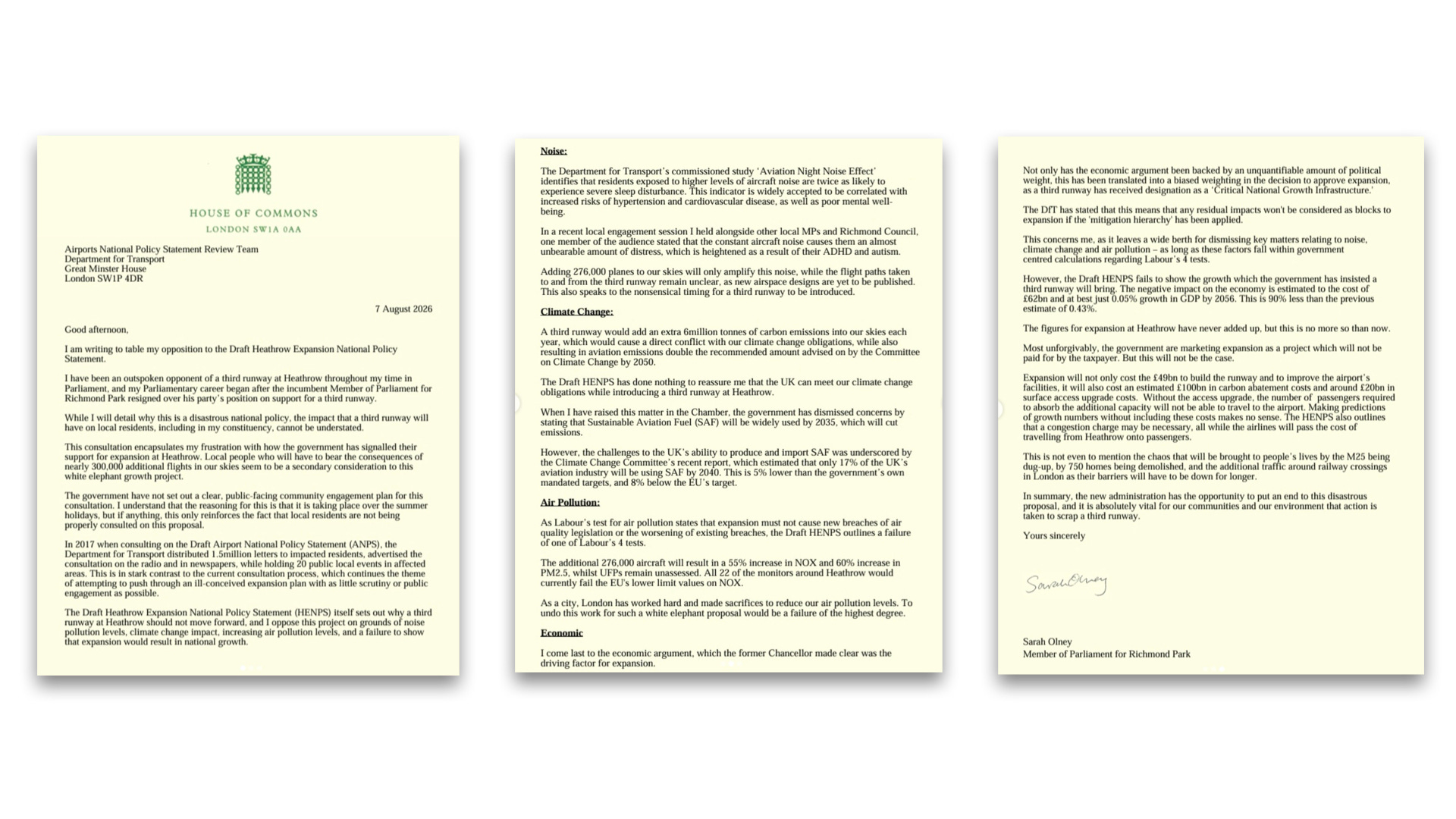
Sarah Olney MP’s letter to the Secretary of State for Transport, Heidi Alexander outlines the case against expansion and is reproduced in full above. Its discussion of the economic case—the central justification for the Government’s support—is particularly useful.
The Mayor of London, Sir Sadiq Khan is opposed to the expansion in part because the UK government’s case for the increased capacity at Heathrow ‘relies heavily’ on findings that are almost a decade old and in part because of the ‘.. severe impact it will have on noise, air pollution and meeting our climate change targets’.
In the Mayor’s submission to the House of Commons Transport Committee, the Mayor and Transport for London argue the plan would allow more flights, and therefore more emissions, while ‘taking advantage of environmental improvements unrelated to airport expansion’.
The Mayor believes that expansion would consume some of the environmental headroom created by policies such as the Ultra Low Emission Zone (ULEZ), which has delivered large reductions in air pollution. ‘This progress must not be undone by expansion,’ the submission says.
Richmond council are opposed to the expansion.
Elsewhere Research by Possible suggests public sentiment is skeptical about how any benefits might be shared.
Now it's your turn
Whatever your view, please contribute to the consultation. Responses need to be submitted before midnight on 1 September 2026.
This is the UK Government survey.
By 2050, the third runway may be old news. The more enduring question for Barnes may be what happened to the skies above us: how many aircraft pass overhead, how often, and how much quiet remains between them?