

Another week in which glimpses of the future appeared in plain sight. Let’s start with the UK government’s new transport strategy.
Transport - UKG says road traffic will grow
In less than a decade, the government forecasts road traffic will rise by 10 per cent. BikeIsBest flagged the line first. It is a sobering number.
Why it matters
Imagine 10 per cent more traffic on the roads around Barnes.
That is where current policy points if nothing substantial changes.
And if Hammersmith Bridge were reopened to private cars, the increase locally would almost certainly be greater still.
Is that the best future?
Transport - UKG supports simpler zebra crossings
The government also confirmed in its new Better Connected transport strategy that it wants to enable new, simplified zebra crossings. These side-road zebras look much like their more familiar cousins, but without the cost and clutter of Belisha beacons.
Why it matters
There are few places in Barnes where such a crossing would bring huge benefit. Currently.
But as the local transport network evolves over time, that could change.
More on this later this year
Welcome to this weekly digest of stories and signals about future Barnes.
Transport - Smile
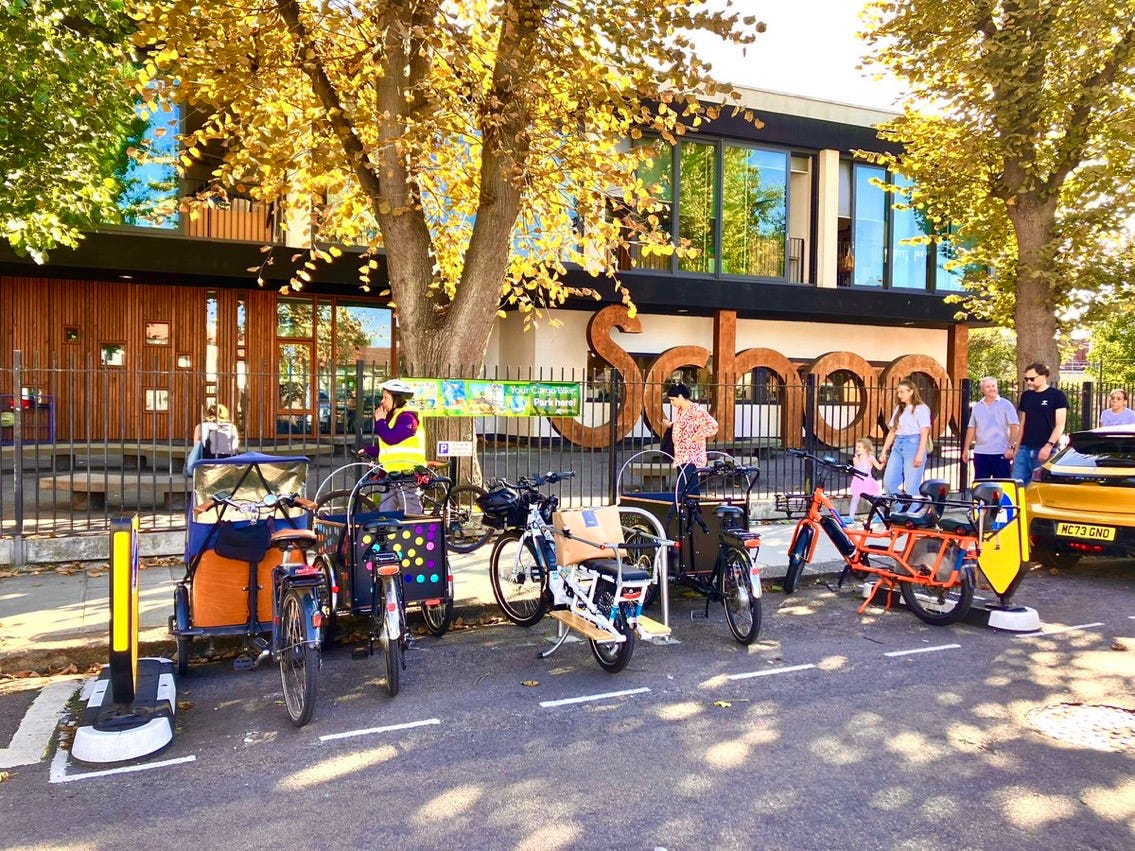
Raphael Younger points out this space outside Lowther School, Barnes used to be a space for one car. Build and they will come?
Governance - Richmond borough election profile
BBC News has published profiles of every local council up for election in May. Here is the one for Richmond upon Thames. The most striking line came from Professor Tony Travers:
Richmond is now the safest London borough in terms of Liberal Democrat control
Why it matters
Britain may have one of the most centralised systems of government in Europe, but local councillors still matter.
Planning, transport, housing, parks, streets and schools are not abstractions here. They shape daily life.
If you want a say in what happens next, register to vote here.
Governance - No school at Stag Brewery
Plans for a new secondary school at the £1.3 billion Stag Brewery redevelopment have been scrapped by the Department for Education, in a move Richmond council says will put serious pressure on future school places, according to MyLondon.
Why it matters
This is what governing looks like in practice: trying to manage long-term trends while coping with short-term pressure.
New homes will increase demand in the near term.
Yet pupil numbers may fall over the longer term.
Those tensions are real, and they are not going away.
Governance - Paris, always Paris
The victory for pro-pedestrian, pro-bike politics in Paris featured here last week. This week brought a wave of reflective pieces. This essay in The Guardian was the best of them.
Why it matters
Barnes2050 has always argued that local leaders need to show more confidence in reclaiming streets for people.
Paris shows that this is not fantasy, nor merely a lifestyle preference dressed up as policy. It is governance.
Change happens when leaders are prepared to lead.
Infrastructure - SUVs are making potholes worse
Scientists say the cumulative effect of more heavy vehicles on the road is one reason Britain’s pothole problem is getting worse. More dispiriting still, recent reporting in The Guardian suggested that hundreds of thousands of people have responded by buying larger cars to cope with damaged roads. A grim loop.
Why it matters
SUVs are now a standard feature of British streets. They accounted for more than half of new car sales in the UK last year. Walk down almost any road in Barnes and you can see the shift for yourself.
The Mayor of London has asked Transport for London to analyse the safety risks posed by large SUVs, and their wider impact on London’s roads.
Incidentally, even bigger SUVs are on their way
Infrastructure - LTNs are popular
As BikeIsBEst reports
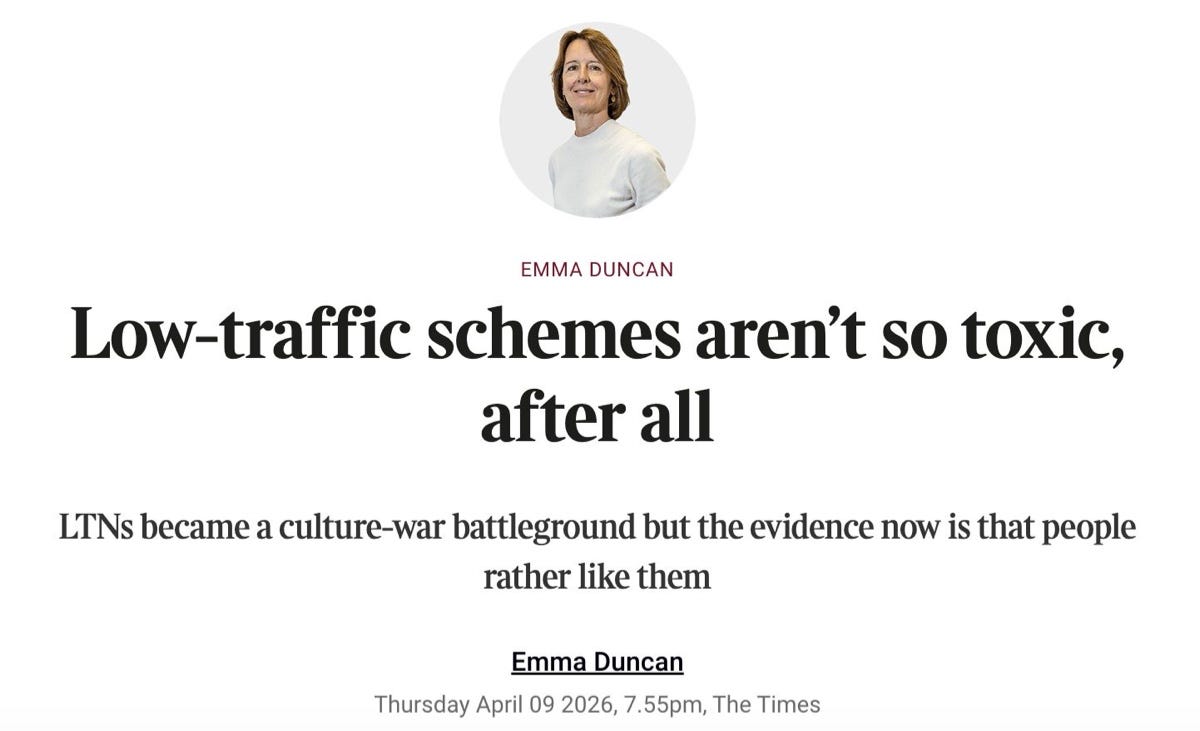
Low traffic neighbourhoods (LTNs) became a culture-war battleground but the evidence now is that people rather like them (££ Paywall), says Times columnist Emma Duncan.
LTNs have followed a now-familiar trajectory: from “Nazi experiments” and “climate lockdown” conspiracy theories to… actually quite popular bits of street design
Emma Duncan is worth quoting at length,
Low traffic neighbourhoods have replicated a classic pattern, which Everett Rogers described in 1962 in Diffusion of Innovations as the ’S-curve of acceptance.
People are hardwired to resist change, so at first acceptance grows only slowly (that’s the base of the S); then it takes off and rises almost vertically (the mid-bend of the S) until the majority are fine with the change; then it levels off (the top of the S) as a minority of diehard opponents digs in.
You can see the same pattern with the adoption of technological change (computers, the smartphone) and the acceptance of social change (female emancipation, gay rights).
Why it matters
Hammersmith Bridge may be on a similar trajectory in terms of local opinion. Nearly every change in traffic arrangements produces resistance at first before following this predictable pattern. Barnes2050 has reported this before, here and here.
It is not possible to say with confidence where the balance of Barnes public opinion sits. There is no single, clean and uncontested measure of local sentiment, whatever politicians may claim.
My sense is that there is probably still a majority in Barnes and in Mortlake & Barnes Common wards for restoring cars to Hammersmith Bridge. But it feels close — perhaps 55–45 — and narrowing every month.
Housing - Plug-in solar explained
Finally a gloriously pithy and useful summary from Simon Clark on the recent UKG announcment about rooftop solar. Two minutes well spent.
Why it matters
Not every sign of the future arrives through a grand project or a giant piece of infrastructure. Some arrive as smaller, cheaper, easier things that suddenly make adoption feel normal. That is often how change really spreads.
How people react to traffic reduction schemes

Public opinion - how we measure it, interpret it and act upon it - shapes the choices we make. It will influence how I answer my organising question. I might want to a live ‘my best life’ in a certain way but if the weight of public sentiment pulls in the opposite direction, my chances of success are constrained.