

Hammersmith & Fulham council’s (H&F) Cabinet meets on Monday to decide whether to seek funding for a repair programme designed to keep Hammersmith Bridge open to pedestrians, wheelers, cyclists and river traffic.
There is no financial option available that would allow its full restoration. (Summary)
You can read more about that recommendation here.
The accompanying officers’ report contains several other details worth highlighting.
One feels especially timely.
As Barnes recovers from its second heatwave of 2026 and prepares for the likelihood of another, it is worth remembering that it was extreme heat that exposed the Bridge’s underlying fragility.
On 13 August 2020, following a five-day heatwave, the micro-fractures in the pedestals widened rapidly, creating a risk of imminent collapse. The bridge was immediately evacuated and closed to pedestrians while detailed analysis was undertaken. (Paragraph 7)
Welcome to Barnes2050, a place-based futures project asking: how do we make sure Barnes - the place and its people - is thriving and climate-ready by 2050?
Repairing the Bridge might cost £128m
The council has submitted a pre-application to the Structures Fund for works estimated at £128m.
(This) phased repair approach for the bridge would prioritise restoration of those elements that are life-expired and present the greatest risk to the integrity of the structure (Paragraph 48)
That compares with the latest estimate of around £300m for a full restoration.
The final application is due by 3 August, with funding decisions expected in autumn 2026.
Structures Fund might not fund the bid
H&F council is considering seeking funding for the next phase of repairs from the Structures Fund.
However, officers make clear there is no guarantee that any funding will be awarded.
If the phased repair is not fully funded through a successful Structures Fund bid, or if the Council decides not to proceed with these works, it will be required to meet maintenance and inspection costs estimated at £1.5m per year to keep the bridge open to pedestrians, cyclists and river traffic and to ensure public safety.
There is currently no approved funding for these ongoing revenue costs. (Finance)
Why H&F council believes it is still owed money
Around £58m has been spent on Hammersmith Bridge since 2019.
H&F council has funded around £54m of stabilisation works, safe operation and preparatory restoration.
A further £4m from the Department for Transport is expected to be spent on permanent repairs to the central hangers.
The report explains why H&F council believes both the Department for Transport and Transport for London should contribute more.
In June 2021, an equal three-way funding split was agreed in principle between Hammersmith & Fulham, the DfT and TfL. The Memorandum of Understanding that would have formalised that arrangement, however, was never signed.
H&F council has received has received £15.96m from the DfT and TfL combined. They expected £38.89m.
On that basis, the council believes it is still owed £22.9m — £6.4m from the Department for Transport and £16.5m from Transport for London.
‘Limited motor vehicle count data’
Paragraphs 36 through 38 reveal the next major surprise in the document.
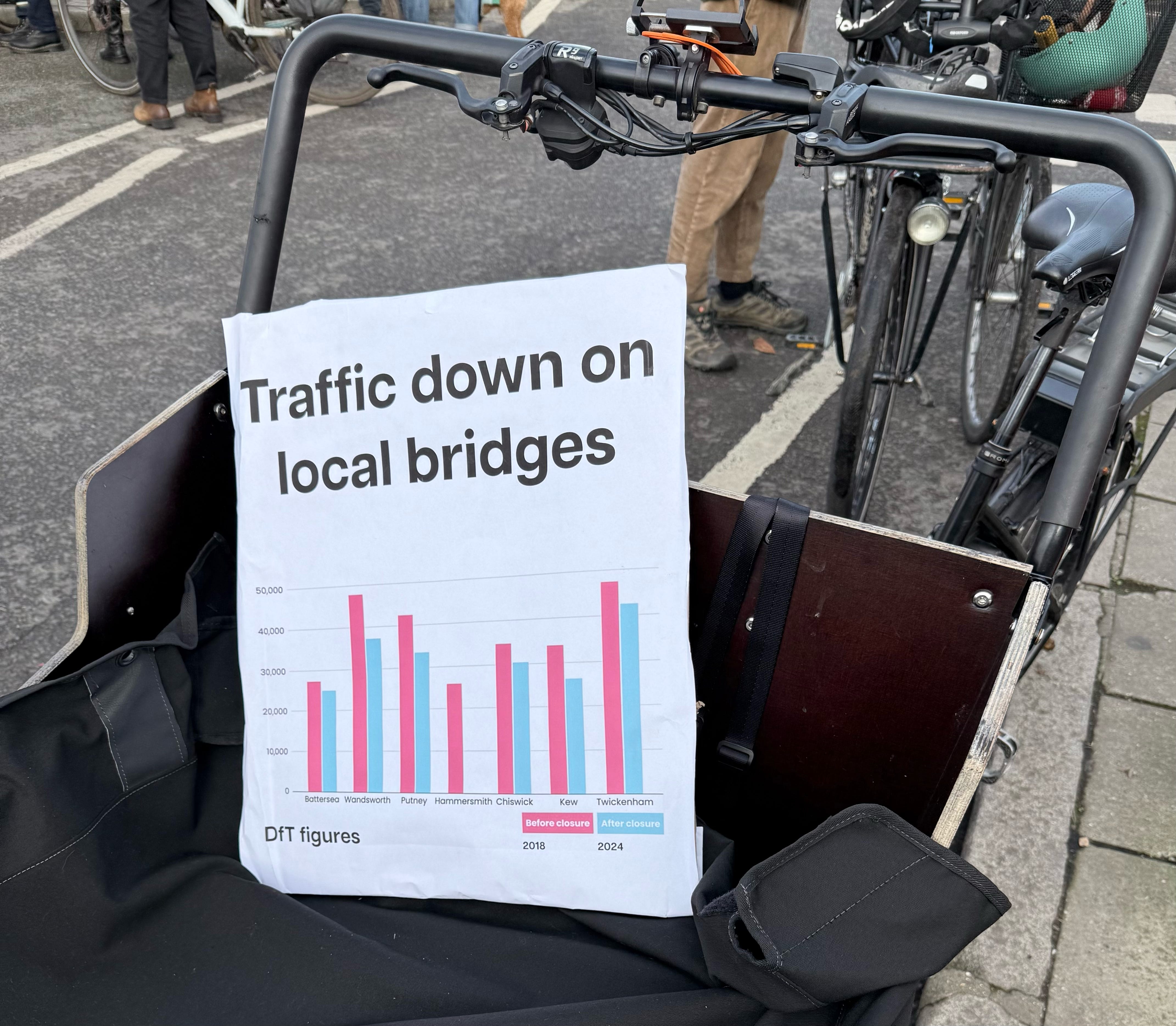
DfT, H&F council , TfL, Richmond and Wandsworth Councils met to discuss the ‘traffic impact on adjacent bridges since the closure of Hammersmith Bridge’.
Their conclusion was cautious.
The review was unable to draw firm conclusions because of both the absence of detailed seasonal traffic data and wider changes to the road network and user behaviour, not just the removal of motor traffic from Hammersmith Bridge, that may have affected traffic flows on adjacent bridges.
The obvious question is: how can there be an absence of detailed seasonal traffic data?
Everyone involved knew traffic patterns would become one of the central questions in deciding the Bridge’s future. Why was this routine information not collected?
Several media outlets have described the resulting evidence as ‘ambiguous’. ChiswickS4.com for example, reported:
Vehicle counts on neighbouring bridges — Kew, Chiswick, Wandsworth and Putney — have in fact fallen since 2018, rather than rising as might be expected if Hammersmith Bridge traffic had displaced elsewhere
That outcome is not inexplicable. It is entirely consistent with the well-established concepts of induced demand and its counterpart, traffic evaporation.
The report may not be able to draw firm conclusions. But neither does it contradict the possibility that some traffic has simply disappeared rather than reappearing elsewhere.
The cast iron casings are costing £120,000 a year to store
The report also reveals an unexpected ongoing cost.
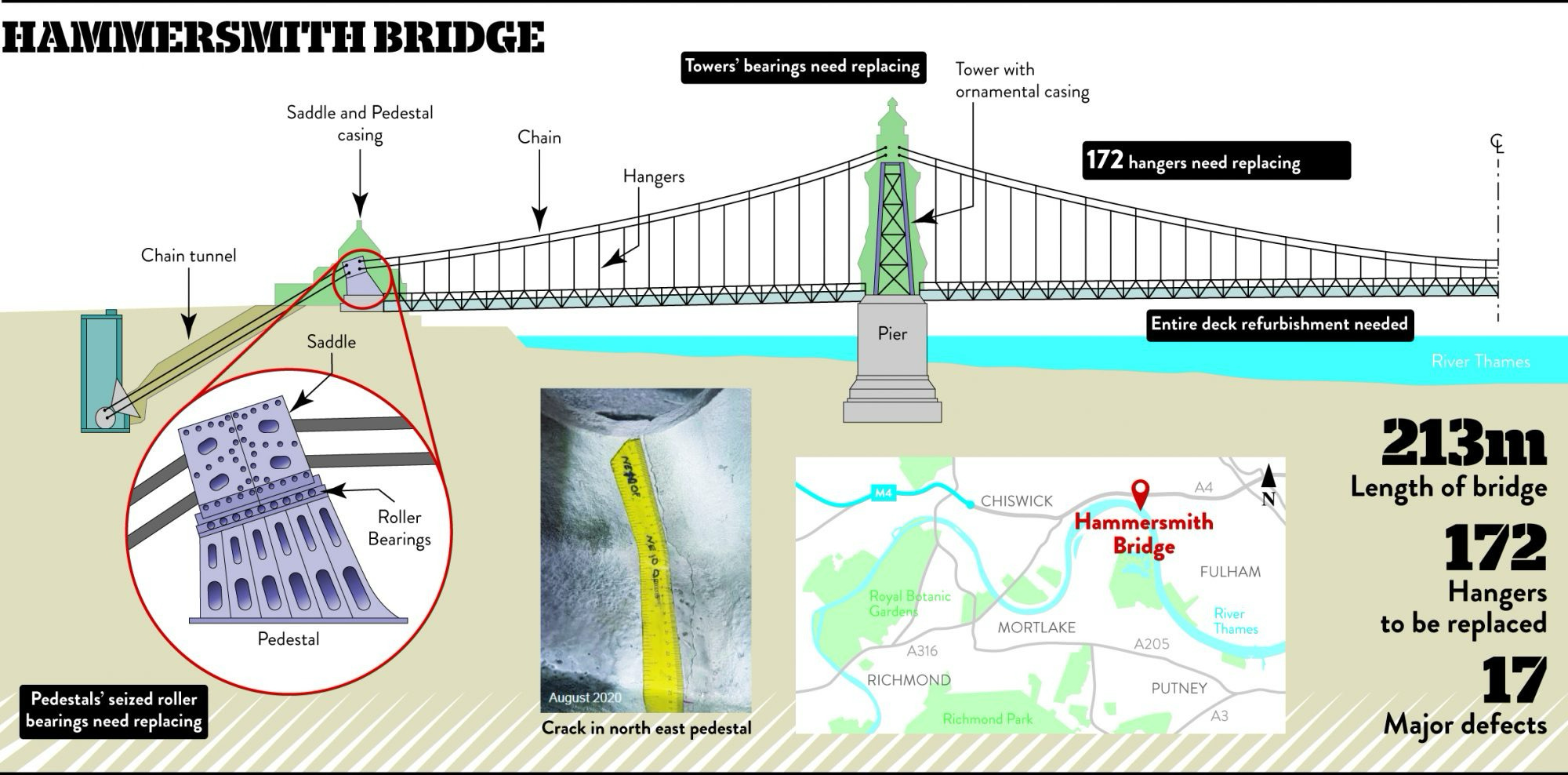
The ornate casings around the four pedestals were removed, at a cost of approximately £10m funded by TfL, to enable the stabilisation works to the pedestals.
Those ornate cast iron casings have remained in storage ever since, costing the council around £120,000 a year.
They have not been reinstated because the long-term approach to restoring the Bridge remains unresolved.
Officers warn that this cannot continue indefinitely.
..if there is no reasonable prospect of the bridge being repaired by the time this amended consent expires, it is possible that continued consent for removal of the casings could be refused.For this reason, it is proposed that an application be made to the Structures Fund
An ‘exit strategy’
Perhaps the most intriguing phrase in the entire report appears on its final page.
Discussing financial risks, officers warn:
There is a high financial risk that funding from the DfT or TfL could cease because of financial pressures, including rising bridge maintenance and repair costs, or because of a political decision.
In that event, H&F council would be required to bear the costs alone.
They then recommend that the council develops,
.. secondary cost strategy and budget be developed in advance of costs exceeding available budgets.
This should include an exit strategy.
Exit from what, exactly?
A repair programme? A funding model? Or something more fundamental?
The report does not say.
Perhaps councillors will provide an answer when the Cabinet meets on Monday 6 July at 7pm. You can watch proceedings live on YouTube.
Notes and thoughts
If approved, this is not the end of the campaign to restore the Bridge. Fleur Anderson MP (Labour, Putney) said as much, ‘I will continue to advocate for the complete restoration of Hammersmith Bridge’.
She has also argued that alternative, lower-cost crossings should continue to be explored.
That debate is unlikely to end soon.
Barnes should not spend those years simply waiting.
The Bridge has now been open to pedestrians and cyclists for longer than many people expected. Every additional year makes it easier to imagine a different future for the village.
One built around people with fewer through vehicles, better public spaces, safer streets and new ways of moving around.
Whether or not the Bridge eventually carries motor traffic again, Barnes has an opportunity to decide what sort of place it wants to become.
That conversation should begin now. This is Barnes2050’s contribution. Or at least the beginning of it.
Hammersmith Bridge is about far more than a river crossing. It is a question about the future of Barnes. At its heart sit questions of transport, climate, health and community. Explore Barnes2050’s wider analysis here.