

War and sunshine is an odd combination but that is where we begin this week, with a sharp rise in the number of solar panels being fitted across the UK.
Solar panels have been fitted every three minutes in UK since Iran conflict started, according to The Times (££ paywall). 27,000 solar power installations in March, the highest monthly total for 14 years. Applications for heat pump grants also jumped.
Why it matters
The single largest source of greenhouse gases in the Richmond borough are domestic buildings - 46% of all emissions
Retrofitting our homes, including the roughly 6,700 in Barnes, is one of the most important things to create a climate-ready city. Richmond council wants to help.
You can get a sense of scale of the task ahead in the next twenty four years by looking at the roofs of your neighbours’ homes as you walk the neighbourhood.
Welcome to Barnes2050, a place-based futures project asking: how do we make sure Barnes - the place and its people - is thriving and climate-ready by 2050?
Transport - Clean Cities campaigners target London’s SUV owners
The Clean Cities Campaign has written to the Mayor asking him to act more decisively on SUVs. Measures they want to see include,
Integrating an oversized vehicle levy into London road pricing schemes;
Ending the paradox of SUV advertising on TfL’s website and billboards;
Supporting boroughs to incorporate vehicle size into parking tariffs;
Delivering alternatives, including electric car clubs and cargo bike sharing;
Campaigning for maximum vehicle dimensions and for Vehicle Excise Duty
and to include a progressively higher tax proportional to the vehicle’s weigh
Why it matterst
Barnes2050 appreciates the engineering but not their presence. The builders in our avenue likely need their SUVs. My neighbours? No. Oversized private cars for short urban journeys are a different matter.
Regional acton from City Hall would be welcome. Local action by Richmond council depends on results of the elections. Only the Liberal Democracts and the Greens have published local manifestos. Of these only the Greens are explicit in their support of a change in the regulations.
Governance - Mayor to regulate the capital’s e-bike market
Meanwhile, the Mayor is getting another slice of authority.
The English Devolution and Community Empowerment Bill has received Royal Assent. It includes several changes relevant to London, including stronger powers over some transport functions.
The most visible local change? Transport for London is expected to gain stronger London-wide powers to regulate dockless rental bikes, including parking compliance and fleet management. Zag Daily has more detail.
Why it matters
e-bikes are going to play an increasingly important role in Barnes’ transport mix. The Gen Z e-bike generation is already crossing borough borders as if the borders do not exist. The rules should catch up.
By the time the Richmond council contract with Forest renews, Transport for London should have a more settled regulatory framework.
Transport - Lime bikes report record growth in Richmond borough
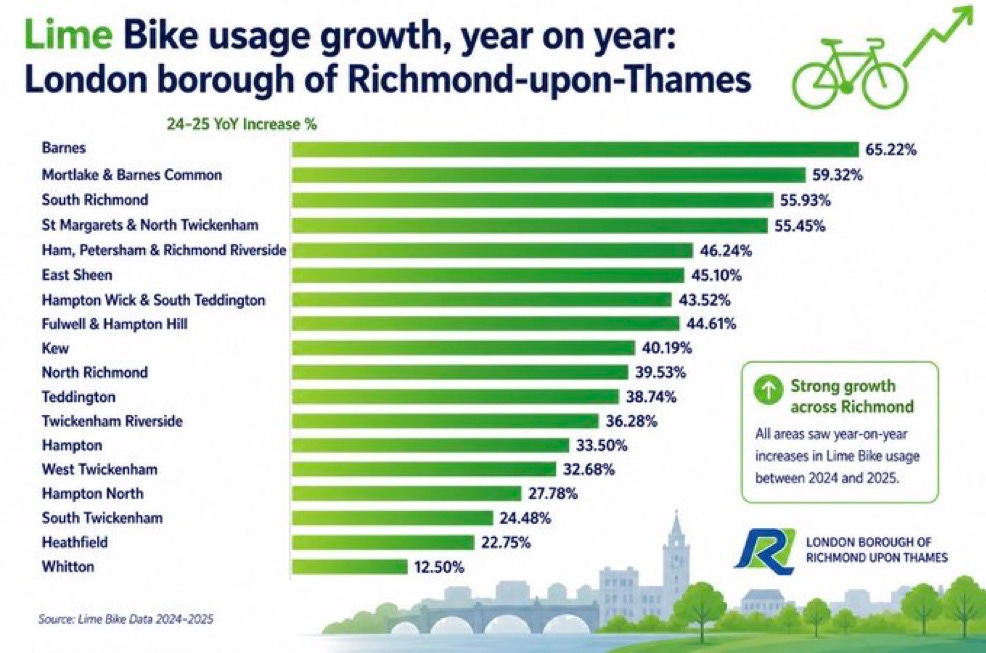
Interesting data from Lime about bike usage in 2024 to 2025.
Why this matters
Hammersmith Bridge looms large in these figures. This chart chimes with previously released data suggesting the Bridge, open to pedestrians and cyclists, has become an important route into and out of Barnes.
There is no obvious reason, from the public evidence, to assume Forest could not also generate strong use when it replaces Lime in the autumn.
Here’s hoping Forest and Richmond council release more of data, more often.
Transport - Forest secure more funding
London e-bike operator Forest secured a further £27m in funding, taking its total Series B round to £40m. The company has grown rapidly, reaching 1.5m users and delivering 2m rides per month across 18 London boroughs
So reports Micromobility. It goes on to say,
The funding will support continued investment in cycling infrastructure, technology, and safety improvements
Why it matters
Whatever your view of Richmond Council’s decision to replace Lime with Forest, London benefits from competition in e-bikes. A viable Forest reduces the risk of a single dominant provider in this increasingly important part of the transport mix. Forest’s status as a UK company is a useful bonus.
More immediately, the funding includes a new strategic partnership to co-develop Forest’s fleet of bikes.
Transport - Why do cyclists ignore red lights?
Ask them?
The University of Leeds is looking for participants for a questionnaire supporting an Active Travel England-funded research project.
The questionnaire takes approximately 10 to 15 minutes to complete and will be open until 17 May 2026. Wider circulation across professional networks is encouraged.
Begin the research questionnaire here.
Why it matters
Stop at red lights, why don’t you? I even stop at the ridiculous traffic lights in Castlenau.
As cycling becomes more popular this is going to become more of an issue. Bike registration plates - a common reach by those used to regulating cars won’t work. Maybe facial recognition? Or maybe in some situations we follow the example of the Netherlands? A new app connects with nearby traffic lights and automatically switches them to green as you approach.
Transport - EV tide is turning
Petrol cars are losing their value up to five times faster than electric vehicles (EVs) as soaring prices at the pumps force drivers to go green, reports The Sunday Times (££ paywall)
Why it matters
This story is bought to you by President Donald J Trump
The EV tide is turning. Electrificantion, something we did to railways is becoming part of our homes. The domestic electric stack — solar, batteries, heat pumps and EV charging — will be part of normal life by 2050.
Transport - Lessons from .. Scotland, on parking
Current parking policy in Scotland imposes avoidable costs on public health, the environment and housing affordability, while reinforcing patterns of car dependency.
That’s the assertion of a new report, Beyond the Kerb.
Why it matters
BikeIsBest go on to point out one in four Scots have no access to a car so ‘there’s a case case to be made’. In Barnes one in three households has no car.
You don’t have to be a ‘kerb nerd’ to see that parking is not a settled topic in Barnes.
Transport - Lessons from .. New York, on walking
Researchers have just mapped New Your City foot traffic for the first time ever.
The model maps foot traffic across all sidewalks, crosswalks and footpaths in NYC during peak periods.
The results are striking. Turns out, more trips are made on foot than by car.
Fast Company reports the work here. The research itself appears in Nature Cities, where the authors write,
Walking is the most prevalent yet least systematically measured mode of urban travel.
And yet what gets counted, counts. In America, transport funding formulas have historically given heavy weight to vehicle movement, including vehicle miles travelled.
If cities could count the number of pedestrians that walked across their streets, they could steer more federal money into urban, people-oriented infrastructure.
Why it matters
In London we count cars. We now count bikes, in central London. But how well do we count pedestrians? TfL’s best-known pedestrian footfall survey is a central London measure, using around 600 count sites, so it should not be read as telling us what is happening on Barnes streets. For places like Barnes, TfL’s wider active-travel counts may offer some outer London indicators, but they are not designed as a representative local walking survey.
Wouldn’t it be useful to understand the flow of pedestrians around the peninsuala?
The best local count known to Barnes2050 is an informal weekend footfall count of Barnes High Street, now more than 10 years old.
Barnes2050 believes several important walking routes should be assessed for shade, seating, crossings and places to rest before summer heat becomes normal.
Transport - London Walking Festival
The weather has changed up just in time for the 2026 London Walking Festival.
Why it matters
I was once told a listener needs to hear a radio advertisement at least ten times before she or he takes in the message. I must have used this phrase a dozen times in the last fortnight - walking is the single most important form of transportation.
Barnes should be a pedestrian-first peninsula. This will be number one when Barnes2050 publishes its list of principles for a designing a better future.
So anything that encourages more of us to step out and walk is to be welcomed.
Infrastructure - Lessons from .. Oxford on 15 20 minute city
A Gen Z reminder about the political fallout from 15 minute cities.
Why it matters
Richmond council adopted this approach in March the borough’s new transport strategy. It avoids mention of 15 minute cities. Instead, it talks about 20 minutes. For example, a core objective of the 2040 vision is that most residents will be able to reach a town centre, school, GP surgery, or green space within twenty minute using sustainable modes of transport - walking, cycling, or public transport - regardless of their age or physical ability.
The decision to duck the inevitable aggro attached to that other number makes political sense.
Barnes2050 supports the idea regardless of the label. It is either true or very nearly true of Barnes - one to assess during the summer, perhaps.
Have a fabulous week and if you don’t live in Barnes, then why not take advantage of the good weather to jump on the train, bus or bike to come visit. You’ll love it.
