

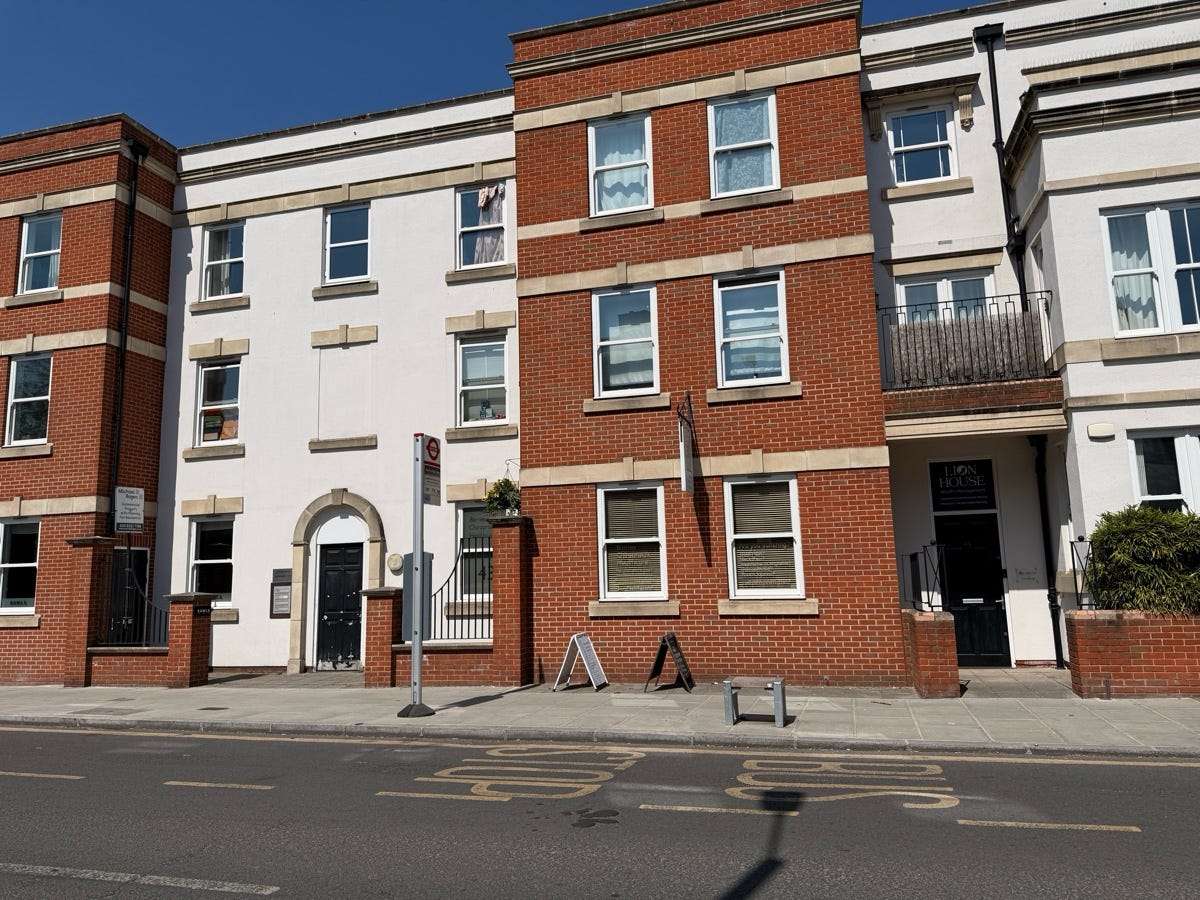
This is Barnes High Street, opposite Marks & Spencer.
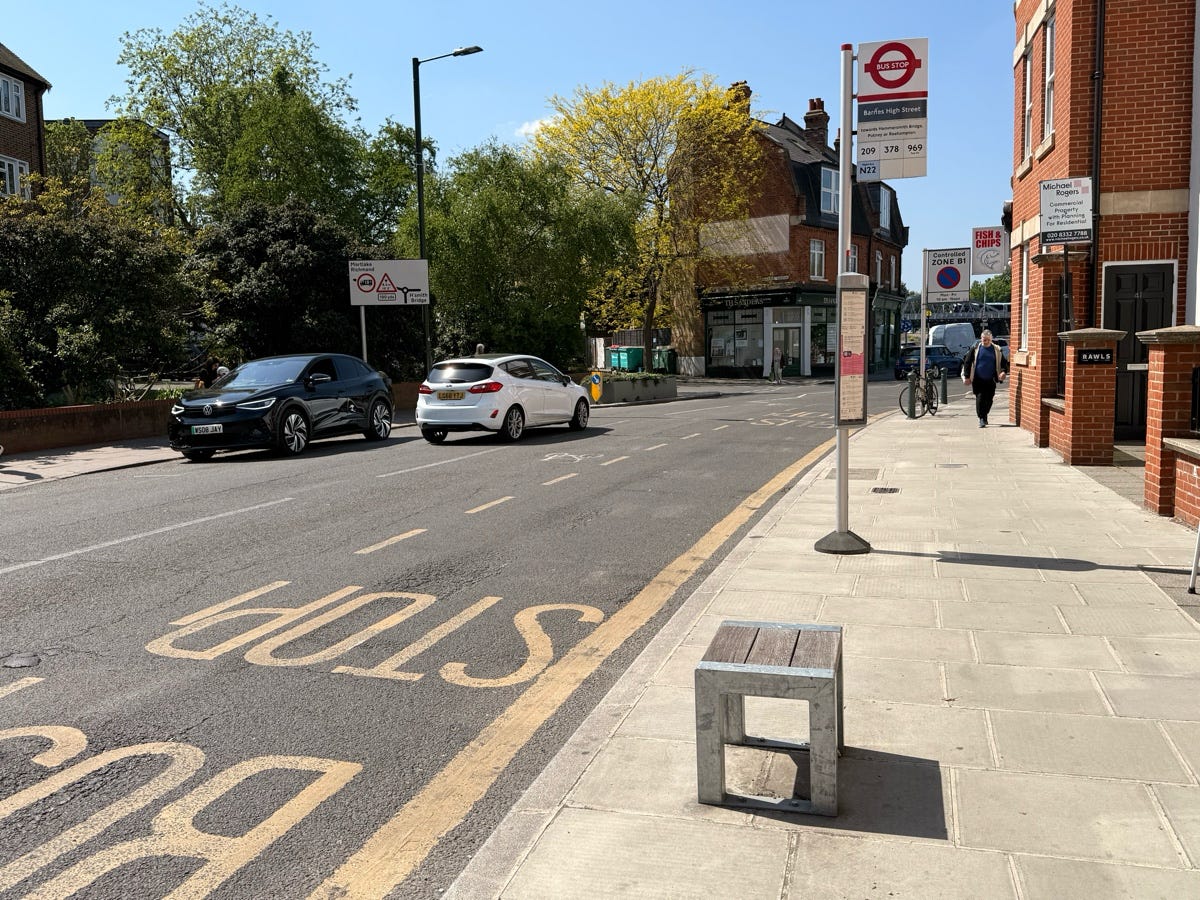
Focus on the seat.
It is popular. You often see people sitting there, and on other benches along the High Street, because the location is useful. Near the shops. Near the bus stop. Near the everyday business of the village.
But look again.
This photograph was taken at about midday on a hot spring day: blue sky, hard sunshine, not much forgiveness from the weather.
The seat itself - metal, timber, modern, handsome enough - is utterly exposed.
If you need to take the weight off, this ought to help.
On a day like this, it does something else.
It offers you a place to sit and bake.
Welcome to Barnes2050, a place-based futures project asking: how do we make sure Barnes - the place and its people - is thriving and climate-ready by 2050?
Notes & thoughts
Barnes2050 believes the need to treat heat and water as equal threats is one of the defining trends of life over next two decades.
Water destroys property and heat kills people is an over-simplification. But not by much.
Much local climate attention has, understandably, focused on flooding. Community BlueScapes has done important work to make the village more resilient to heavy rain, flood risk and extreme weather.
Now heat needs the same level of seriousness.
Heat and the over-60s
Heat does not become dangerous only when Britain reaches 40°C.
In London, the risk to life starts rising well below that. The ONS found that mortality risk begins to rise once temperatures move above roughly 22°C. Above 29°C, the capital’s death risk is around three times higher than at optimum temperatures.
England recorded an estimated 1,504 heat-associated deaths during just five hot spells in summer 2025. The brutal summer of 2022 was linked to 2,985 excess deaths.
The official evidence is strongest for over-65s, especially over-75s. But the warning does not politely wait for 65 candles on a birthday cake.
Heat risk rises as age overlaps with frailty, heart disease, breathing problems, dementia, diabetes and homes that are hard to keep cool.
Global warming and Richmond borough
Richmond is projected to get more of this.
The Council’s latest climate evidence, drawing on Met Office projections, warns of hotter, drier summers, more frequent heatwaves and a growing number of hot nights when homes fail to cool down.
The Met Office report suggests that, at global warming levels of between 2°C and 4°C, Richmond borough can expect the number of hot summer days above 30°C to rise from around two a year now to between 10 and 28.
Tropical nights — when temperatures do not fall below 20°C — would rise from none to between three and 15.
This is not the Mediterranean arriving in SW13.
It is something more awkward: English streets, English houses and English habits being asked to cope with a climate they were not designed for.
Protecting private and public spaces
So the Barnes question is no longer whether summer feels warmer.
It is whether an ageing village in an ageing borough is ready for ordinary-looking days that are no longer ordinary: 25°C, 28°C, 30°C, repeated over several days, especially in homes that do not cool overnight.
A climate-ready Barnes will need cooler homes. For some, that will mean installing air-conditioning. More on that in the months ahead.
In public, it means more shade, water, trees and places where all of us - but especially Barnes residents over the age of 60 - can safely get through hotter days.
Learning from others
Others are already trying.
Derby City council planned to replace 90 bus shelters, with around half given planted ‘Living Roofs’, branded as ‘Bee Bus Stops’, under a ten-year Clear Channel contract at no cost to the council or taxpayers.
Shelter, shade, biodiversity, maintenance and advertising were bundled into one street-furniture contract, rather than treated as a nice-to-have add-on.
Leicester treats bus shelters as small pieces of green infrastructure. It has a network of 30 living-roof, solar-powered shelters which were presented as part of the city’s response to the climate emergency.
Ordinary bus stops become micro-climate assets, not just places to display timetables.
So now what do you see?
Which brings us back to that bench.
Barnes2050 thinks it is a job half done.
In a people-first Barnes designed to improve the health of all its residents, Richmond council should not install another seat without also considering shade, ideally natural shade.
A bench in the wrong place, under the wrong sky, is not quite civic kindness.
It is furniture waiting for a tree.
You can read more on the effects of heat on Barnes, now and in future, here.
BCA x Bulls Head = Shy smiles + countless stories

You can overthink a pint of Diet Coke. Or maybe not. Barnes Community Association (BCA) held their first ‘Barnes Tuesday Local’ at The Bulls Head on Tuesday 27 January. It was billed as,