

Monday night was spectacular. More than 3,000 lightning strikes lit up the skies above southern England as thunderstorms rolled across London for over two hours. By Tuesday morning roads across west London were underwater. Heathrow flooded. Parts of Hammersmith flooded. Richmond and Twickenham were hit particularly hard.
Barnes?
Almost nothing.
That seemed odd.
After all, Barnes is one of London’s best-known flood-risk communities. It sits inside a mighty bend of the Thames which swings from energising to. threatening and back again.
The Beverley Brook cuts through the village before joining the river. Parts of Barnes lie within Flood Zone 3.
If anywhere ought to flood, surely it is here.
So why didn’t it?
The answer isn’t the one you might expect.
Welcome to Barnes2050, a place-based futures project asking: how do we make sure Barnes - the place and its people - is thriving and climate-ready by 2050?
A different kind of flood
Tuesday’s flooding was not primarily caused by the River Thames overflowing.
It was a surface-water flood.
An extraordinary amount of rain fell in a remarkably short period.
Roads flooded because drains, gullies and sewers simply could not carry the water away quickly enough.
Flash flooding is less about how much rain falls in a day than how much falls in twenty or thirty minutes.
On Monday night, the most intense downpour appears to have fallen over Richmond and Twickenham rather than Barnes.
But storms only tell part of the story.
Weather explains why the storm happened. Geography explains where the water went.
Where the water went
Once the rain had fallen, the shape of the landscape determined what happened next.
Richmond and Twickenham have several characteristics that make this sort of flooding particularly dramatic.
Water runs rapidly downhill to low-lying dips, shallow valleys, and under-railway bridges that all act as natural bowls.
Once the drainage system reaches capacity, these become temporary lakes.
Barnes has vulnerabilities too but different ones.
Its flatter landscape, larger gardens, Barnes Common, the Wetland Centre and other green spaces can buy valuable time during the first phase of an intense storm by slowing runoff before it reaches the drains.
That does not make Barnes safe.
It simply means our greatest danger often arrives later.
Our flood comes differently
Barnes lives with two watercourses.
One is the Thames.
The other is the Beverley Brook.
This week, the Brook was not the problem. But after prolonged heavy rain it can become one.
If the Brook is carrying high flows while the Thames is also high, it struggles to discharge into the river. Water backs up instead.
This is the potent combination of fluvial and tidal pressures.
This creates a very different type of flood from the sudden street flooding seen in Richmond and Twickenham but one that can ultimately prove more extensive.

Notes and thoughts
The biggest lesson from Monday night is not that Barnes escaped.
Rather we got lucky.
Move that thunderstorm a kilometre or two east and this could have been a very different story.
There is another lesson too.
We often think of heatwaves and flooding as two separate climate threats. One leaves us sweltering. The other leaves us underwater.
In reality they are often the same story.
The exceptional rainfall that flooded parts of west London was made possible by the exceptional heat that came before it. A warmer atmosphere holds more moisture. When that moisture is released, it falls harder and faster, overwhelming streets, drains and sewers that were designed for a different climate.
It wasn’t simply too much rain.
It was too much rain arriving in too little time.
That is why, at Barnes2050, heat and water deserve equal attention. One increasingly creates the conditions for the other.
The implication is straightforward. We should stop thinking about floods as rare emergencies and start treating water as part of everyday urban design.
Thankfully we’ve made a start.
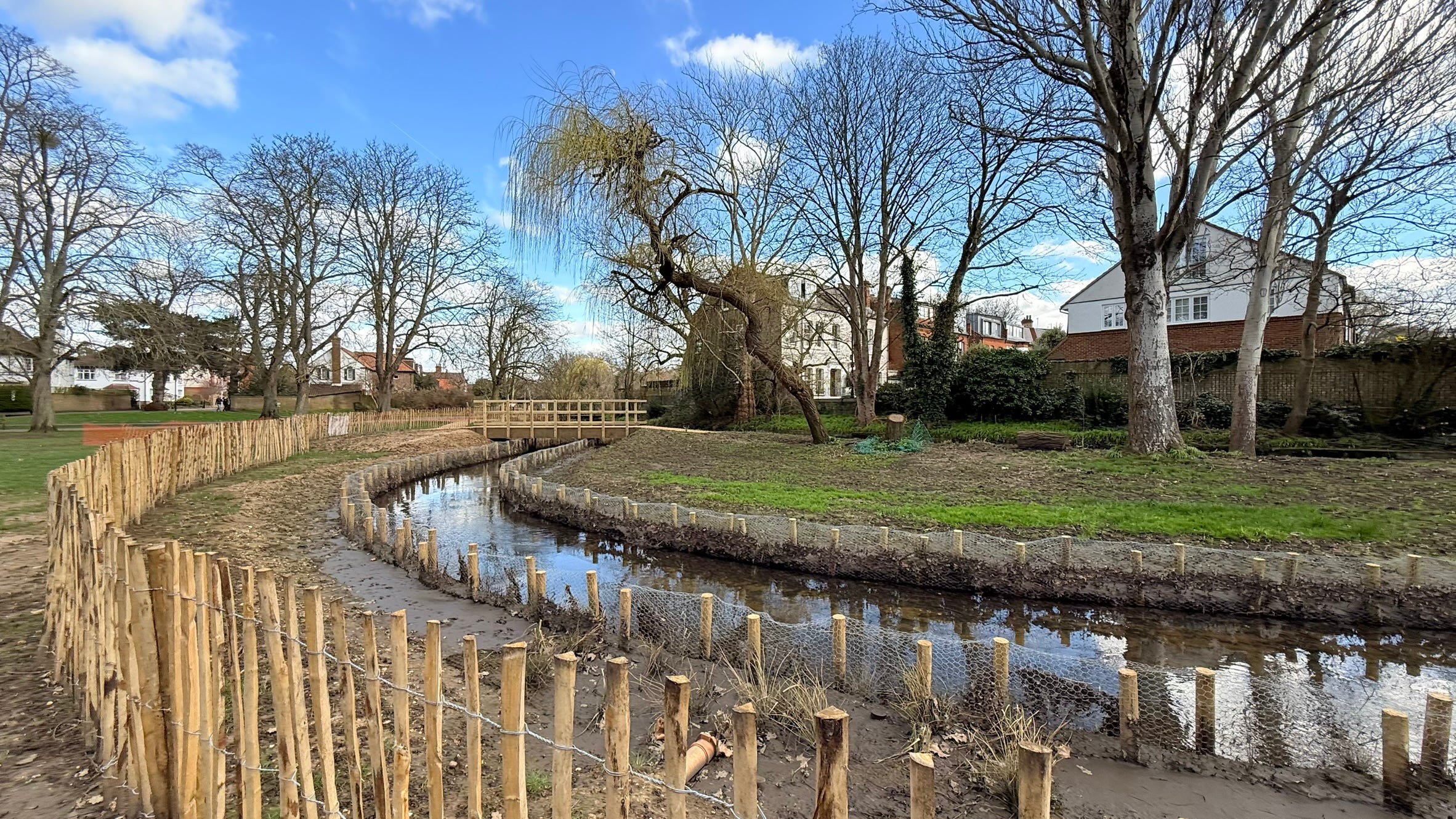
The £6 million Community BlueScapes programme is investing in natural flood management across the Beverley Brook catchment. Rain gardens, restored reed beds, re-wriggling the Brook on Barnes Green all are designed to slow the flow of water.
This is working with nature rather than against it.
We need to maintain this momentum. Swap trees on streets for car parking? Removing those paving stones covering the front garden?
These are no longer environmental nice-to-haves.
They are becoming essential infrastructure.
Because there will be a next time. The Met Office are clear about that.
And next time, Barnes may not be quite so lucky.
Follow Barnes2050’s ongoing coverage of how heat is shaping Barnes today and tomorrow.