

Hammersmith & Fulham (H&F) council, which owns Hammersmith Bridge, had begun preparing a bid to the UK Government’s £1billion Structures Fund.
As Barnes2050 noted at the time, nobody knew what the council intended to seek funding for.
Now we do.
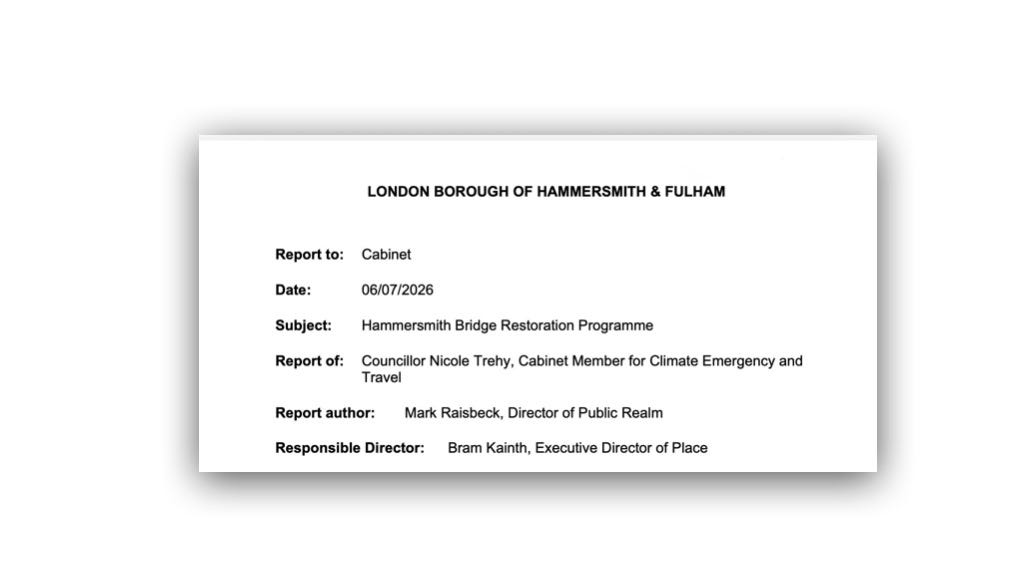
A report from council officers ahead of the H&F Cabinet meeting on Monday 6 July recommends against pursuing funding for the Bridge’s full restoration.
Instead it concludes:
There is no financial option available that would allow its full restoration.
The report says restoring the Bridge for motor traffic would now cost around £300million.
Instead, officers recommend seeking funding for a phased repair programme designed to keep the bridge open to pedestrians, wheelers, cyclists and river traffic.
The H&F Cabinet report is available online or can be downloaded below.

Welcome to Barnes2050, a place-based futures project asking: how do we make sure Barnes - the place and its people - is thriving and climate-ready by 2050?
H&F council’s financial pressures
The report argues that full restoration would amount to rebuilding much of the structure.
.. [It] essentially requires a brand-new bridge to be built as all of the Grade II* listed heritage structure needs to be replaced or strengthened or restored.
The cost of a full restoration of Hammersmith Bridge to allow its use for motor vehicles is now estimated to be £300million.
For the council, that cost is simply unaffordable. The report says,
.. the significant impact of the most recent medium-term financial settlement from Government on the Council’s General Fund from 2026/27 means that there are no options within Council funds for repair of the bridge.
Doing nothing is not an option either.
The bridge is officially classed as substandard and, the report warns:
Without significant investment, the bridge is likely to have to fully close again on safety grounds in the short to medium term.
Meanwhile, H&F says it is spending around £1.5million each year meeting its ongoing statutory obligations
Department for Transport (DfT ) advice
The Department for Transport had previously indicated that Hammersmith Bridge would be a strong candidate for the new £1billion Structures Fund, raising hopes among supporters of full restoration.
However, the H&F report says the programme timetable rules that out.
The latest date for programmes to reach completion is 31 March 2030, which precludes full restoration.
Following discussions with the Department for Transport, officers instead recommend submitting a bid focused on the Bridge’s most urgent structural needs. H&F should
.. submit a bid for a phased repair focused on the most critical life-expired elements of the structure, with the immediate aim of keeping the bridge open and safeguarding access for pedestrians, cyclists and river traffic.
The report says the Department for Transport supports this approach.
Notes and thoughts
Assuming H&F council Cabinet approve this change of policy, it marks an important moment. Vehicles will not be restored to Hammersmith Bridge.
At least for the foreseeable future.
This is only one government funding programme. Others may emerge.
Even so, the direction of travel is becoming clearer.
Unless there is a fundamental change of approach — perhaps replacing the historic Bridge altogether — the cost of restoring Hammersmith Bridge for motor traffic is likely to keep rising. This design is unlikely ever to cost only £300 million again.
By the time another funding opportunity appears, public sentiment may also have shifted.
Experience elsewhere suggests that communities often become more comfortable with traffic reduction the longer it remains in place. The longer people adapt to new patterns of movement, the more normal they can begin to feel.
There are hints this may already be happening.
Traffic modelling in the report suggests that, compared with 2018, vehicle numbers on Kew, Chiswick, Putney and Wandsworth bridges have all fallen since Hammersmith Bridge opened only to pedestrians and cyclists.
That evidence is not new. Barnes2050 has highlighted similar trends using Department for Transport and Transport for London data since 2025.
At the same time, new alternatives become more realistic. Barnes2050 believes a trial of small electric ‘people movers’, or pods, could become an important part of the future transport system serving Barnes. The proposed Barnes Hammersmith Electric Light Transit, or BEHLT, is one example of how access across the bridge could be improved without returning private cars.
If public attitudes continue to evolve, they should increasingly be visible in the traffic data. That matters because Hammersmith & Fulham’s own officers are now recommending that future decisions on whether motor traffic should return to the bridge should be based on objective travel and traffic-flow evidence.
Whither Barnes?
Attention should now turn to the future.
What sort of Barnes do we want if Hammersmith Bridge remains open to pedestrians and cyclists, but not private cars?
What happens to Castlenau?
How should the transport system work on the peninsula?
And how do we want to live, work, play and belong in Barnes, 2050?
Hammersmith Bridge is about far more than a river crossing. It is a question about the future of Barnes. At its heart sit questions of transport, climate, health and community. Explore Barnes2050’s wider analysis here.