

There’s a row brewing over the pending changes to the buses in Barnes. Transport for London (TfL) had a plan for changing the routes, they put it out to consultation. The latest Barnes bus plan goes live in August, 2026.
Two parts of the plan look wrong.
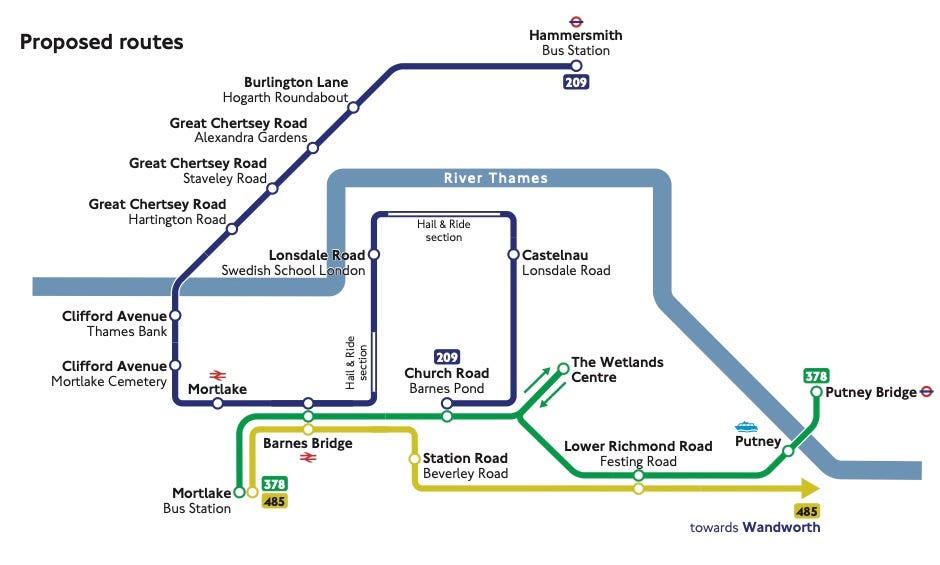
Barnes Pond will become a terminus with buses turning around the ‘swan triangle’ several times an hour. One of the busiest walking junctions in the area will be busier still.
TfL has also prioritised Lonsdale Road over the High Street. So one of the most valuable forms of sustainable transport - a bus - will no longer run both ways down one of the village’s most important streets, the High Street. HGVs, thousands of cars, delivery vans: fine. Buses: apparently not.
The Travel Barnes group of the Barnes Community Association (BCA) has been actively involved in petitions to, and discussions with, TfL about the red bus network. (Full disclosure, I am a member of the group). It is also hoping to meet TfL and the new Richmond council members in the hope that the worst effects of the plan can still be reduced.
But this is not, at heart, an anti-TfL story.
TfL has been dealt a poor hand. Hammersmith Bridge remains open to pedestrians and cyclists but not to motor vehicles. Bus user numbers are falling. Public money is tight. Barnes has been living with a semi-temporary, semi-permanent bus network since 2019. The TfL plan may make network sense. It may even be the least-bad answer to the question TfL was asked.
The problem is that Barnes may now need to ask a different question.
Not whether every old route should return. Not whether Barnes needs more full-sized red buses. Not whether the village should pretend Hammersmith Bridge is about to resume its old life.
The better question is this:
Does Barnes now need a different layer of public mobility - smaller, local, sociable and designed for the short journeys that help people stay connected to the life of the village?
Call it, for now, the Barnes e-hopper.
This is not an original idea from Barnes2050. For instance, several members of the BCA Travel Barnes group have raised versions of it. What follows is inspired, in part, by those conversations.
This is not yet a vehicle specification. Not quite a proposal. It’s an idea that needs testing.
Welcome to Barnes2050, a place-based futures project asking: how do we make sure Barnes - the place and its people - is thriving and climate-ready by 2050?
What the latest bus network does — and does not — solve
The new TfL network is simpler. Route 209 is due to be extended, taking over much of what route 533 has been doing since Hammersmith Bridge closed to motor traffic. Routes 378 and 485 are also being changed, while other Barnes-area routes remain outside this specific package.

The larger issue is not simply route geometry.
TfL is trying to provide trunk connections: getting people in and out of Barnes, particularly towards Hammersmith, Putney, Mortlake and the wider network. That is what the red bus system is mostly designed to do. It is a corridor system. It serves lines of movement.
Barnes, however, is not just a corridor.
It is a peninsula with several centres: Barnes Pond, Barnes High Street, Castelnau, White Hart Lane, Barnes Bridge, the riverside, the Wetland Centre, stations, schools, churches, pubs, shops and cafés.
It has distributed brilliance rather than one obvious centre of gravity.
A standard bus network can serve parts of that pattern. It cannot easily stitch all of it together.
That is the gap.
Barnes already has more than red buses
It is worth saying this clearly, because otherwise the argument becomes too neat.
Barnes does not have only two transport choices: TfL buses or private cars.
There is already a small but important layer of community transport. FiSH Neighbourhood Care runs a popular door-to-door supermarket service using accessible transport, taking people to Sainsbury’s in Richmond and Marks & Spencer at Kew Retail Park. Last year it made over 1,500 trips. It is exactly the sort of local provision that matters more than official transport maps usually admit.
But FiSH does a different job.

Its shopping bus helps people get from their front door to larger shops beyond Barnes, Sainsbury's in Richmond and M&S in Kew. It is practical, social, trusted and targeted. It should be protected, celebrated and learned from.
Any additional service would not replace it. It would complement it.
The distinction matters. FiSH helps people leave Barnes for essential shopping. A Barnes e-hopper would help people move around Barnes itself: to the Pond, High Street, Castelnau, White Hart Lane, Barnes Bridge, the Wetland Centre, the riverside, stations, cafés, churches, clubs, surgeries and events.
One is door-to-supermarket. The other would be village-to-village-within-the-village.
Together, they suggest a better way to think about local transport: not one grand system, but a layered ecology.
Red buses for trunk routes.
FiSH for door-to-door shopping beyond Barnes.
Walking, cycling and e-bikes for those who can.
And perhaps a small civic connector for the awkward local trips in between.
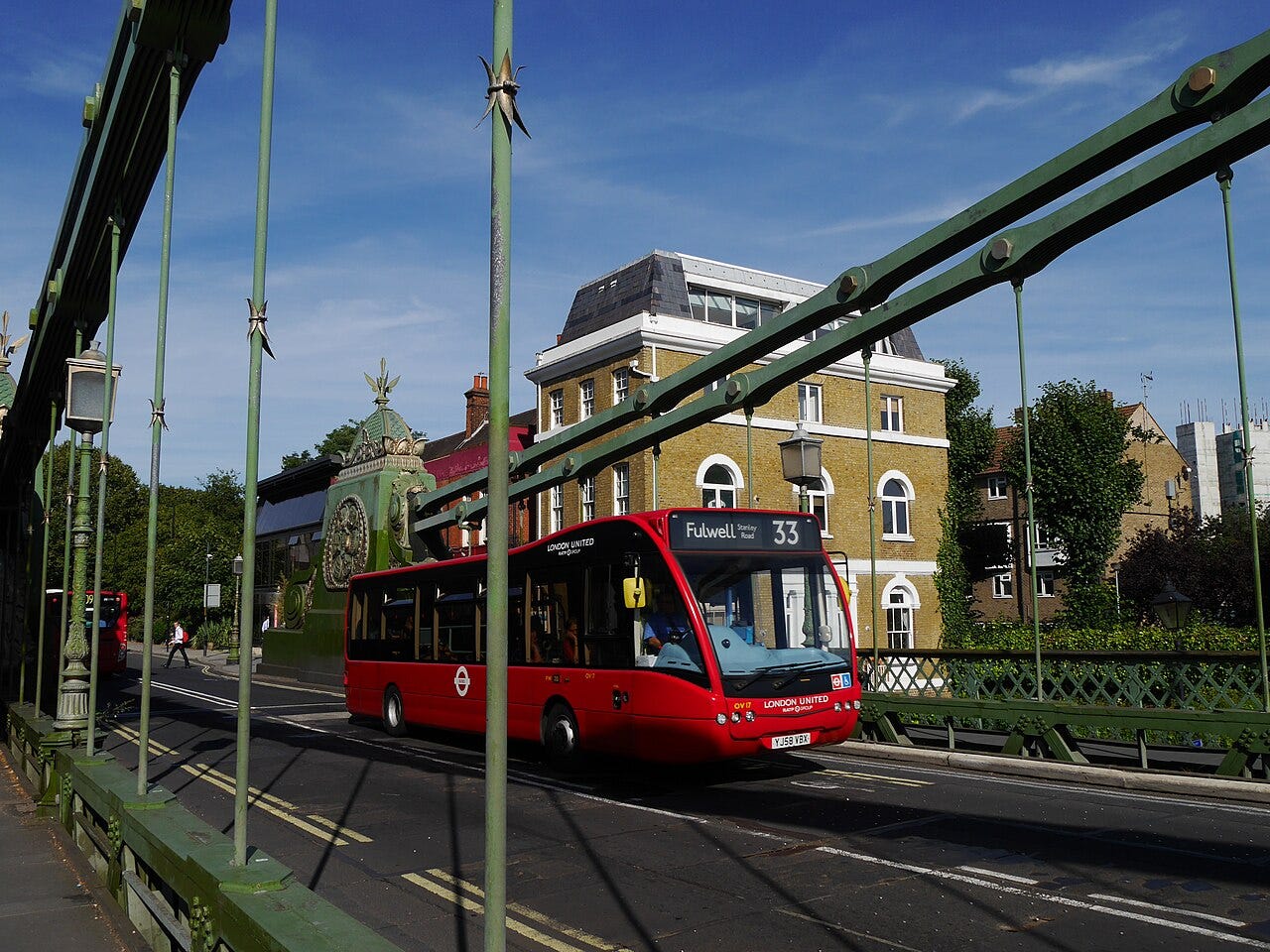
Hammersmith Bridge revealed the problem
Hammersmith Bridge did not create every Barnes transport issue. It revealed them.
When the old volume of through-traffic disappeared, Barnes became quieter in some ways and more awkward in others. Some people adapted quickly. Some walked or cycled more. Some changed route. Some relied more heavily on cars for local errands. Others simply had fewer good options.
All the while, London is seeing a long-term reduction in bus passengers numbers, with TfL trying to balance need with budget. The result can feel like transport austerity in 2026 arriving in Routemaster red.
But the point is not to re-litigate the Bridge in every transport discussion. The point is to admit what the Bridge has taught us.
Barnes cannot simply wait for an old transport pattern to return. Even if future proposals emerge for limited vehicle access across Hammersmith Bridge, TfL has said it would keep the bus network under review.
That makes the current network contingent, not eternal.
So the task is not to design Barnes around a particular Bridge future. It is to build a local transport system that works under several futures: Bridge open to pedestrians and cyclists only; bridge partly reopened to some vehicles; Bridge served by a shuttle or pod; Bridge still politically stuck.
Under all those futures, Barnes will still need better local circulation.
Case for change - a new sort of Barnes bus service?
I am confident about some aspects of this idea but less sure about others. That is probably a good sign. A fully certain transport idea is usually either too small to matter or already in trouble.
The local participation gap
The real issue is not transport in the abstract. It is participation.
Can people get from home to the High Street, Castelnau, White Hart Lane, the Pond, the riverside, the station, the doctor, the shops, the café, the church hall, the club, the Bridge approach — without always needing a car?
For many people, the answer is yes. They can walk, cycle, use an e-bike, catch a bus, drive, or mix the lot.
For others, the answer is more fragile.
Some are older. Some are less mobile. Some do not own a car. Some own one but would happily use it less if the alternative were easy enough. Some can manage the outward journey but not the return. Some can walk in fine weather but not on a wet Tuesday afternoon in February, , carrying shopping and nursing a bad knee.
This is where the language matters.
The audience for a Barnes connector is not only ‘vulnerable residents’, though they matter. Nor is it only drivers, though they matter too.
The more interesting audience is broader: pragmatic residents who use the car because, for certain short local trips, it remains the most convenient answer.
The ambition should not be to shame that choice. It should be to beat it.
This fits the wider direction of policy
One reason this question matters is that all three levels of government are pushing, in different ways, towards fewer short car trips.
Nationally, the Department for Transport’s (DfT) cycling and walking strategy says the ambition is for 50 per cent of journeys in towns and cities to be walked or cycled by 2030. (DfT guidance also describes treats demand-responsive transport as most useful where it complements the main network rather than replaces it.)
Regionally, the Mayor’s Transport Strategy sets the larger London target: 80 per cent of all trips to be made on foot, by cycle or using public transport by 2041.
Locally, Richmond council’s Local Implementation Plan mirrors that broad direction, with a target for 75 per cent of trips in the borough to be made by walking, cycling or public transport by 2041.
The Barnes question is therefore not eccentric. It sits inside the mainstream policy argument.
The harder question is practical: how do you reduce short car trips in a place where the awkward journeys are not always long enough for a conventional bus, not always easy enough for walking, and not always suitable for cycling?
That is the space a civic connector might occupy.
What might a civic connector be?
A Barnes e-hopper should not be understood as a tiny TfL bus.
It would be a different thing: a light civic connector, designed for short local journeys within and around Barnes. It might be scheduled. It might be on-demand. It might be a hybrid. It might use a small electric minibus, a shuttle, or another accessible vehicle. The point is the service layer, not the gadget.
Its job would be to connect the village to itself.
That might mean a route linking Castelnau, Barnes Pond, Barnes High Street, White Hart Lane, Barnes Bridge, the Wetland Centre and the Hammersmith Bridge approach. It might include Mortlake. It might connect to existing bus stops and stations. It might run only during certain parts of the day. It might be more useful on market days, wet days, weekends, school-holiday days or late afternoons.
Whereas FiSH connects people to larger supermarkets beyond Barnes, an e-hopper could connect people to Barnes’ own centres of everyday life.
The new service could make local life easier to join, reduce short car trips, and create a modest shared social space in motion.
The service must not be designed for one imagined user
There is an obvious trap here.
Make the e-hopper too much like a social-care shuttle and many practical drivers will never try it. Make it too much like an app-led convenience product and the people who most need it may be excluded.
The service would have to sit somewhere more interesting.
Civic enough to be trusted.
Convenient enough to be used.
Accessible enough to be legitimate.
Visible enough to become part of everyday life.
Older residents - of which we have many - may be among the keenest users. But they should not be treated as the only users. The real opportunity is a mixed service: older residents, people without cars, people with temporary mobility issues, parents, visitors, shoppers, people going to local events, and drivers who would leave the car behind if the alternative were not faintly heroic.
The test is simple.
Would someone use it who could have driven?
If the answer is no, the service may still have social value. But it will not seriously reduce short car trips.

Learn from others
Barnes would not be starting from scratch.
Britain already has flexible connector services worth studying.
Wiltshire Connect offers bookable journeys by app or phone and operates across defined rural and semi-rural zones.
Callconnect in Lincolnshire, has operated since 2001, mixing demand-responsive booking with some timetabled services.
Travel Telford On Demand and West Berkshire Community Connect are also useful comparators for booking, hours, fares, operating geography and public trust.
But Barnes is not Wiltshire, Lincolnshire, Telford or West Berkshire.
It is denser, wealthier, older in parts, more walkable in parts, more congested in parts, and politically allergic to anything that looks like either gimmickry or creeping institutional fog.
The lesson is not ‘copy a demand-responsive transport model’. The lesson is more precise: study how these services handle booking, trust, accessibility, fare simplicity, operating hours, subsidy, and the relationship with the main bus network. Then design something Barnes-shaped.
Indeed the most relevant local lesson may already be closer to home. FiSH shows that trusted, human, door-to-door community transport can work here. But it also shows the importance of clarity. People understand what the FiSH shopping bus is for. Any e-hopper would need the same discipline.
Experiment then scale
Part of the appeal for this e-hopper service is that a small electric buggy or shuttle ought to be light enough to organise quickly. This is not a mega-project, but the sort of thing a place should be able to test, observe and refine without (seven and counting?) years of delay.
If the Barnes e-hopper has merit, that is part of its merit: it should be possible to scramble something small and learn from it fast.
The next move should be a pilot, not a fully worked service proposal. The point of a pilot is not to prove that the final model has already been found; it is to discover whether there is really a thing here at all, and if so what shape it wants to take.
This approach is also consistent with Richmond council’s own public-sector habit of using pilots and trials where the evidence is uncertain and the learning matters to later plans.
A pilot would need to answer the practical questions: on-demand or scheduled, tiny vehicle or slightly larger one, key day-parts etc..
Questions that need answering before a pilot
There are good reasons to be sceptical about this idea.
If demand is too dispersed for a normal bus, it may also be too dispersed for a small connector. If the service is too irregular, people will not trust it. If it is too expensive per passenger, it will become hard to defend. If it is free, it still has to be paid for. If it is app-only, it will exclude people. If it is not app-based at all, it may be clunky. If it overlaps too much with TfL buses, it could weaken the very public transport network Barnes needs.
There is also a political risk.
A Barnes e-hopper must not become a subsidised convenience for the already comfortable. Its public value would need to be clear: fewer short car trips, better access for those without easy mobility, stronger local participation, and better links to the existing bus and rail network.
That is why the pilot would need hard measures, not just warm feelings.
What a pilot would need to find out
The point of a pilot would not be to prove that the Barnes e-hopper is a good idea. The point would be to discover whether there is really a thing here.
A useful pilot would need to answer questions like these:
Purpose — is the aim fewer short car trips, better access for older residents, stronger north-south movement, local sociability, or a blend?
Users — who actually rides: older residents, non-car households, practical drivers, visitors, parents, shoppers?
Geography — should it serve only Barnes, or include Mortlake and key bridge or station connections?
Destinations — which places matter most: Pond, High Street, Castelnau, White Hart Lane, Wetland Centre, stations, riverside, Bridge approach?
Model — scheduled loop, on-demand, semi-flexible, or different by time of day?
Vehicle — small electric minibus, accessible shuttle, buggy-style vehicle, or something more weather-proof?
Accessibility — wheelchair access, step-free boarding, space for shopping, non-app booking, telephone support?
Payment — free, low fare, donation, sponsorship, grant, Oyster/contactless, or mixed?
Operator — council, community body, social enterprise, private operator, or partnership?
Trust — would a civic brand help, perhaps involving Barnes Community Association, or would that make it feel too informal?
TfL relationship — feeder, complement, overlap, or nuisance?
Success — ridership, satisfaction, reduced car trips, access for non-drivers, cost per passenger, repeat use?
Failure test — what result would prove the idea is not worth continuing?
One more moving part: the Hammersmith Bridge pods
There is also talk of a possible pod or shuttle service across Hammersmith Bridge. Charles Campion raised the idea at the May 2026 Barnes Town Meeting. pt before.)
That matters because a Bridge shuttle and a Barnes e-hopper could either compete, duplicate or reinforce each other.
If a future Bridge pod created a strong southern stop near the Bridge approach, a local connector could feed it from across the peninsula. That would make it easier for residents from White Hart Lane, Castelnau, Barnes Bridge or Mortlake to reach the bridge without driving to the bridgehead.
In that version, the e-hopper is not a rival idea. It is the local mesh around a stronger crossing.
Again, this is not yet a plan. It is a design question.
So, does Barnes need an e-hopper?
Maybe.
That is the honest answer.
Barnes probably does not need a new transport scheme. It may not even need a permanent new service. But it does need to understand whether there is a missing layer between walking, cycling, driving, existing buses, the FiSH shopping bus and whatever eventually happens at Hammersmith Bridge.
A small civic connector is one plausible answer.
Not a toy bus.
Not a nostalgia bus.
Not a way of avoiding hard choices about streets, cars and public transport.
A test.
Put something modest on the road. Give it a clear purpose. Make it accessible. Measure who uses it. Ask whether it replaces car trips or merely creates new subsidised ones. Find out whether people use it once, or fold it into daily life.
Then Barnes would know something it does not know now.
Whether the village has discovered a missing layer of itself - a lighter way to stay connected - or merely another charming idea that looked better in a meeting than on a wet Tuesday in February.