


The dissonance is deliberate. Heat? I am more bothered about keeping warm right now. But this is the perfect time to prepare for next summer.
That might mean preparing to cover your windows, the simplest of solutions, or investing in an air conditioning. Even portable ones run into the hundreds of pounds. Time spent planning now will be rewarded in more ways than one.
Welcome to Barnes2050, a place-based futures project. Let’s change how we talk about the future of Barnes.
If this is your first visit, you might want to start here.
Summer 2027
It would be hard to forget the summer of 2026. Five heatwaves and all that.
Less obvious is the underlying trend. Although temperatures in 2026 didn’t touch the highs of 2022, the average temperatures were remorselessly high. Take the month of June. Eight of the last ten Junes were well above the 1991–2020 average at Heathrow.
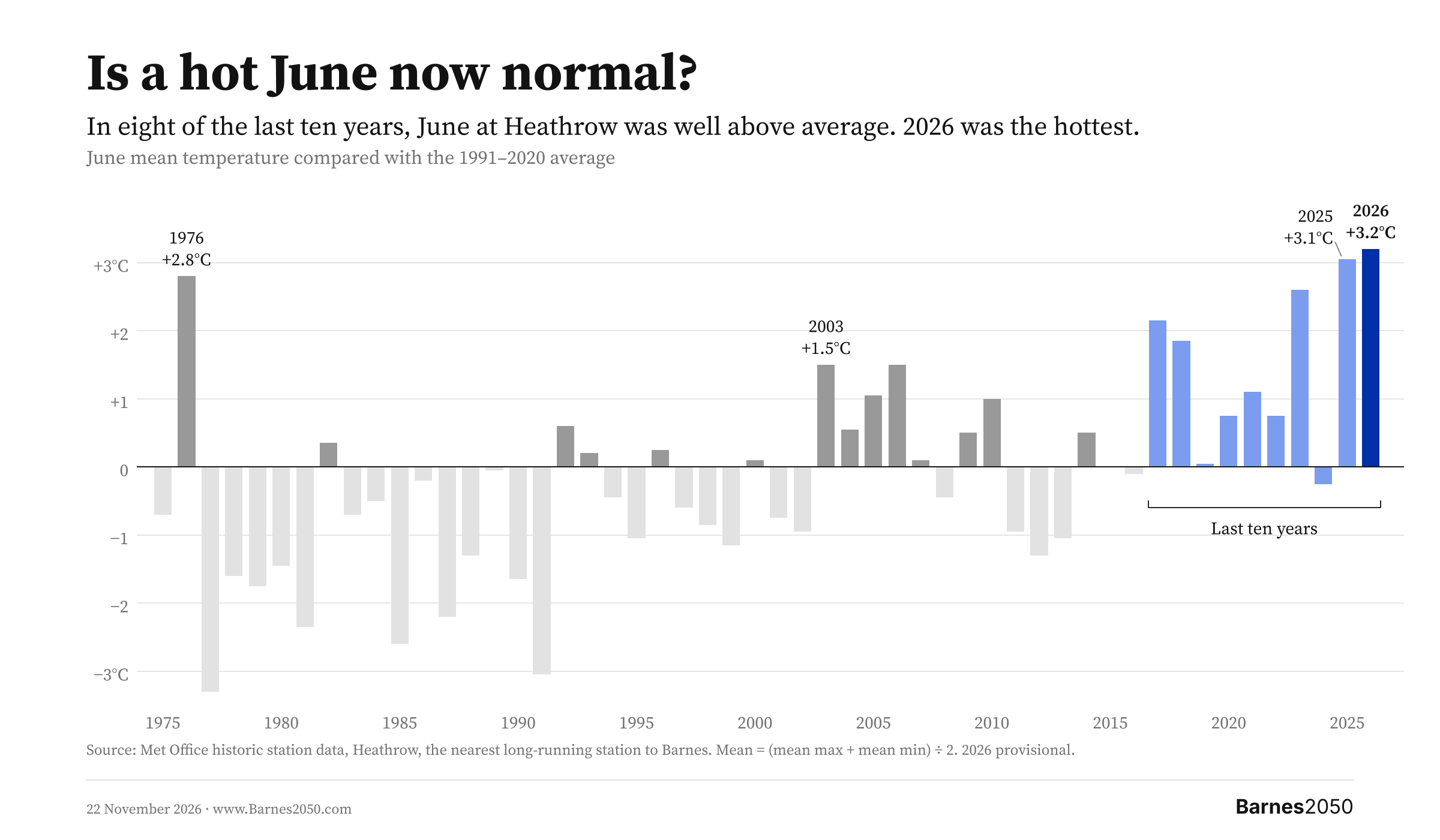
Since no UK passport holder has ever been punished for discussing the climate or weather, a quick word on why the chart uses temperature data from Heathrow.
It seems nobody has ever kept an official temperature record in Barnes.
Met Office climate figures come from standard weather stations: instruments in a white box on open grass, read the same way for decades. Barnes has none. The nearest are Kew Gardens, about 3km away, and Heathrow, about 12km away.
So why Heathrow not Kew?
Kew Gardens is a proper Met Office station, and an important one. In May 2026 it set the UK record for the hottest day in May: 26 May 2026, 35.1°C. But Kew isn’t among the stations the Met Office publishes as free, ready-made monthly tables, and Heathrow is.
To be fair to the Met Office, there is a dataset called HadUK-Grid. It takes readings from stations across the country and uses them to estimate temperatures for every 1km square in the UK. Monthly temperatures in this dataset run from 1884 to the present.
There is a square that covers Barnes, with June figures going back well before 1975. But these are estimates not measurements. The estimate would probably come from Heathrow.
What sort of protection?
Wherever the source of the temperature reading in south west London, the point is to Be Ready, to borrow a phrase. You would be following the advice of the group tasked by the UK Government with helping it navigate our changing climate. The Climate Change Committee’s last major report was clear, we need to start adapting to the climate we are going to have.
At a Richmond council Sustainability Forum, David Shukman, former BBC science editor and now author of The Response, made the case for where to start,
We must do everything we can to stop the sunshine hitting the glass.
The easiest and cheapest needs no preparation: close the blinds or curtains while direct sun is on the window. It costs nothing but it does help.
Anything beyond that would benefit from a spot of winter planning.
A securely fixed, light-coloured fabric screen, sheet or shower curtain can block sun before it reaches the glass.
Want to go further? Historic England suggests solar-control film. It can reduce the sun’s heating effect, but it changes the window year-round and may affect its appearance.
Alternatively, plan to cool the room. But portable air conditioners are more expensive, still. Even though they come with no installation fee, buying one will still set you back between £250 and £700. They typically cost 20–50p per hour to run. Which?(pay££) have a useful guide including a ‘Great Value unit’ costing £300.
If you want to understand how these changes and others might protect your home against the climate to come, Richmond council has published a useful guide on how to retrofit your home, whatever its size, shape or location.
Barcelona rules
If you do invest, you can be sure it will be for the long term.
The Met Office has outlined the climate Richmond borough can expect.
Kew Gardens interpreted that in a way that I find useful. Barcelona’s climate today is similar to what we can expect in 2050. Of course Kew Gardens isn’t saying that Barnes in 2050 will have Barcelona’s weather today. Climate is not weather. The comparison is about the underlying climate: patterns of heat, rainfall and extremes over time.
Still, this forecast provides a moment.

End as we begin. Dissonance. 15° is appealing. But a mild November day is not the whole bargain: hotter summers, milder winters, rain falling differently. Barcelona has seasons, too. The question is whether we want Barnes’s to change.
Explore more stories about our changing climate, and what it could mean for Barnes and the rest of London by 2050.