

The Manifesto is the heart of this journal: the place where the ambition is made visible. If Barnes is to be reimagined seriously, the thinking needs to be set out, tested, refined and, when necessary, reworked. That is the job of the Manifesto.
It is made up of several chapters:
Inputs
Trends - signals from the present which might point toward the future
Visions - plausible futures based on values and experiences
Outputs
Principles – small number of guiding ideas that shape how decisions are made
Proposals – specific interventions, big and small to change Barnes
This post introduces the first of these: Trends.
Possible futures leave clues in the present, capturing changes already underway. While some shifts - like those in housing, travel, and demographics - are easily measured, others are subtler, found in evolving behaviours, expectations, or in the way a place begins to feel different before anyone has quite named why.
Sometimes one trend emerges clearly from the mix and you can can imagine how it might gain momentum over time. Projecting them is not just a statistical exercise. It requires judgement: about pace, direction, significance and consequence.
Some of these trends will appear in the weekly digest of news and signals about the future.
This is the first set of trends. Others will follow.
And of course, these trends should be read alongside the generational challenges.
Welcome to Barnes2050, a place-based futures project asking: how do we make sure Barnes - the place and its people - is thriving and climate-ready by 2050?
Not every global trend will feature here. Barnes has its own texture, constraints and peculiarities. Artificial intelligence, for example, may transform daily life. But much of that transformation will not be uniquely Barnes-shaped. The better question for this journal is: how do large forces play out on this peninsula, in these streets, beside this river, among this particular mix of people and institutions?
One other thing.
Trendlines are not destiny. They can be bent. Policy, design, civic pressure and practical action can change their trajectory.
As we look to 2050, the question is not simply: what is coming?
It is also which of these trends should we encourage, which should we resist, and which should we redirect?
Initial list of trends
Today Barnes2050 is launching the first six forces which will play an outsized role in shaping the Barnes of 2050:
These will be brief description of each. A fuller consideration of each will follow in the coming months .
Other trends will also be added, too.
If you think this list or any element on it could be improved, then please get in touch.
Barnes is getting older
Barnes today looks more like an older, settled outer-London neighbourhood than a place being replenished by large inflows of younger adults
Census data shows that around 55% of residents are aged 45 and over in Barnes ward (ONS Census 2021 via Nomis), well above the London average. The strongest growth has been in the 50–69 age groups.
The wider borough tells the same story. Richmond’s own analysis describes the borough as having fewer people aged 20 to 34 than London, and more people in older age bands, linking this in part to affordability.
From 2011 to 2021, the ageing story strengthened. In Richmond upon Thames, the median age rose from 38 to 41, making it the joint highest in London, and the number of residents aged 65 and over increased by 24.9%. In Richmond Borough, the 85–89 age group is projected to grow by nearly 50% by 2035 .
London provides a real contrast. It has agred too but more gently. In 2021 its median age was 35, compared with 41 in Richmond, and it remained the youngest English region by that measure.
Barnes is a place where people tend to stay. That is part of its strength. It is also part of its challenge. High housing costs limit younger in-migration. The result is a community that is stable and settled, but gradually tilting older.
Why does this matter?
Fewer young families and newcomers will mean slower cultural change and fewer informal social resets.
It will reshape demand for housing, mobility, healthcare and public space. Social patterns in Barnes are already shifting towards smaller households and more single-person living, partly because of ageing, and partly because younger adults are forming households later. Nearly one in three households in Richmond borough is occupied by one person.
By 2050, this could affect the kinds of homes Barnes needs: more accessible flats, more senior-friendly housing, more support for solo dwellers, and more everyday places where people can remain socially connected without needing to join a club, own a car, or book something online.
Barnes risks becoming London’s largest gated community
Extreme concentration of property value
Very high property values increasingly lock Barnes into a narrow socio-economic band, reducing churn and diversity.
There are approximately 6,700 homes in Barnes.
Sold-price trackers for 2025 put Barnes/SW13 overall averages around £1.36m to £1.44m, while semi-detached homes average over £2m, amongst the highest outside central London. (Sources include HM Land Registry Price Paid Data, Property Solvers and Zoopla)
Barnes is unlikely to add much new housing relative to demand. There are three obvious reasons:
conservation - many parts of Barnes are subject to conservation rules covering 18th–19th century buildings
resident resistance - knocking down a property to build even a low level apartment block or flatting a large house is rarely simple
limited space - adding to the restrictions over half of Barnes is green or blue: commons, woods, river, streams and wetlands.
At the same time, fewer people are living in each of these expensive houses. The average household size in Richmond borough fell to around 2.3 people per household in 2021 (ONS Census 2021), continuing a long-term trend towards smaller households. More people are living in couples without children, single-person households, or as older residents whose children have left home.
Why does this matter?
Barnes risks becoming London’s largest gated community.
Nothing to do with a Bridge.
No gates. No guards. Just prices.
Access to Barnes housing is increasingly determined less by income than by intergenerational wealth. Over 40% of London first-time buyers now rely on family support; in high-value areas such as Barnes, that pressure is likely to be even sharper.
A place can remain physically open and still become socially closed.

Heat and water are climate threats
Barnes2050 has supported and celebrated the Community BlueScape project: an extraordinarily far-sighted civic achievement.
Kitson Road will always provide a thrill. Not a sentence you read everyday.
Work to manage flood risk - from river and rain - needs to continue. Barnes needs to understand what, if anything, will be required after the Thames Barrier changes its approach to managing upstream flood risk after 2035.
But the same attention now needs to be paid to heat.
The Met Office has published a detailed climate report for Richmond borough, setting out what to expect as the climate warms.
This Climate Report provides high level, non-technical summaries of climate change projections for a local authority area. It uses scientific research to provide robust climate information to help decision makers plan for the future.
The Met Office report suggests if global warming levels rise between 2º and 4º, Richmond borough can expect the number of hot summer days with a maximum temperature of 30º to increase from around two year currently to between 10 and 28. Tropical nights (20º) would similarly increase from none now to between three and 15.
Barnes2050 examines how our climate is changing and what that could mean for Barnes and the rest of London by 2050.
Two immediate consequences come to mind.
Water destroys property, heat kills people.
That is an over-simplification, but only slightly. Older people - see the trend on the Barnes population mix - are particularly susceptible.
If we can re-wriggle a river and replant reed beds because osiers are as useful today as they were in their seventeenth-century pomp, then surely we can think seriously about shade, seating, trees, cool refuges and better-designed public space.
And then comes the awkward question: what do we do about air-conditioning?
Energy retrofit becomes social divider
Bridged2050 applauded Richmond council when it launched its guide to retrofitting your home.
Between now and 2050, most of the 6,700 homes on the peninsula will need to be retrofitted. Barnes is no different from London, or indeed the rest of the UK, which must retrofit roughly 19 million homes by 2050.
The sums involved, even with grants and loans, can be eye-watering.
Richmond council’s excellent guide included a useful breakdown costs.
Whilst it is true for many if you can afford to live in Barnes, then you can afford to retrofit over the next two decades.
It is not true for all.
Worse, house prices will increasingly reflect whether a home has been retrofitted, and how well. An area of expensive houses could become more expensive still. Meanwhile, retrofitted homes will benefit from lower energy costs: savings denied to those who cannot afford the upfront work.
So the property divide hardens. Those with capital improve their homes, lower their bills and increase their asset value. Those without capital are left with colder homes, higher running costs and fewer options.
Wars in Ukraine and then Iraq have kick-started the process of retrofitting our homes.
Why this matters?
Richmond borough has a distinctive emissions profile. Housing is the single largest source of local green house gasses, at about 46%.
Many will be looking to the market to fix the unit cost of retrofitting coupled with better-targeted government subsidies and cheaper loans.
But this is not a short campaign. It will take all the years to 2050.
A gas boiler fitted in 2025 could still be working in 2045, if well maintained. Decisions being made now will still be shaping emissions, bills and comfort two decades from now.
Contested kerbs
In the twentieth century, cars dominated kerbs.
SUVs represent peak kerb-bossing by cars. Magnificent engineering, perhaps. But not quite essential kit for most residents of SW13, unless your work actually requires it. Builders, yes. Bakery run, less persuasive.
You don’t need to be a ‘kerb nerd’ to see more claims already being made on this precious part of our built environment:
there are more bikehangars
there’s more provision for parking for e-bikes and e-scooters
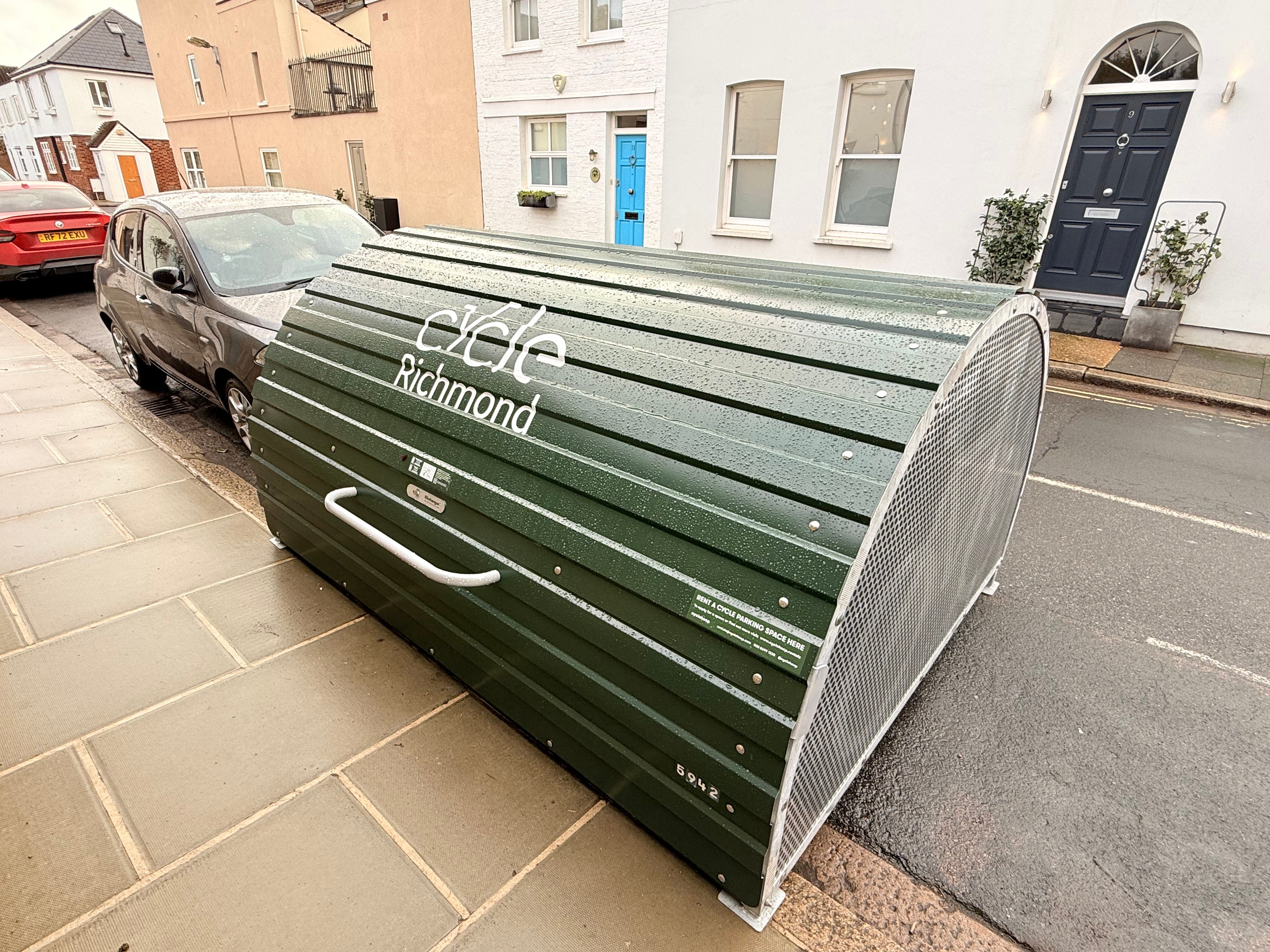
Meanwhile the vehicle mix is changing. Every day, dozens of delivery vans zip across SW13. The expectation now is for same-day delivery, frequent drop-offs and app-scheduled convenience.
Looking further ahead, the twin stressors of heat and water will demand a physical response. More kerb space will have to be given over to shade, seating, trees and SUDS
Nature, logistics and servicing then will reshape kerb space. Streets that fail to adapt choke themselves.
Why does this matter in Barnes?
72% of households in Barnes have access to at least one car or van. Many of these are SUVs. Many of them are left parked in the street, often for days on end. Many of those streets are narrow Victorian streets.
This is where the argument becomes uncomfortable.
Richmond’s political leaders have been reluctant to engage with SUV owners, fearing pushback. That position is not sustainable. By 2050, Barnes will need a fairer way of managing conflicting demands on kerb space, including the gripes of drivers who may lose some inconveniently claimed space, or at the very least pay more for the privilege of storing private vehicles on public land.
Dynamic space management: data-driven control replaces fixed rules
London has historically relied on static road layouts and permanent signage to manage much of the public realm.
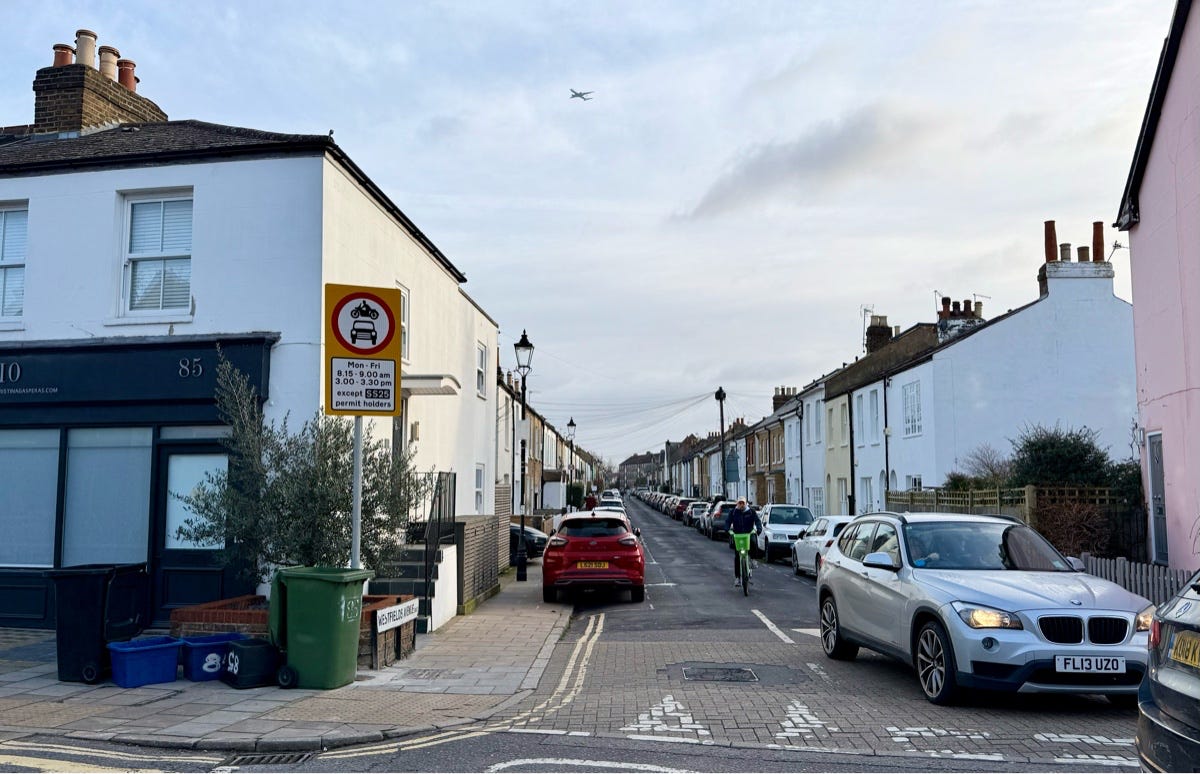
That is beginning to change. Bus lanes can operate at particular times. School Streets control access during the school run. Parking, loading and access rules are becoming more conditional.
Users of streets and spaces are already adept at managing sophisticated real-time data. Traffic apps such as Apple Maps and Waze are obvious examples. Digital bus stop information boards are still rare in Barnes, but they point to the same direction of travel.
The range of time-sensitive rules will grow over the next twenty years. Autonomous vehicles (AVs) may accelerate that shift: not only as vehicles, but as sensor-laden observers and commentators of the surrounding environment.
The critical missing feature is the feedback loop: something that connects people, data and place.
Perhaps you receive a warning, short of a fine, telling you not to enter a School Street zone. Perhaps high pedestrian numbers trigger more generous crossing times. Perhaps a road is temporarily reallocated for wider pavements during an event, a heatwave, or a flood-risk episode.
This is how it will feel as a Barnes resident to see the gradual replacement of fixed rules with responsive management.
Why does this matter?
Barnes has an unusually rich natural environment. More than half the area is blue or green. That is one of its great strengths. It also limits the space available for new activities.
Barnes will not be able to solve its problems by building more. Instead, it is more likely to redistribute space, time and access.
Done well, this could be more a elegant approach, in a data-rich environment. Done badly, it could feel intrusive, arbitrary and infuriating.
Richmond Council be warned: the petitions prompted by algorithms may be even more spirited and more common than the petitions prompted by traffic cones.
Notes & thoughts
These are six long term trends that will shape Barnes in 2050.
In time there will be deeper researching and reporting on each. There will also be more of them
Our challenge, as we think about life in Barnes in 2050, is to decide how to harness these trends to our advantage and where necessary, how to change them. The sooner we start the better.
Walk SW13 and you can already see glimpses of that future: bikehangars, rain gardens, trees planted for shade, wider pavements, better seating, more attention to the spaces between buildings.
Barnes2050’s Manifesto will suggest principles and proposals to address these trends. If you would like to contribute or have thoughts on what you’ve read, please do get in touch.
Richmond council to look into keeping HGVs out of the High Street and off The Terrace

Richmond council has agreed to examine whether the weight limit for lorries using Barnes High Street and The Terrace should be reduced.