

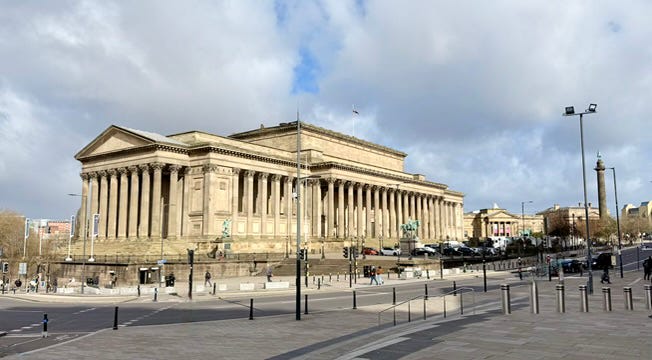
Not your typical conference centre, then. Welcome to St George’s Hall, Liverpool, the setting for the 2026 Walking Summit, organised by Living Streets.
Welcome to Barnes2050, a place-based futures project asking: how do we make sure Barnes - the place and its people - is thriving and climate-ready by 2050?
Living Streets, the ‘UK charity for everyday walking’, gathered in Liverpool at an interesting moment for the organisation: one strategy period closing, another beginning.

This was my first Walking Summit. I said almost nothing. I wanted to absorb it properly: the speakers, the mood, the assumptions in the room. A government minister. Regional politicians. Specialist consultants. Local campaigners. All of them, in different ways, wrestling with the same question: what would it mean to design places around people on foot, rather than treating walking as an afterthought?
Notes & thoughts
Here are my five top takeaways, , followed by a few practical implications for Barnes2050.
Barnes is pedestrian-aware
Travelling to Sydney, Australia, and Rotterdam in 2026 made me appreciate more clearly the progress already made in SW13. Liverpool - both the conference content and the city centre - had feel the same effect.
I am sometimes asked: if Barnes is already such a good place to live, why keep arguing for change?
The answer, which I hope to explore more fully in a summer piece, rests on two ideas.
The first is that the current generation of Barnes’ residents have inherited something unusually good. A recent talk at FiSH captured this beautifully. Barnes’s built and green environment is not an accident. It is the product of patient stewardship, of people over time making choices that preserved quality and character. We need to show that same level of stewardship in the twenty first century.
The second is that privilege creates obligation. Barnes has pockets of inequality in income and wealth, but broadly speaking it is prosperous. It is also facing a set of generational questions that London, and Britain more broadly, will need to answer: how to adapt to climate pressure, how to rethink mobility, how to use public space better, how to live well with trade-offs rather than pretending they do not exist. If a place like Barnes cannot engage seriously with those questions, it is hard to know who will.
So yes, celebrate the excellent — Love this, love this too - and look to improve for 2050 so we are all thriving and climate-ready. Starting with a shift to being pedestrian-first.
Impressive UK government minister
I have heard many and met several. Authenticity is one of those qualities that sounds vague until you encounter it. Then it is obvious. You hear it more than you see it. Which is, among other things, a useful reminder that voice still carries things the printed word cannot.
Lilian Greenwood MP, the Minister for Local Transport, came across as thoughtful, articulate and entirely human. No bombast. No performance of certainty. Just a clear attempt to speak plainly about how streets are experienced in real life.
She focused on women’s safety in public space and on the fact that transport policy is never just about movement. It is also about confidence, fear, freedom and constraint. She also pointed towards new work from Active Travel England, which has now published guidance to help councils make streets feel safer.
Design for difference
The minister made the case that women’s needs should shape how we think about streets and infrastructure. A later session added another layer, and made the point more tangible still.
Dr Amit Patel, a DEI consultant and trustee of Living Streets, became blind later in life and spoke about what that means in everyday movement through public space. The practical detail mattered. It shifted the conversation from good intentions to lived reality.
According to the RNIB, around 4 per cent of adults in England are living with sight loss. Once you hold that number in your head, ‘designing for difference’ stops sounding like an optional act of generosity. It starts to look like a basic test of whether a place is functioning properly.
That, for me, was one of the most useful reframings of the day. Difference comes in many forms when the default a car driver.
Autonomous vehicles (AVs)
I expected the session involving a senior London-based Waymo figure to focus mainly on safety. It did.
But that was not the part I found most interesting.
The more revealing thread came from the host, Adam Tranter, who kept returning to a simpler and more awkward question: if autonomous vehicles arrive in meaningful numbers, what happens to congestion in the short and medium term?
Maybe. Possibly. Probably. That was the gist of the answer.
The topic featured recently on Bridged2050 following Waymo’s latest announcement as they aim to be operating their first service outside of the USA in London, UK government approval permitting.
More on this topic in future.
Pedestrian-first road crossings
This was already on my long list of ideas. After hearing about its impact in Liverpool, it has moved up several places.
The principle is straightforward. At some crossings, once a pedestrian presses the button, the traffic sequence should begin changing quickly — green to amber, amber to red — rather than making the pedestrian stand there waiting for the system to catch up with the human being who has already announced their presence.
In other words, the default logic should lean more towards near-instant priority for people on foot on some roads and streets.
It is a small design shift, but one with a larger philosophical point behind it. Who is the street for, really?

Practical implications for Bridged2050
As Bridged2050 moves into its second year, a few practical lessons stood out.
Production - Walk the ground
The amateur historian in me already knows this. Reading about the Battle of Arnhem is one thing. Driving over the John Frost Bridge is another. Place turns abstraction into something physical. You understand with your body as well as your brain.
The Liverpool walkshop offered nothing especially novel in itself — SUVs, hostile crossings, no obvious trace of school-street thinking in that particular part of the city — but the discussion around it was excellent.
A senior Liverpool traffic planner spoke to me about plans to introduce e-scooters. Another participant explained how London looks from her perspective in Leeds. A campaigner described her work helping councillors in south Wales develop policy around higher parking charges for heavier vehicles, including SUVs.
That mix — place, conversation, contradiction, comparison — was encouraged by this ‘walkshop’.
Production - Storytelling through short films
Note to self: get moving on audio, if only to make a late-2026 video push realistic.
One of the strongest storytelling sessions came from Simon O’Brien, Active Travel Commissioner for Liverpool City Region. Yes, being a former Brookside actor probably helps when it comes to speaking on camera. But the session worked because there was more than polish. He walked and talked through his neighbourhood, then cycled through Paris, carrying off the difficult trick of being visibly delighted by city life while still making serious points about how it can be improved.
Production - Tools and frameworks
Regular readers will know I have a weakness for a framework. It stops the mind fizzing off in six directions at once and producing little of value in any of them.
My notes from the day are full of structures, prompts and tools. Consider that less a threat than a gentle warning: some of them will, almost certainly, find their way into this project before long.
This was a good conference in a wonderful city: stimulating, thoughtful and, at moments, properly challenging.
And if you are tempted to get involved, here are the details for either the Richmond local group or the wider national organisation.
Farewell to Wet Wipe Island

It took a decade to grow, and will take a month to dismantle. On the Thames foreshore beside St Paul’s School, a dense mound of congealed wet wipes — ‘Wet Wipe Island’ — is finally being removed.