

This matters to me. I didn’t realise how much until I began writing this post.
Big Barnes Ponder has left an indelible mark on Barnes SW13 over the past decade, all for the better.
I support it, unequivocally.
So why am I writing this?
My answer begins in October 2023.
Welcome to Barnes2050, a place-based futures project asking: how do we help Barnes - the place and its people - thrive and be climate-ready by 2050? If this is your first visit, you might want to start here.
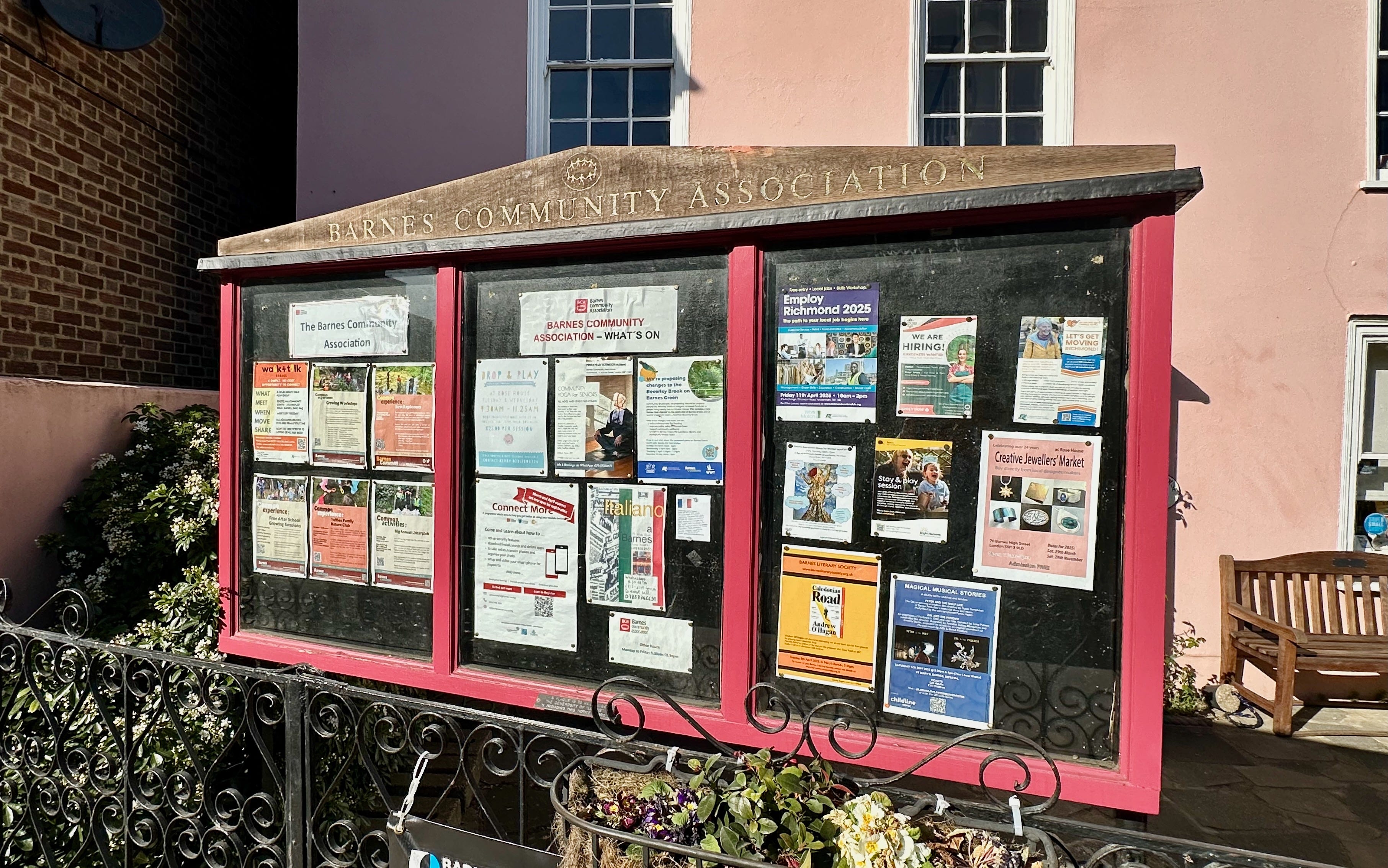
Ponder 1: What I missed — and what I learned
I wasn’t part of the first Barnes Ponder, run by the Barnes Community Association (BCA) from 2013 onward. I say ‘missed’ because I hadn’t grasped the scale of what others had been doing.
Yes, I saw, felt and enjoyed the changes: the new High Street scheme, the Suffolk Road playground, the parklet, open-air events on Barnes Green, the 22 bus campaign, re-routing of the 378, the rickshaw, the defibrillator phone box, the 20mph campaign, the Barnes Day Out project, the shop-local initiative and the murals.
Another version of the BCA’s blog includes a sentence that struck me,
Placemaking lies at the heart of the transformation — benefitting the whole community and drawing visitors .. year-round.
Placemaking. I’ll return to that.
Ponder 2: The reboot
The BCA Ponder team decided to reboot the project for a second cycle. This presentation even without the commentary explains that process
By the time of the ‘Town Team Meeting’ meeting in October 2023 the co-ordinating group had bundled a subset of the proposals into six thematic workstreams - One Barnes, High Streets Barnes, Placemaking Barnes, Safer Barnes, Green Barnes and Travel Barnes.
Progress continues.
A disclosure: I’m a BCA member. I happily pay my £18 a year. I helped with the traffic team at the 2024, 2025 and 2026 Barnes Fairs. I also offered my time for Ponder 2.
Notes and thoughts
Three impressions from that October 2023 meeting stayed with me:
Don’t mention the Bridge
Computer says no
Back to basics, at least for me
Hammersmith Bridge was the elephant in the room. It came up as a joke, repeatedly. Everyone knew we could spend hours discussing and disagreeing, so, without saying as much, we avoided the topic. Like Brexit before, the Bridge was the unspoken B-word.
The Ponder team, understandably, concluded they had no real influence over the decision, and so chose not to engage with it. Ponder time should be focussed on the things that could be addressed. The right call.
But I wanted to talk about the Bridge.
I knew people in the room had strong, opposing views. I wanted to hear them and try to understand them. The BCA’s thoughtful report, published a year after motor traffic stopped crossing, captured the complexity well.
I wasn’t interested only in the mechanics. I wanted to explore what it might mean if the Bridge never reopened to private cars. What would that imply for Barnes? For the wider area?
That question has since become less hypothetical. But the more interesting question was always larger: what kind of place might Barnes become if we stopped treating the old pattern of movement as the inevitable one?
That interests in how an urban area works probably makes me as much urbanist as a placemaker.
Another memory: frustration. Not with the Ponder team. But in the room from people who deal with others when trying to make things happen. Sometimes it is silence from businesses; sometimes from government bodies. Transport came up a lot, particularly buses and rail.
I understand why this is off-putting. But this has been my life for over twenty years . I am drawn to these seemingly intractable ideas.
Ask some of the many (so many) financial professionals in Barnes about patient capital and they will assume you are talking about long term investment. But there is another kind: the intellectual and social capital required to stay with an idea that is initially rejected by your peers.
My public service experience shows it can take years, sometimes more than a decade, for radical ideas become reality.
Finally, I remember listening. To more than a hundred thoughtful, impressive residents. I felt out of my depth. A novice. I realised I held untested opinions. I needed to go back to basics. Build my own case, from the ground up.
I’ve done this before. I find that journey from not knowing to some understanding, intellectually and emotionally rewarding.
Where do I stand?
Ponder and Barnes2050 are walking the same ground, but sometimes looking towards different horizons.
Ponder is largely concerned with what can be improved now, working through local knowledge, voluntary effort and the institutions that already exist. It turns ideas into practical action. Barnes would be poorer without it.
Barnes2050 takes a longer view. It looks for signals of change already visible, imagines several possible futures and asks what choices made now might lead towards one rather than another.
The difference is not simply radical versus practical. Nor is it Ponder versus Barnes2050. It is partly a difference of method and timescale.
Ponder generally works within the constraints Barnes has inherited. Barnes2050 is more inclined to ask whether those constraints will, or should, still govern the place in 2050.
Cars are the clearest example. Ponder’s transport work understandably looks for achievable improvements within a place where high car ownership and use remain facts of life. They are making progress.
Barnes2050 starts with a different question: what happens if we design Barnes for people first, not cars?
That does not mean no vehicles. It means fewer unnecessary car journeys, better alternatives and public space that does not automatically put the movement and storage of private cars first.
That question has led in several directions. The disappearance of thousands of journeys after Hammersmith Bridge stopped carrying motor traffic challenged forecasts of permanent traffic chaos. Asking what happened to those journeys produced evidence about disappearing cars.
Accepting that some people cannot comfortably walk or cycle across the Bridge led to the idea of a lightweight public-transport connection. That developed into considerations about a different sort of Barnes bus and a possible Hammersmith Bridge pod pilot.
The method has become clearer too: observe, interpret, imagine. Look for evidence. Make the possibility tangible. Then test new thinking with purpose, accepting that some ideas will fail or change.
This remains ambitious. I may not have a role in achieving much of it. I’m still learning. Others are already doing important work. I may be late to the conversation. But if the best time to plant a tree was twenty years ago, the second-best time remains now.
And I want to do all this while helping Ponder improve the Barnes we already have.
One works patiently on the inherited place. The other asks what that place might need to become.
Yes, and…
Updates to this page
The first version of this story was published on 09 April 2025. You can read it here.
The story was updated to reflect the following:
The original defined the distinction between Ponder and this project too narrowly, with cars figuring prominently. Since spring 2025, Barnes2050 has developed beyond transport. It is now more clearly about taking the long view, reading signals, imagining alternative futures and developing ideas that conventional civic processes may have little room to accommodate.
The original story only implied Barnes2050’s method. The project now has a recognisable discipline: observe, interpret, imagine; connect trends, visions, principles and proposals; then test ideas in public.
The contrast with Ponder was too binary. This change reflects the evolution of my thinking, not any change in the position of the BCA. Ponder concentrates mainly on improving Barnes within today’s constraints. Barnes2050 also asks whether those constraints will, or should, still govern the place in 2050, and what Barnes may need to become.
Why changing our street environment is so hard

Useful reflections from another campaigning group downstream of Barnes.