

Richmond council has launched a new transport strategy for 2040 that sets out
a long-term framework to modernise how people and goods move across the borough.
The council argues transport is about far more than simply getting from A to B.
Transport is fundamental to economic vitality, public health, social equity, town centre resilience and environmental sustainability.
Decisions taken about roads, bridges, bus routes, parking and public space shape the daily lives of our communities and the long-term trajectory of the Borough.
(All quotes in this article are taken from the Strategy document)
Welcome to Barnes2050, a place-based futures project asking: how do we make sure Barnes - the place and its people - is thriving and climate-ready by 2050?
What the strategy is trying to do
Here are the main things you should know.
Why, what and how
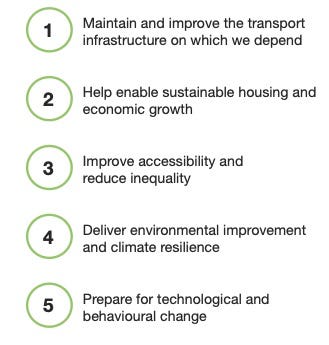
The strategy sets out how the council intends to manage transport over the next 15 years.
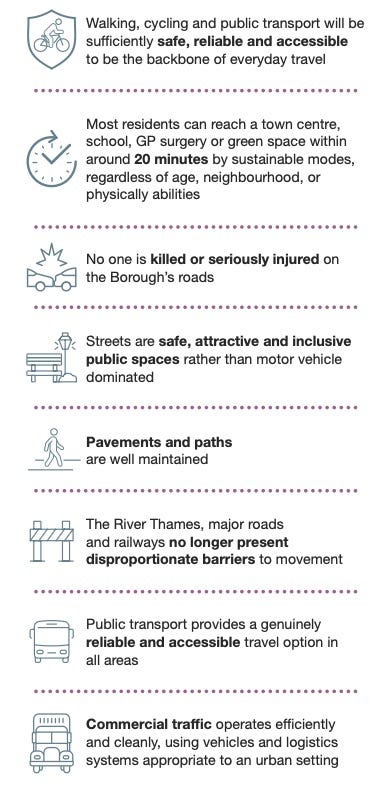
If successful, this is how the council believes transport across the borough could look by 2040.
Rather than prescribing every future project, the strategy establishes an overall direction.
The Strategy provides a structured but flexible framework to 2040. It establishes clear objectives and priority areas for action, while recognising that funding, technology and travel behaviour will evolve over time.
Those objectives are then translated into a long list of actions organised around a series of themes, for example
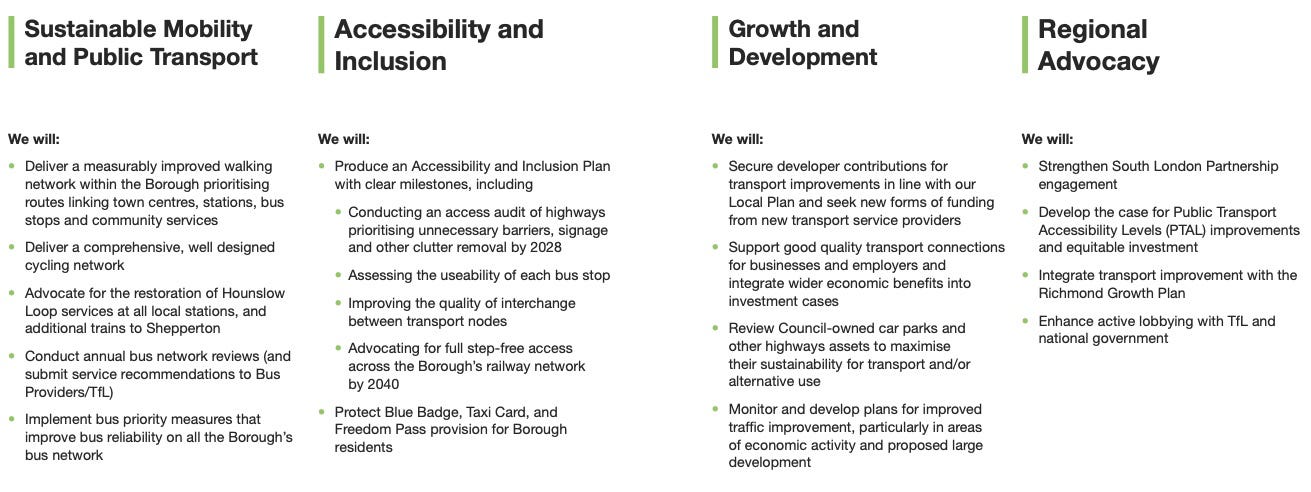
There are three versions of the Strategy available online. The short, long and accessible versions.
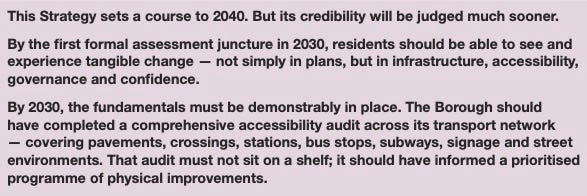
Things should feel different by 2030
You don’t need to wait long for improvements. Actually four years.
Active travel becomes the ‘backbone’
The council points out the borough has the highest proportion of residents in Outer London achieving at least 20 minutes of active travel a day.
It wnow wants to push further.
The Council’s aim is to make active travel modes practical options for everyday journeys. Providing residents with safe and accessible travel options is therefore a central part of this strategy. In turn, this will help reduce congestion, improve air quality, and support local high streets.
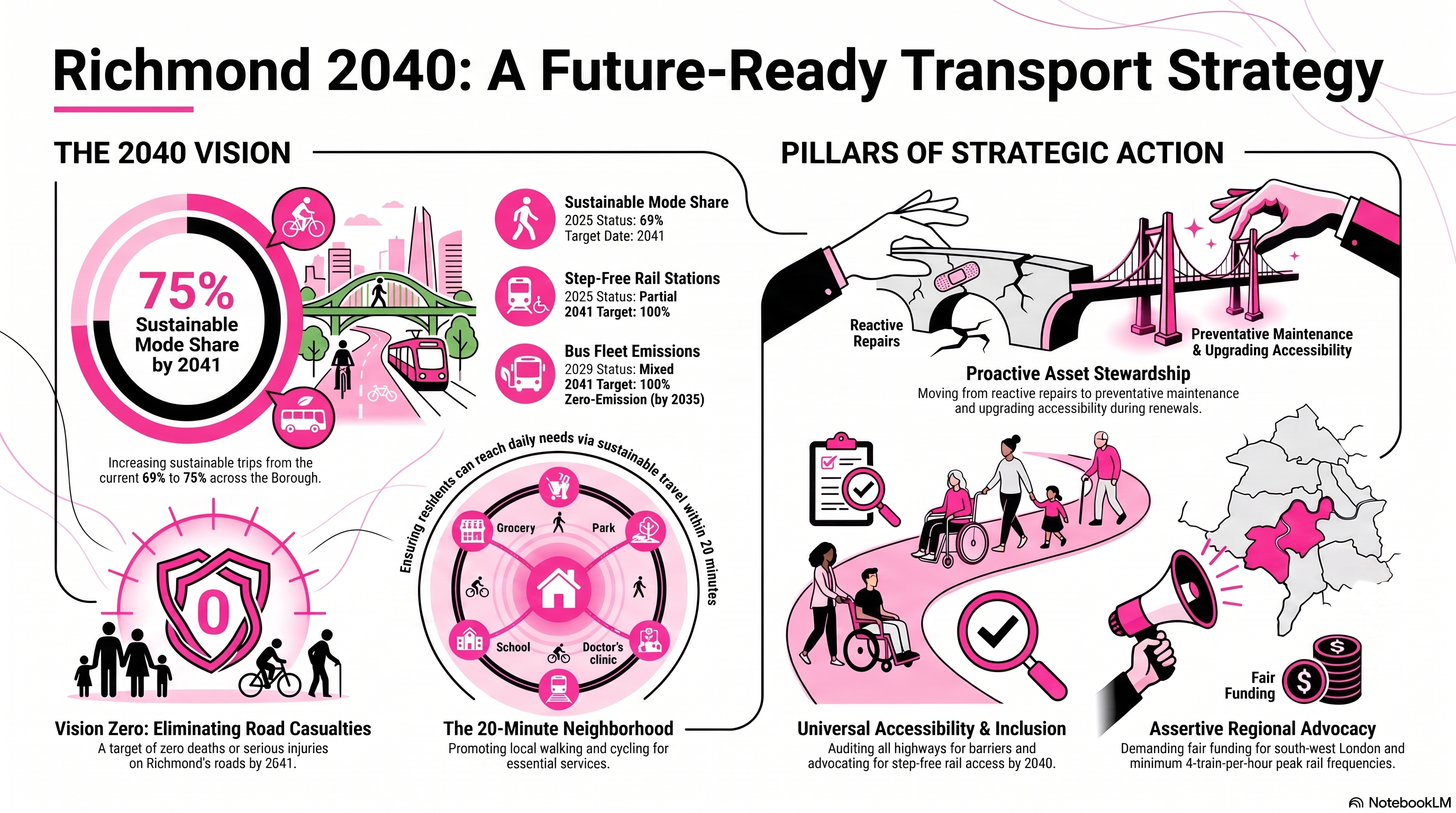
The strategy says in 2025, 69% of trips made in the borough were by sustainable modes - public transport, walking, wheeling or cycling. The goal for 2041 is 75%, reflecting the direction set by the Mayor’s Transport Strategy.
This new strategy signals a turning point and marks the start of our journey towards better connectivity and more sustainable and reliable transport that all our residents can access
Councillor Alexander Ehmann, Deputy Leader and Chair of the Transport and Air Quality Committee
From maintenance to stewardship
The council is proposing a noticeable shift in how it manages transport infrastructure.
Rather than simply repairing assets when they fail, it wants to protect and improve them over the long term.
Its proposed ‘Repair for Good’ approach argues that repairs should be carried out to the highest practical standard and at the earliest opportunity, rather than relying on repeated short-term fixes.
A long list of practical commitments
The strategy is (reassuringly) full of practical commitments. Among them,
achieving Vision Zero by eliminating deaths and serious injuries on the borough’s roads by 2041;
expanding electric vehicle charging so every resident is within a five-minute walk of a charge point;
campaigning for at least four trains an hour at peak times from every local station, alongside better reliability;
creating a borough-wide walking network and connected protected cycle routes linking town centres, schools, parks and stations.
More revenue from government and private business .. and perhaps residents
The strategy makes clear that future transport investment cannot rely solely on council budgets.
Private developers, it says,
Private developers will be expected to contribute to the infrastructure necessary to accommodate the Borough’s sustainable growth and add value to their investments.
It also expects newer transport businesses to contribute.
New transport markets, like e-mobility providers and electric vehicle chargepoint suppliers will be expected to provide both quality services to users whilst reinvesting a proportion of revenues into the Borough’s transport offering
(Some) residents could be paying more, too.
The Council will also set fees and charges for transport services such that those that cause greatest impact on the transport system and environment should expect to pay most.
It doesn’t spell out what that means in practice.
SUV parking surcharges, anyone?
Hammersmith Bridge
... features as a case study in what happens when strategic infrastructure is neglected.
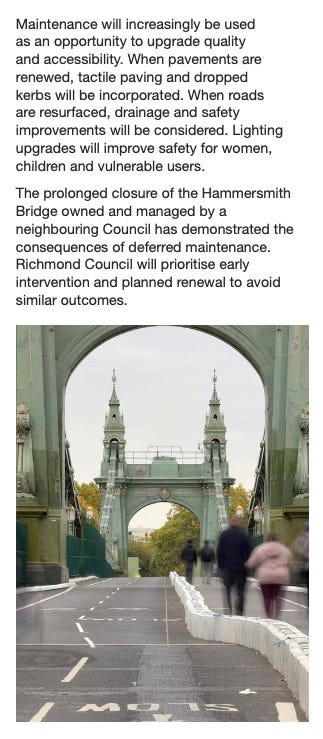
The emphasis is overwhelmingly on political leadership and institutional failure.
Wise south of the river, less so to the North.
Improvements are needed across Richmond upon Thames, but our investment will focus on those areas where the connectivity gaps are the greatest.
Richmond council 2040 Transport Strategy
Barnes not mentioned
The maps throughout the strategy tell an interesting story.
Barnes should benefit from many borough-wide improvements, but additional attention and investment will largely be directed towards places with the weakest transport connections.
The strategy says:
We will ensure that neighbourhoods with the poorest public transport accessibility — including Ham, Hampton, Heathfield and Whitton — are supported by detailed local plans, clear prioritisation frameworks and persistent, evidence-based advocacy for funded delivery. Indeed explicitly, equity drives investment
A change of posture
One of the most striking aspects of the strategy is its tone.
The council argues today’s transport challenges
are not the result of geographic inevitability. They are the result of prioritisation decisions.
Insufficient or unreliable transport services create a vicious cycle: poor service reduces demand, which in turn leads to further service cuts.
And concludes:
The Borough’s future case must therefore be articulated more strongly, not more modestly.
The implication is clear.
Rather than waiting for opportunities, the council wants to create them.
It intends to build a pipeline of transport business cases so schemes are ready when funding becomes available.
It describes its future role as being a ‘persistent advocate and constructive challenger’ with regional partners including TfL and Network Rail.
Or, in its own words, becoming
...organised, evidence-driven and assertive.
Notes and thoughts
There’s much to like about this strategy.
Its very existence is welcome: this is the borough’s first transport strategy designed to look well beyond a single election cycle.
For Barnes2050, though, this is only the beginning.
The strategy needs to be tested, asking what it means specifically for Barnes and whether its ambitions translate into meaningful change on the peninsula.
Perhaps with a posture that be described as:
organised,
evidence-driven,
and assertive.