

Occasionally you get a glimpse of a future. A decision by a business or government. A news headline. A chance conversation. Freshly published research.
Barnes2050 collects these.
They are not predictions. They are nudges. Signals.
What might this mean for Barnes SW13? What can we learn from them? Which should we resist?
Here are selection of stories from September, the month the 2026 hot summer broke. They suggest climate adaptation, ageing infrastructure, transport transition and constrained local government are beginning to collide in Barnes.
The stories this month,
Planet earth is on track to break 1.5ºC threshold
Another London Bridge might have to close
Why buses are slowly across London
The triple demon posed by e-bikes and what we might do about them
The discussion about robotaxis moves being just about safety
Richmond council’s walking and cycling strategy
Once more Barnes might learn from Putney, this time for its future dock*
Heathrow Airport’s expansion has a difficult month
Leg O’Mutton joins the natural landscape which will be used to protect Barnes from flooding
Richmond council plans for losing over half of its core funding over the next four years
Bitter sweet reflections on poverty in Barnes.
Let’s start with the climate.
Welcome to Barnes2050, a place-based futures project asking: how do we help Barnes - the place and its people - thrive and be climate-ready by 2050? If this is your first visit, you might want to start here.
Climate
Europe’s hottest summer on record. A collapsing glacier in Nepal. Wildfires and droughts and freakish storms around the world
That’s what 1.5 degrees Celsius in warming above preindustrial levels looks like. It’s a number I found difficult to wrap my head around until a climate expert explained it to me this way: Imagine your body temperature going up by 1.5 degrees. You feel unwell. Now imagine it rising by 2 degrees — you’re seriously ill.
New York Times (free link, gift) reports on the shift in political language from climate change to energy security as scientists warn the world is now likely to cross the 1.5ºC long-term warming threshold.
Meanwhile the Ursula von der Leyen, President of the European Commission, said in her state of the EU address said,
These were the hottest summer months ever - but probably the coolest of the years to come.
Science is clear.
Europe is warming at double the global rate.
Against that background, Prime Minister Andy Burnham recommitted to achieving Net Zero by 2050.
The effects of the 2026 heatwaves are being totted up.
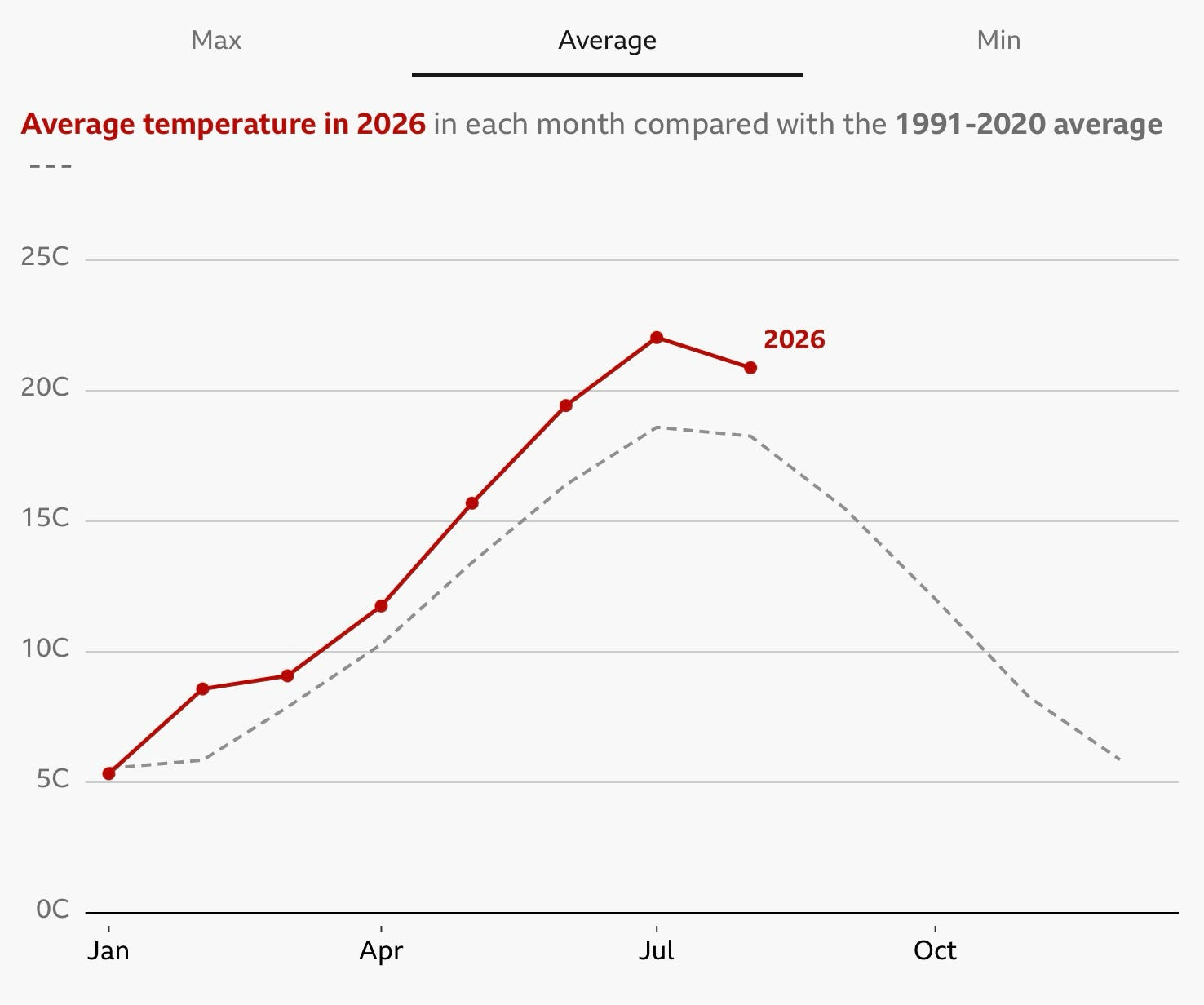
BBC News created a simple tool to show how hot and dry was your summer. Enter a postcode and it tells the story. For Barnes SW13,
The average daily high during June, July and August was 26.8C, according to provisional Met Office data.
This is 4.2C above the long-term summer average between 1991 and 2020.
Your area had about 35 days above 28C, the local temperature threshold for a heatwave.
Each of the statements is backed by data and graphs.
For rainfall,
Approximately 90.6mm of rain fell in your area over three summer months.
This is roughly 38.6% below the long-term summer average between 1991 and 2020.
Meanwhile, Transport for London said the hot summer hit revenue. It turns out if if the tube and the bus networks are uncomfortably hot, people will stay at home or get on a e-bike instead.
Lea & Sanderson might feel better though. English winemakers are expecting a ‘vintage year’ but there’s no cheer for beer makers.
The reason to dwell on the experiences of 2026 is to make sure we learn from the experience. If all we do is heave sigh of relief and then move on to the next season, we will find in the same, or maybe a worse, position in 2027.
For Barnes, that makes shade, trees, cooler homes, water management and heat-resilient public transport increasingly look less like nice-to-haves and more like infrastructure.
And with that in mind, here is the forecast for Barcelona, Spain for the week ahead.
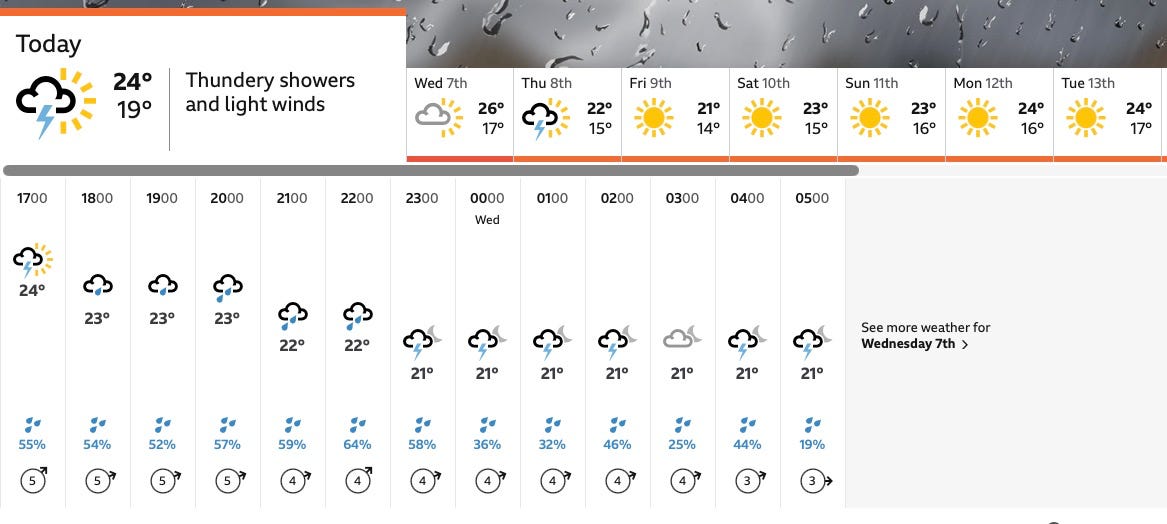
Remember, Barnes climate in 2050 could feel more like Barcelona’s today.
Infrastructure
Another London bridge might have to close.
Waterloo Bridge could be forced to close ‘within four years’ with major repairs needed, reported The Standard
An inspection of the bridge found water damage and cracks as wide as 2 millimetres (0.08 inches), Westminster City Council said in a funding-bid document which Bloomberg obtained in response to a Freedom of Information request.
The Londoner says,
Its near century-old stone frame, the reports suggest, is struggling to cope with years of heavy traffic and increasingly extreme weather (it’s amazing some of the unexpected ways climate change is having an impact, eh?)
So far familiar and increasingly alarming. Hammersmith Bridge, Albert Bridge and Vauxhall Bridge have already demonstrated how major London bridges can require expensive repairs, restrictions or closures..
Then comes two important riders.
The council are now asking for £6million to fund repairs.
And guess where they’ve turned for help? That’s right, the UK Government Structures Fund.
Transport
Buses
Excellent summary from The Guardian about why buses are slowing.
Research from Transport for London (TfL) suggests a 10% fall in speeds leads to a 6% drop in demand. Demand falls and bus services are consolidated. Reduced
At least the Mayor has confirmed every London bus driver’s cab will have air conditioning by 2027.
E-bikes
Another important part of the 2050 transport mix in Barnes - e-bikes - have come under further scrutiny in September.
A third of the 1,500 Forest e‑bikes in Richmond are to be fitted with identification plates in an attempt to track down cyclists in the event of an incident or parking issue, reports The Standard.
When is an e-bike not an e-bike? When it has a powerful, illegal engine. Get this menace off our roads
Peter Walker, The Guardian
You can read about e-motos, reckless riding and anti-social parking here.
Resolve the illegal bikes. Punish the reckless and anti-social behaviour. And a deeper challenge with e-bikes remain: the redistribution of road space away from private cars and towards bus passengers, walkers, wheelers and yes, riders.
Robotaxis
It’s less obvious the scale and impact of robotaxis, or shared automated electronic vehicles, will be.
But September was a big month for discussion.
Why the battle for London’s robotaxis is so important (Times, ££ Paywall). TLDR if they work here, they can work almost anywhere
Wayve vehicles being used through Uber have been licensed by TfL as private-hire vehicles, although they still require safety drivers.
TfL says no robotaxis have been approved by the Driver and Vehicle Standards Agency yet
When do they, it is possible we’ll be living through the Congestion Paradox.
This sounds like a third rate east European sci-fi movie. In fact the Department for Transport scenario modelling suggests highly automated driving could bring a 24% rise in road miles by 2050, with significant effects on congestion and road speeds.
AVs are unlikely to reduce urban congestion merely by entering the vehicle fleet. Until they reach sufficient scale and are shared, pooled and regulated, they may generate more traffic than their driving efficiency removes.
This infographic from Adam Tranter, BikeisBest explains the maths.
And that makes this a very Barnes question. Do robotaxis eventually replace parked private cars, buses and some journeys on foot or simply put more vehicles onto already crowded roads?
Walking and Cycling in Richmond borough
Richmond council agreed how they are going to create the next Walking and Cycling Strategy.
This will cover the five-year period of 2027 to 2032 and is one of the major works flowing from the council’s new Transport Strategy.
This work will feature regularly in the coming year.
For now, one key point is worth repeating. Recalling Richmond’s successes highlighted in the 2026 Healthy Streets Scorecard, Barnes2050 believes
Perhaps the next chapter in Richmond’s transport story is no longer about persuading people to walk and cycle.
Perhaps it is about building a borough that better reflects how people are already choosing to travel.
River services
Looking to the day when Barnes might enjoy a regular river bus service, there may be lessons from Putney available on how to build a new river dock.
Heathrow airport
Since the public consultation on the proposed third runway closed there have been at least three significant stories,
Climate Change Committee says Heathrow expansion is not compatible with the UK’s Net Zero policy under current policies
If approved, the projected opening of the third runway has slipped another four years, until 2039.
Prime Minister Andy Burnham refused to back a third runway for Heathrow
Landscape
Richmond council approved a flood resilience project for Leg O’Mutton
This project is part of the Community BlueScapes initiative which uses nature-based solutions to improve flood resilience across the Beverley Brook catchment.
It has UK Government funding through DEFRA and is a partnership between between Richmond council, Barnes Common Ltd and WWT, the charity for wetlands and wildlife.
The Leg O’Mutton work will enable the lake to store surface water when heavy rainfall coincides with high Thames tides.
The council paper explained the particular nature of the flood risks facing Barnes.
Heavy rainfall can overwhelm the drainage system. High Thames tides can prevent Beverley Brook discharging into the river — ‘tide-lock’. High water levels can also prevent surface-water sewers from discharging, pushing rainwater back through road gullies.
In other words, several different systems can fail at once.
As the council paper puts it,
These interactions mean that the highest risk of flooding in the area occur during heavy rainfall events that coincide with high tide. This was memorably demonstrated in July 2021, where the Barnes Green area was most affected and areas of North Barnes also flooded.
This is what climate adaptation looks like at the hyperlocal level: not simply preparing for more rain, but understanding how rain, rivers, tides, drains and landscape interact in one particular place.
Greater London Authority (GLA) have published a detailed tree map of London showing that without further climate mitigation and adaptation, more than 72% of London’s current public realm tree population may struggle under future climatic conditions.
These are the detailed reports for Barnes ward and Mortlake and Barnes Common ward.
The allotment-lover in me was taken by a Hackney council initiative called Right to Grow, which gives residents the chance to repurpose suitable council land into community growing spaces for fruit, vegetables, herbs and flowers.
Maybe Castlenau Park should be a collection of allotments and growing beds?
Governance
Councillor Jim Millard, Deputy Leader and Finance and Resources Lead Member, introduced the council-wide Transformation Programme. This is the centre piece of the council’s challenge of a £29 million annual cut to core funding over three years. This is over half of its core funding and the largest percentage reduction in London.
The reduction follows a change to the way the UK Government funds English councils. The new system directs more money towards places judged to have greater need and less ability to raise money locally.
That creates winners and losers. London boroughs including Richmond, Wandsworth and Westminster are among the losers partly because the new formula assumes greater ability to raise revenue locally.
Their costs, however, have not disappeared.
Social care, housing, SEND, waste collection, streets and parks still have to be paid for and many costs are rising.
The result: less government funding, rising costs and sizeable holes in council budgets. Richmond council’s full response is here.
This new programme aims to deliver £39 million in annual savings by its fourth year and focuses on prevention, early intervention, better use of technology, streamlining processes, and optimising assets.
Across the borders other London councils are having to cope with the effect of this UK Government decision
Hammersmith and Fulham council says it warns it may have to increase council tax by 150% to maintain current services, reports The Guardian
Wandsworth council plans to nearly double council tax from April 2027. This report from PutneyNews explains the background to this decision.
Lifestyle
Child poverty
A bitter sweet chart to end this summary of September that offers us a glimpse of the future.
The Trust for London has produced a new way to unearth data about who lives in the capital’s 75 parliamentary constituencies.
London’s Poverty Constituency Tracker allows you to compare how London’s constituencies compare across living standards, health, education, employment and more.
This first chart shows the number of children in poverty by London constituency. Barnes is in Richmond Park, the yellow bar in the far right corner.
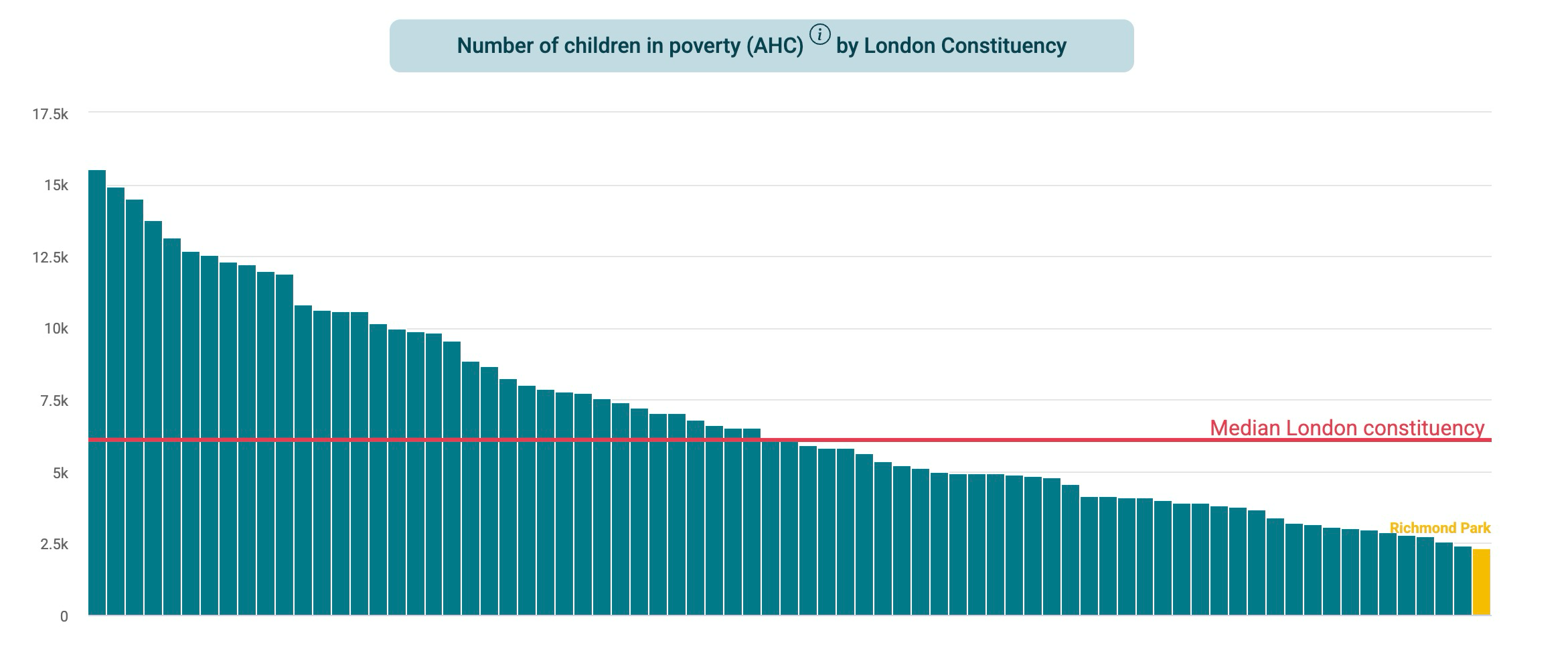
A bitter sweet result.
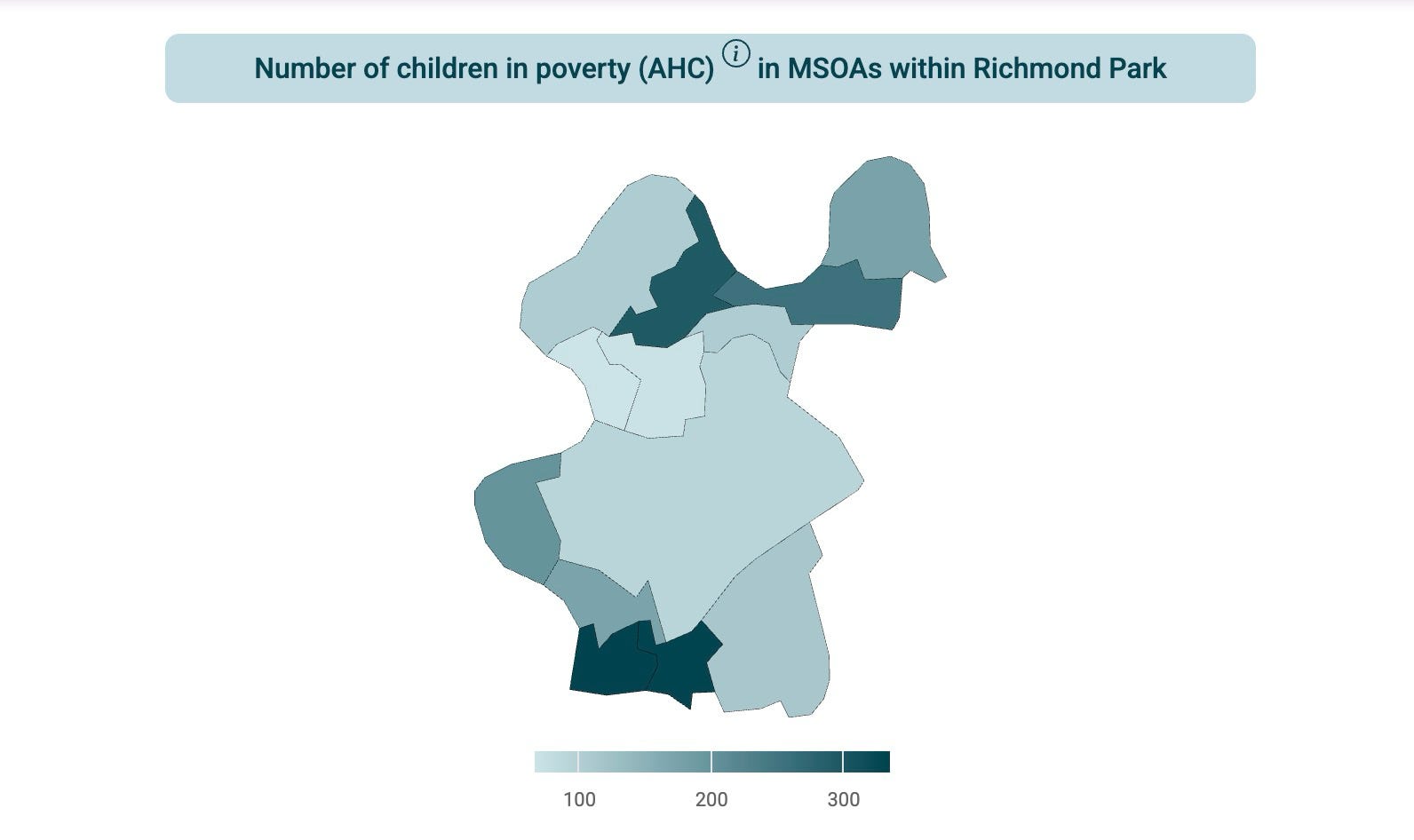
Here’s the detailed map for Richmond Park. The distribution is probably what should be expected: even relatively wealthy parts of Greater London have inhabitants who struggle to make ends meet ,and that hardship is unevenly spread.
Which of these stories will matter in five years?
Most weak signals disappear. A few turn out to have been early glimpses of something much bigger.
The useful thing is to notice them.
You can read back-issues of this take on the recent news relevant to future Barnes here.