

Barnes2050 believes we should design Barnes for people first, not cars.
Much of the thinking about this has has been about how we move around the peninsula: Hammersmith Bridge, School Streets and pedestrian pop-ups.
But there is another question,
What about cars when they aren’t moving?
They occupy public space. And, increasingly, they occupy quite a lot of it.
Which makes a recent change introduced by Bath & North East Somerset Council relevant to Barnes SW13.
You could call it an ‘SUV charge’.
But it is much better than that.
Welcome to Barnes2050, a place-based futures project asking: how do we help Barnes - the place and its people - thrive and be climate-ready by 2050? If this is your first visit, you might want to start here.

How much?
Bath now asks two questions about a resident’s car when calculating the price of a parking permit:
How much does it pollute?
How much street space does it occupy?
The first establishes the baseline price. Bath doesn’t simply distinguish between electric, petrol and diesel cars. The charge rises through a series of CO₂ bands: the more CO₂ a car emits, the higher the starting price. Diesel cars pay a further premium because of their impact on local air quality.
Then comes something new.
Bath calculates the physical footprint of the car, its length multiplied by its width, based on manufacturer data and including its extended mirrors. Small cars get a discount. Bigger cars pay progressively more for their first permit.
So an enormous electric car can pay more than a small electric car despite both producing zero CO₂ emissions.
A second car attracts no small-car discount and a much larger size charge. Bath also wants to discourage multiple vehicles per household.
In case you are wondering, Bath says Blue Badge holders living in an affected area are entitled to a free permit and aren’t affected by these size charges.
Why are Bath doing this?
The argument for these changes isn’t primarily climate-related. It’s about street space and safety,
To support public health and the safety of pedestrians, we already link the cost of parking permits to a vehicle’s emissions.
By also linking permit costs to the size of a vehicle, we encourage ownership of smaller vehicles that reduce risks for pedestrians and cyclists.
There is a reason this is becoming an issue. Cars have been getting bigger, says the council
SUVs became the most popular car type in the UK in 2024, accounting for over 60% of all new car sales, a significant increase from less than 50% in 2020.
Bigger cars take up more road and kerb space. They can reduce visibility. And their greater size and weight can increase the consequences of collisions with people walking and cycling.
Bath’s answer is to put a price on both things.
The growth of SUVs has come despite warnings over ‘carspreading’. Research has shown cars have grown 1.2cm longer, 0.5cm taller and 0.5cm wider each year on average since 2000 and that buyers are undeterred by warnings that SUVs are more likely to kill pedestrians.
How does this works in practice?
The easiest way to understand the policy is with actual cars.
Start with three electric vehicles.
All three produce zero CO₂ emissions from the exhaust, so all start from Bath’s £120 basic permit emissions charge.
What changes the price is their size as the table below shows.
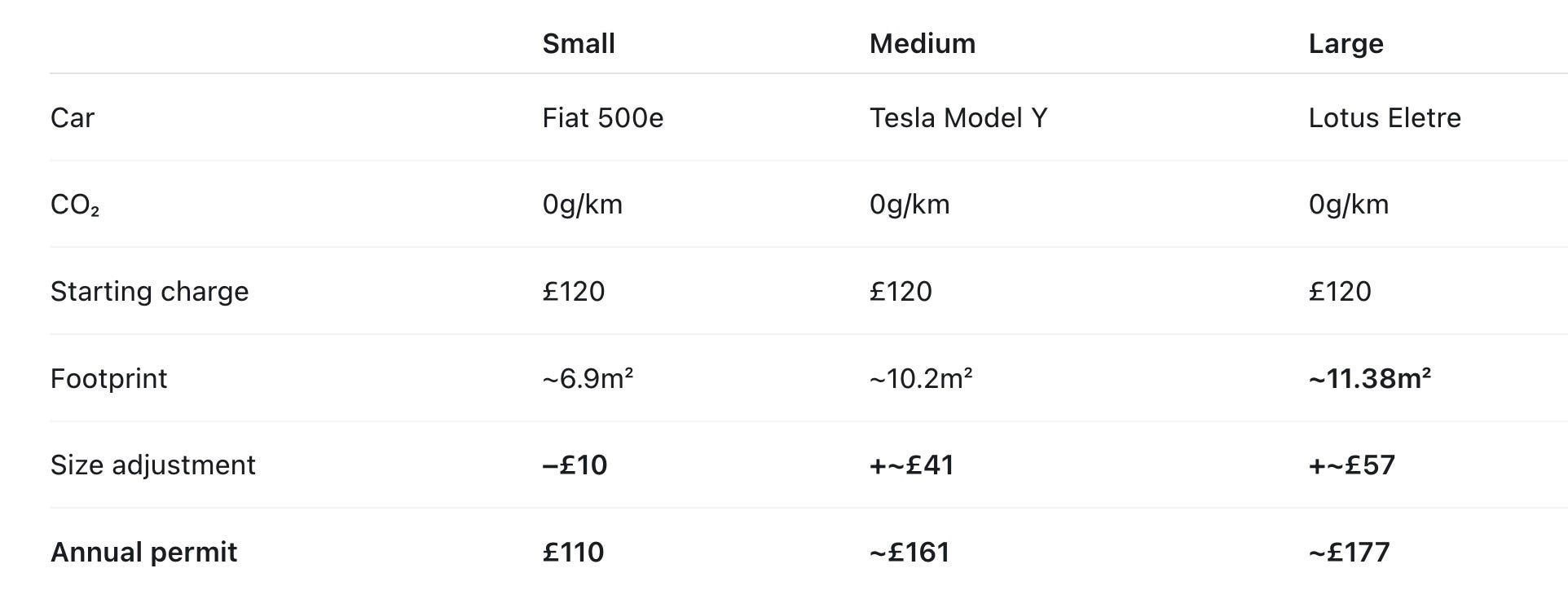
That is a £67 difference between two zero-emission cars simply because one occupies considerably more street space.
Same emissions. Different footprint. Different price.
Now turn the experiment around.
Take these three BMW models with almost exactly the same physical footprint: an electric iX1, petrol X1 and diesel X1.
Their size charge is therefore essentially identical, costing about £28.
What changes the price of the parking permit is their pollution charge.
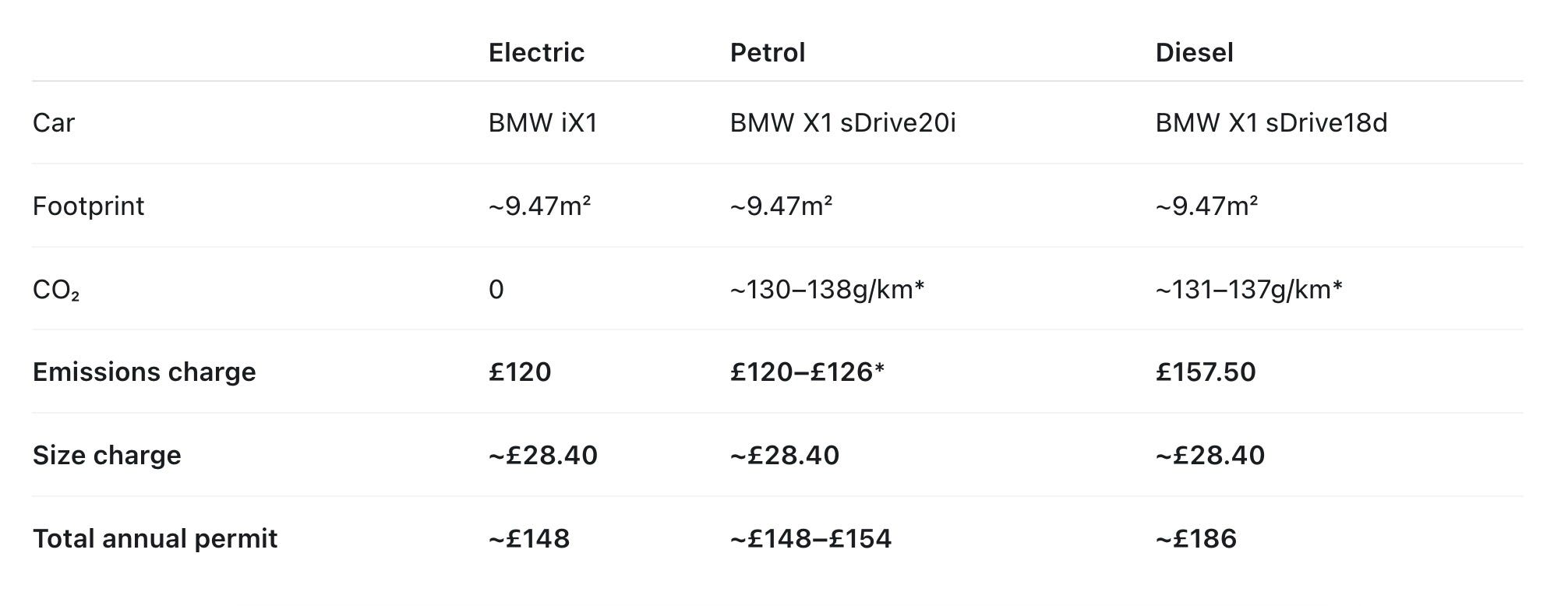
In this case the £38 price differential is the result of pollution.
Same footprint. Different exhaust emissions. Different price.
Put the two explanations together and Bath’s system becomes surprisingly simple:
Bigger cars pay more. More polluting cars pay more. If your car is both, you pay for both.
Notes and thoughts
This approach feels particularly relevant to Barnes.
Barnes2050‘s people-first principle isn’t simply about making it easier to walk or cycle. It raises a more awkward question about cars,
How much public space does your car consume?
That matters particularly in Barnes with its frequently narrow streets, constrained kerb space and high levels of car ownership.
A parked car is, after all, private property occupying public land.
Bath has decided that the price of doing so should partly reflect the nature of that occupancy.
Barnes2050 agrees. That is why it supports an SUV parking charge. Bath council has provided one way of making this happen.
Political leadership
There was a public consultation about this proposal. The size-based proposal wasn’t universally popular, but neither does the evidence suggest overwhelming opposition.
The consultation attracted 490 responses; 50% supported it and 44% opposed it.
There is a lively Bath Reddit discussion which is also not representative but useful.
Several highly upvoted comments strongly welcomed charging larger vehicles more because of space, safety and environmental impacts.
Others thought the additional sums were too small to change car-buying behaviour.
There were also objections from people saying they genuinely need larger vehicles — including one commenter describing needing a wheelchair-accessible vehicle.
Bath & North East Somerset Council, which has a Liberal Democrat majority, went ahead with the changes at the end of August, 2026. The Liberal Democrats dominate the council, holding 38 or 64% of the 59 seats.
Barnes2050 believes leadership, especially political leadership, has an outsized role to play in helping Barnes come to terms with the changes needed to thrive in the climate to come. Between now and 2050 they are going to be presented with several opportunities to make a progressive decision.
This is one of them.
Richmond council should learn from its political colleagues in Bath and implement something similar across the borough.
If - when? - they do, they can return the favour by sharing an easier to use online way of applying for a permit. The Bath council website is (unnecessarily) bad.
Is the price high enough?
This is where things get more interesting.
Our two electric examples suggest a Fiat 500e would cost roughly £110 a year to park, compared with about £177 for a Lotus Eletre.
Would someone buying a £85,000 luxury EV change that decision because their residents’ permit costs another £67 a year?
Perhaps not.
Early discussion of the policy in Bath has raised exactly this issue: the differential may simply be too small to change behaviour.
That deserves another story.
So does an even more fundamental question: what should it cost to occupy a piece of public street in Barnes for a year?
My space in a bike hangar costs me nearly £72 annually. A residents’ car-parking permit can cost less, £68.50 in some Richmond CPZs.
I have no beef with paying to store my bicycle there. The hangar has to be provided and maintained.
The interesting question is the other way round.
Why is storing a car on public land so cheap?
That is for later.
For now, Bath has done something worth watching.
It may have created a model more powerful than the price signal it has attached to it.
Continue exploring: Designing Barnes for people first, not cars
Barnes should be shaped around people living, working, playing and belonging, not chiefly around the movement and storage of cars.
More stories about designing Barnes for people first, not cars.