

This week has been all about the name. The project is becoming Barnes2050. You will see that name appearing across the journal, although, as of Sunday 26 April, a few old links and references remain. Digital tidying is never quite as glamorous as strategic clarity.
Please bear with me while I work through them. If you spot an old or broken link, email me and I will fix it.
Welcome to this weekly digest of stories and signals about future Barnes.
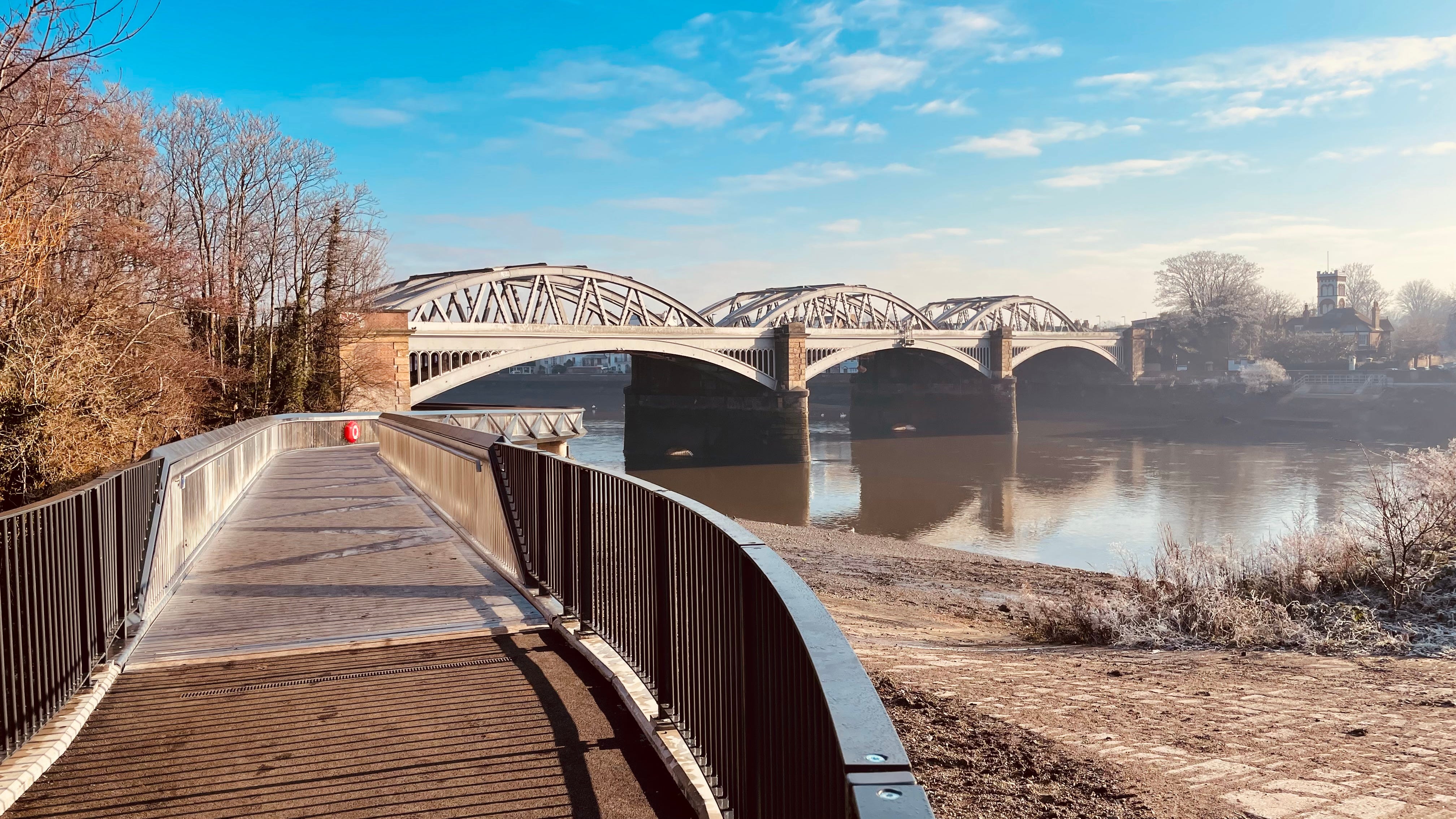
Transport - Hammersmith Bridge
A fourth Commons debate on Hammersmith Bridge revealed more details about the UK Government’s (UKG) approach funding a potential restoration of vehicles.
Simon Lightwood MP, the transport minister, set out the timetable for the UKG’s £1billion Structures Fund. Draft applications must be submitted by 19 June, with final bids by 3 August. Funding decisions will be made in the autumn, and all successful schemes must complete works by March 2030. As FulhamSW6 reported,
added that a local contribution would still be required, but not necessarily the three-way split between the Government, Transport for London and Hammersmith & Fulham Council proposed under the previous administration.
A few other things emerged.
The roughly £50 million already spent by Hammersmith & Fulham Council, the bridge’s owner, would be recognised in some way.
Officials have been working with key stakeholders on viable engineering options.
The next Hammersmith Bridge Taskforce meeting is expected after funding awards are made.
The bridge was again described as a good candidate for the fund, but not a special case.
the Minister repeated his remarks the Bridge is a good candidate for the fund though he stressed,
he stressed that it would be assessed under the same criteria as all other bids.
Why it matters?
Politicians continue to frame this topic by cars and cash. How quickly can vehicles be restored to the Bridge? And who else is going to fund that? ‘Who else ‘because although all Labour, Liberal Democrat and Conservative politicians want to see it restored, no-one want it enough to fund it. The UKG are funders of last resort. With this annoucnment they are saying, we will contibrute but others will too. How much do those parties want to contribute will become clearer in the autumn?
The other potential other funders make for an intriguing listL Wandsworth council who have previoiusly refused; Richmond council who coping with a huge cut in UKG funding; or private investment. If any of these result in tolls being required, then
One other thing - ‘All vibe and no data’. Anecotes, rhetorical flourishes are necessary but not sufficient. The Task Force promised a shared bedrock of data. Will that feature in the investment process?
Transport - Forced experiment
Forced experiments continue to change London’s transport mix.
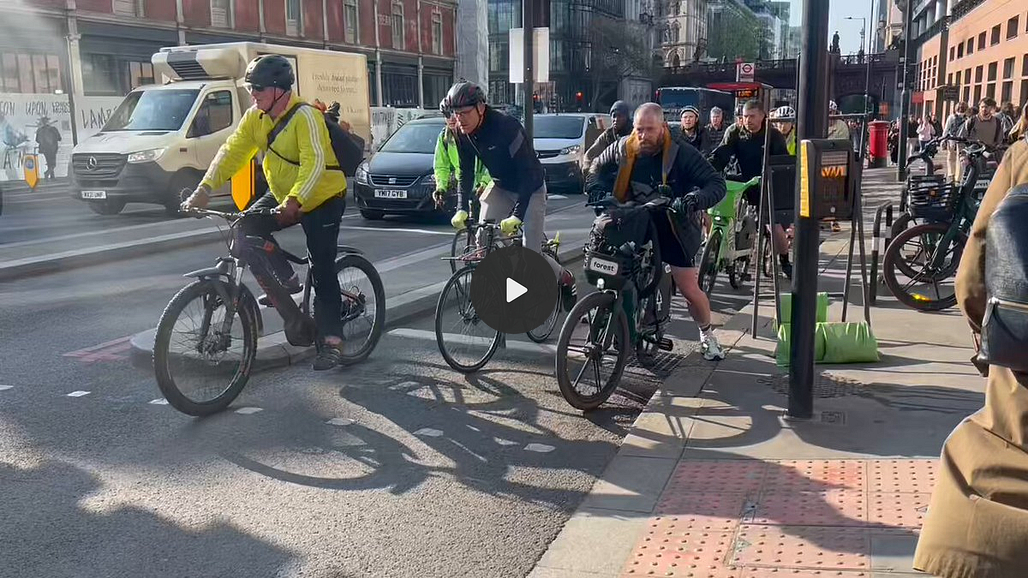
Bike operators Voi and Lime reportedly saw usage on Tuesday 21 April, an RMT strike day, rise by 52% and 23% respectively compared with the previous week. Transport for London’s cycle hire scheme saw a more modest 14% boost.
Carla Francome captured what this meant at a central London junction.

More widely, BikeIsBest reports that as fuel prices rise, so does active travel. A YouGov survey for Cycling UK of more than 2,000 adults found that almost 30% of drivers were walking or cycling more, with another 15% considering it.
There is a but.
Seven per cent of women had bought a new bike in response to fuel prices, compared with 13% of men.
Why it matters
Forced experiments can have lasting effects. The Quarterly Journal of Economics, quoted by Nick Miani, provided evidence of how the London Underground strike changed some travel patterns.
They found that about 5% — one in 20 — of affected commuters permanently switched to their new route after the strike ended, and that the time saved in the long term by those who found better routes actually outweighed the time lost by all commuters during the strike itself.
On one level, moving people from one form of sustainable transport — trains — to another — bikes — does not directly reduce our dependency on cars.
But more bikes still matter. They make streets feel more active, visible and people-first.
They also build habits. And habits are how transport systems shift.
There is one huge forced experiment that should be recognised as such by the UK Government: Hammersmith Bridge being open to pedestrians and cyclists, but not to motor vehicles.
The public data available suggests that experiment is working, at least if the measure is reduced traffic pressure through Barnes.
The question is whether government treats the past five years as an interruption, or as evidence.
Transport - Growing bike network in west London
Meanwhile, London’s cycle network continues to grow.
This video tells the story of west London’s cycle infrastructure.
Why it matters
With Hammersmith Bridge not allowing cars, there is a tendency to think of it mainly as protecting Barnes from 20,000 cars hurtling through the area.
That is valid, but inward-looking.
The bridge is also a gateway to a cycling network that is growing each year.
This film shows that the area around Hammersmith is getting better cycling infrastructure, which means crossing the bridge and heading north or west becomes easier and safer.
That matters because Barnes does not only look towards Richmond. Many daily journeys point north and west: to Hammersmith, Shepherd’s Bush, Fulham, Kensington and beyond.
This is one lesson from the Richmond town centre discussion. The borough map says one thing; everyday life often says another.
Dedicated cycleways address one of the biggest reasons people reject cycling: safety.
Other stories this week
Forest e-bikes are now expected to arrive in Barnes in June, replacing Lime bikes under Richmond council’s new borough-wide arrangement.
Lessons from Luxembourg? Probably not directly. But it is still useful to notice the lengths some places will go to when they decide transport has to change. Luxembourg became the first country to make public transport free nationwide.
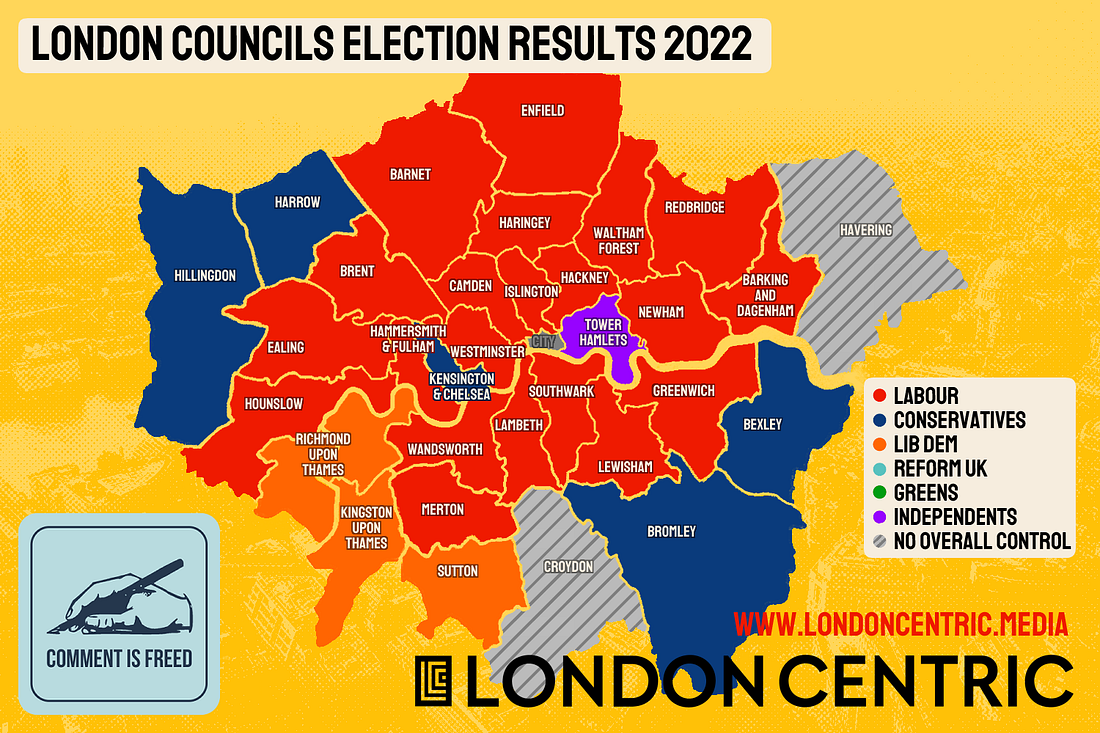
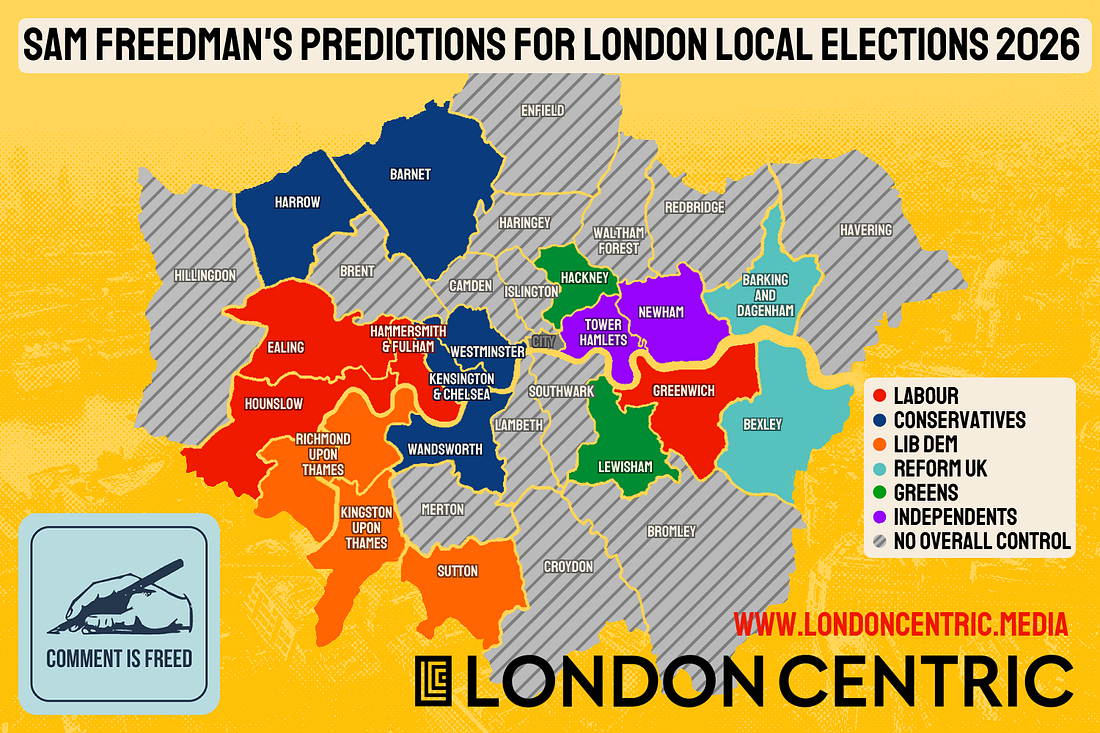
Governance - More leaflets and another candidate knocking on the front door. Local elections on Thursday 07 May are edging closer. London Centric’s forecasts, based on the most recent polls, suggest the result will be no changes on either Surrey and Middlesex banks of the Thames in Barnes. Neighbouring Wandsworth may be more interesting.
Civics - The next Barnes Town Team meeting takes place on Wednesday 13 May at 6:30pm at the Barnes Green Centre. There’ll be updates on all the Barnes Community Association Ponder projects including the new Barnes website - the Barnes Hub. See you there.
The following night ..
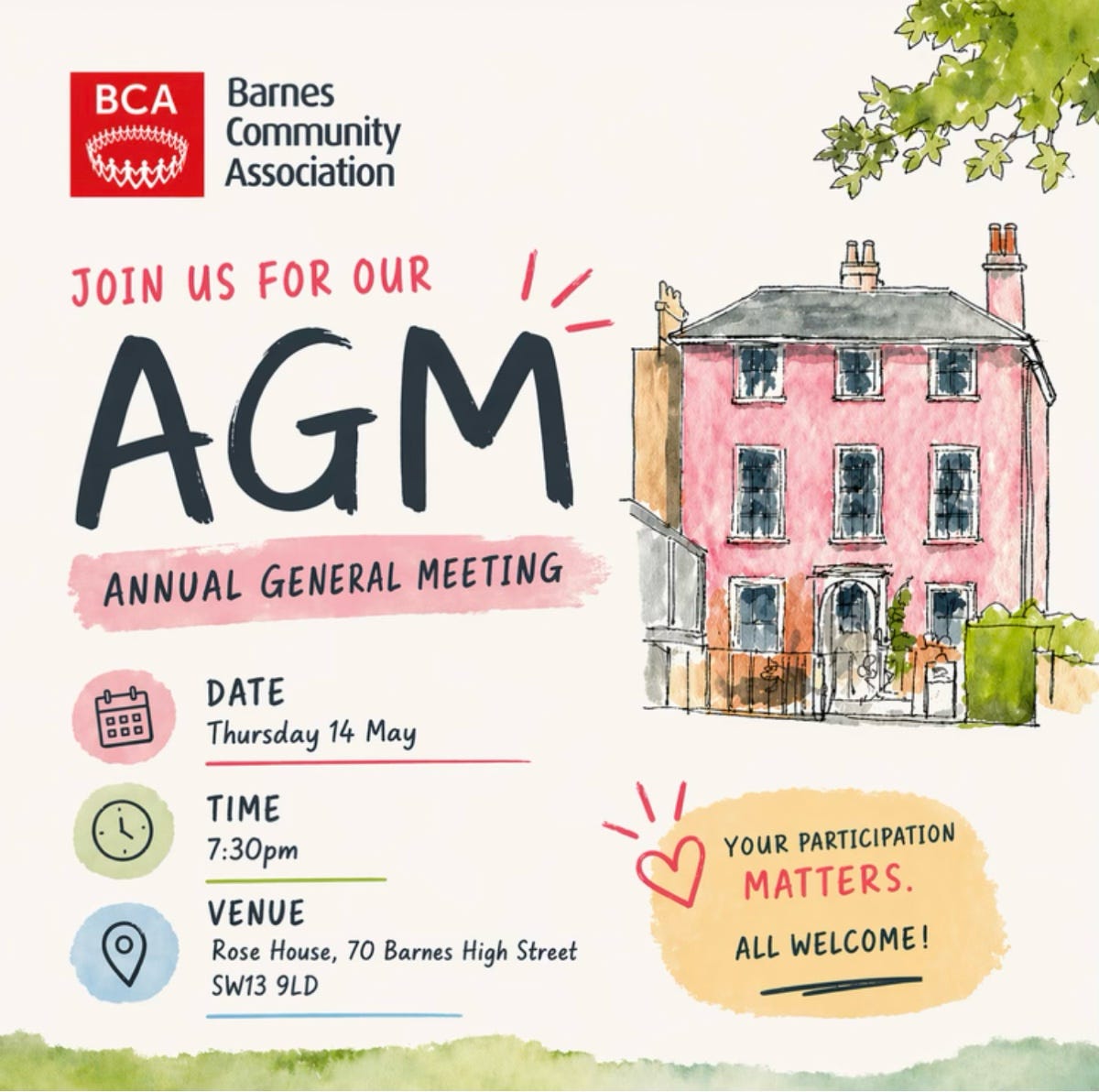
The meeting is open to all residents but only BCA members may vote. There’ll be business and wine, which should mix well.
BCA Ponder and me: yes and ..

This matters to me. I didn’t realise how much until I began writing this post.