


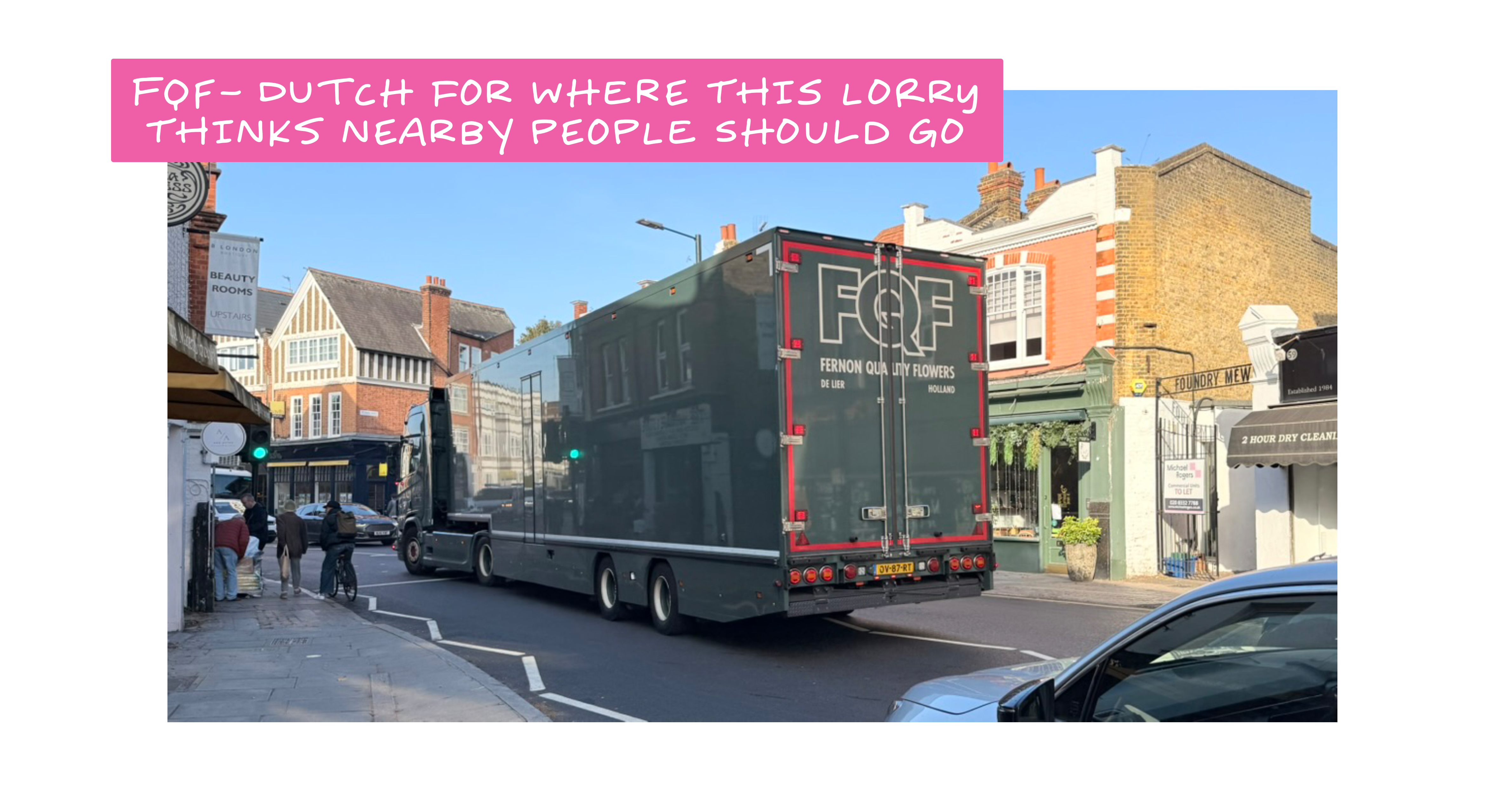
The flowers did it for me. Or rather the shock of the huge delivery lorry crawling along the High Street to bring them to Barnes. That got me thinking.
Then a few days ago, walking along Oxford Street, newly pedestrianised, I wondered should we do the same in Barnes?
My first thought was no.
And that surprised me.
I’ve argued for a Hammersmith Bridge permanently free of private cars, better walks around the peninsula and more buses. Yet here I was, trying to work out how to get rid of that oversized lorry and keep the flowers.
I don’t want to pedestrianise the High Street. Not now and never permanently. But there are afternoons when I’d happily walk down the middle of it.
Richmond council got there first
Richmond council‘s Local Plan, adopted in October 2025, says it wants to ‘enable future pedestrianisation of A3003 in Barnes centre’. The aim is to make the centre easier to get around on foot and give traffic less sway. In other words, room to linger on a street whose narrow pavements have mostly been somewhere to get through.
The same plan wants Barnes, the biggest of the borough’s local centres, to keep its independent shops and everyday needs within easy reach. That’s the council’s ‘living locally’ idea, sometimes called the 20-minute neighbourhood.
Fuelling this is the Mayor’s Transport Strategy that wants 80% of trips in London made on foot, by bike or by public transport by 2041. Richmond’s own target is 75%, up from 69%. The council’s Transport Strategy 2040 says better travel choices should cut congestion and support local high streets.
So the direction of travel is clear. More emphasis on strengthening the local and a shift in balance between the driver and others. Given the importance of Barnes High Street to SW13, it should play a bigger role in that shift over the next two decades.
Welcome to Barnes2050, a place-based futures project asking: how do we help Barnes - the place and its people - thrive and be climate-ready by 2050? If this is your first visit, you might want to start here.
The case for bustle
The plan leaves open how much of the High Street might be pedestrianised, when it might happen and whether the buses would stay. Presumably there’s someone from the council working on that.
The largest definition of the centre is probably the stretch from The Terrace and Lonsdale Road to the junction with Station Road. From Thames to triangle if you will. The challenge with this approach is how people would reach their homes via Terrace Gardens and Stanton Road. A shorter stretch would treat those as ends points.
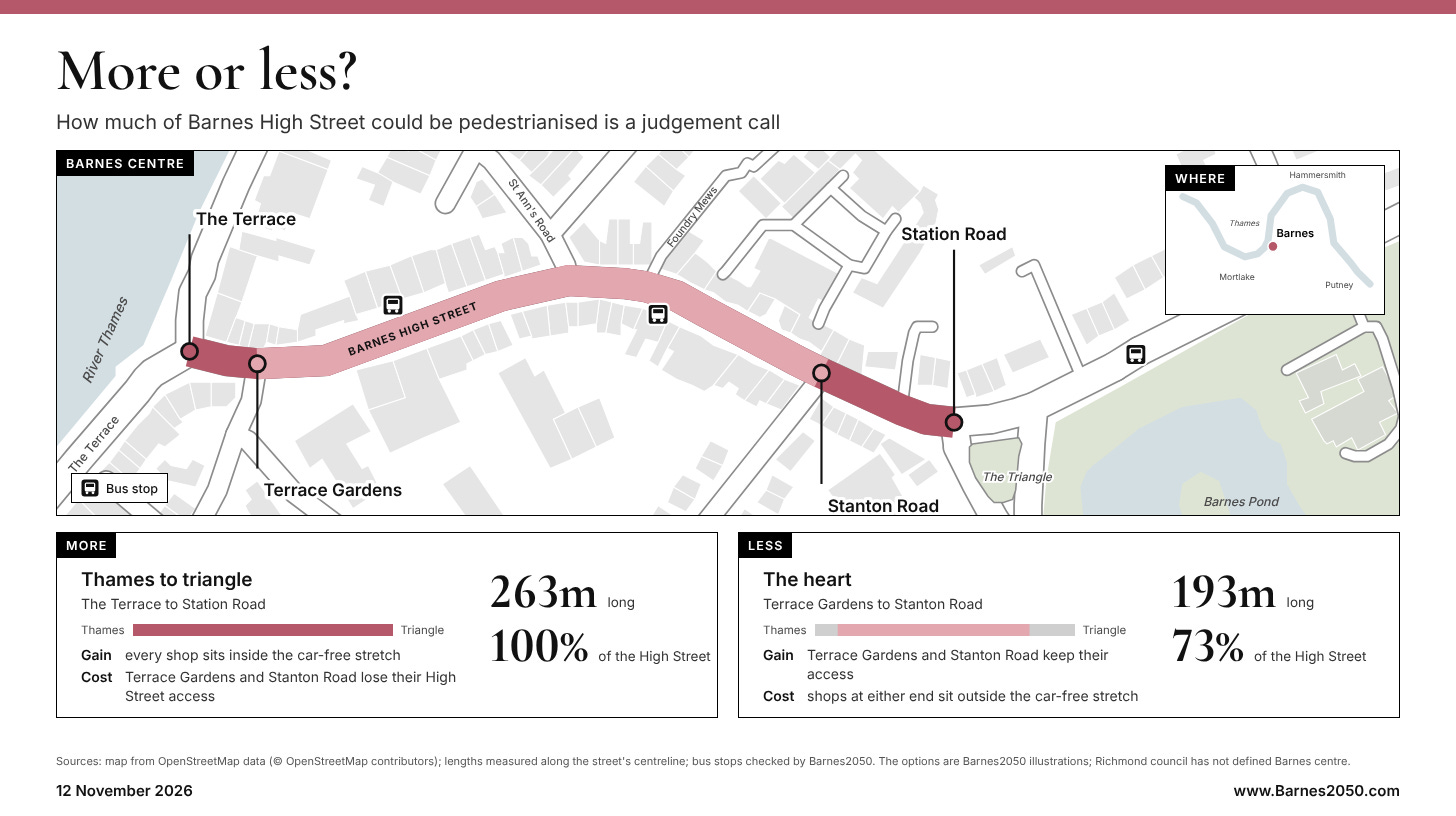
It’s tempting to see the choice for this short, important street as pro-pedestrian or pro-car. That approach falls apart quickly.
Take buses. Take them away and some people find it harder to reach the shops. Then there’s the florist. The flowers have to come from somewhere.
So what is the High Street for?
Bustle.
People buying things, bumping into each other, on their way somewhere else. A bus pulling in is part of that rhythm.
The strongest argument for pedestrianising the High Street is what it could give us on an ordinary Tuesday. Room to stop outside a shop without blocking the pavement. Somewhere to sit in the shade. An easier walk from the Green to the river.
I want those things too. So I’d start by widening the pavement where it pinches, making it easier to cross at Essex House and giving up a parking space for a tree and a bench. You could sit there for five minutes. You could still catch the bus home.
Which brings me back to that walk down Oxford Street.
The stretch I walked, between Orchard Street and Great Portland Street, went traffic-free on 26 October. The layout is temporary and will be refined as people use it. Its prompting discussions about whether other areas should be pedestrianised, such Parliament Square.
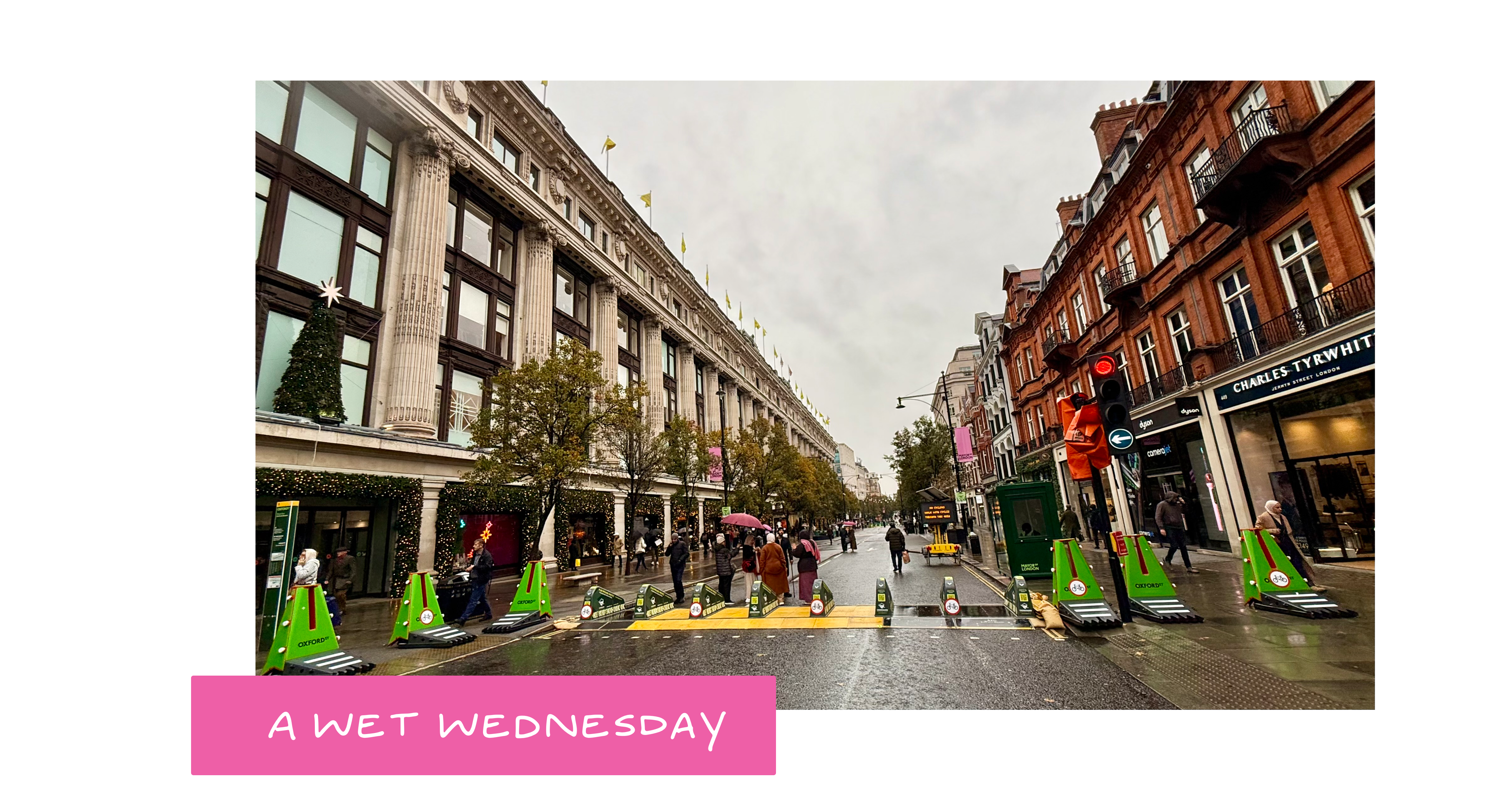
It was a bit grim, in part. And that was helpful.
This desire for bustle is an aesthetic and emotional preference, admittedly. But I‘ve walked through enough soulless pedestrian spaces to know what taking out all the traffic can do to a street. The artists’ impressions looked good. The lived experience fell well short.
We need to think about how the High Street would feel at different hours, on different days and in different seasons. We might accept a lower ceiling and a higher floor: less pure pedestrianisation, more bustle, more often. Oxford Street already varies access by the clock, allowing deliveries and servicing between midnight and 7am.
Of course, go too far and all this movement overwhelms everything else? Go too far and you get Mortlake High Street.
One day on the High Street
This chart might help workout where best to land in this discussion. It shows six ways the High Street could work, from full pedestrianisation to giving more room back to general traffic. Richmond council‘s plan points one way. Judging by my conversations with them, some traders and drivers would go the other. Barnes2050‘s view is in pink.
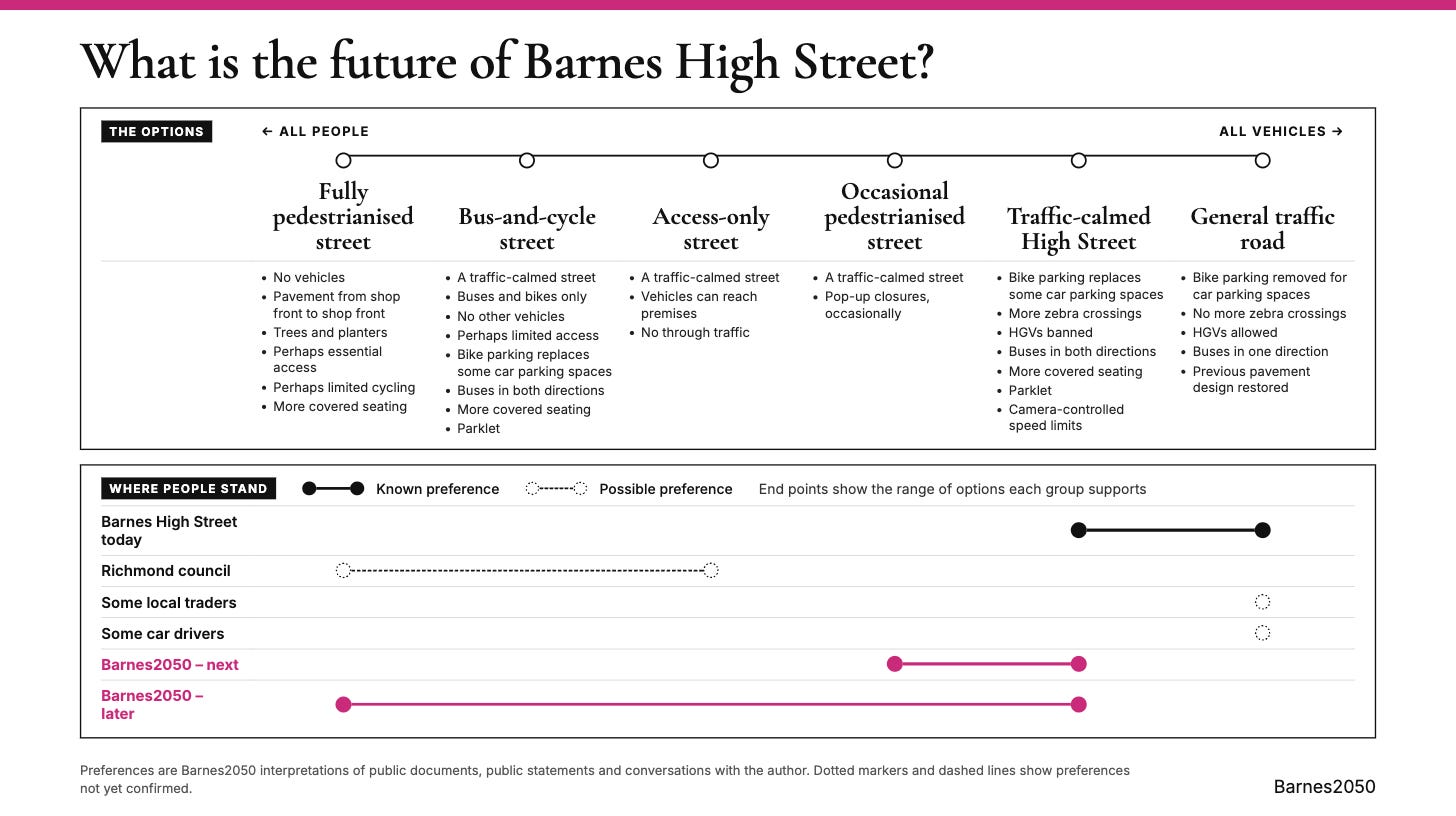
Where would you put your dot? Would it be in the same place on an ordinary Tuesday as on the afternoon of the Barnes Fair?
That second question is where my thinking turned. A street doesn’t have to be one thing all day. So take a day on the High Street, and ask at each point what we want from it and what we’d give up to get it.
Early morning: the flowers arrive
Vans and smaller lorries supply the shops, sometimes several on one trip. Take out most of the through traffic and those businesses still need their deliveries. The questions are what comes in, how big and when?
The Barnes Community Association petition to keep most HGVs off The Terrace and the High Street puts the hard part in plain sight. If restriction goes ahead, it’s worth another look at how M&S, Sainsbury’s and the florist get their deliveries. Getting even one of those lorries off the street would be progress.
Daytime: the bus comes through
A bus brings people to the High Street who might otherwise drive, ask for a lift or go somewhere else. The bus services Barnes needs should do that from across the peninsula, including a direct ride along the shopping stretch from North Barnes.
Cars are a separate question. If London and Richmond are to hit those traffic targets, the High Street has to play its part. A traffic-calmed street would still let private cars in alongside buses and deliveries, but give drivers less reason to hurry and pedestrians more chances to cross. Think a camera-enforced 20mph limit, and perhaps a signal-controlled crossing outside Essex House.
We’d need to trial it. If through traffic falls on the High Street, we need to know how much has gone away and how much has simply turned up on, say, Nassau Road.
Afternoon: a reason to stay
The wider pavements, championed by the Barnes Community Association, already give us room to pass when someone stops outside a shop. You can see what more space does for a street without imagining another vehicle restriction.
What’s missing is somewhere to sit, especially in the shade. As Barnes gets older and summers get hotter, a seat halfway along the walk to the shops starts to matter. A tree can make somewhere a good place to stop, even if you’re perfectly capable of walking on. That’s worth a parking space.
Then there are the bikes, especially e-bikes. Barnes needs more people riding them, and the rest of us need to get round the corner when they’re piled up there. More designated bays would help, as long as riders had to use them when ending a trip on or near the High Street. Another car parking space or two, repurposed, would give the hire bikes somewhere to go and keep the pavement clear.
Fair day: everyone has the road
What we want from the High Street on an ordinary Tuesday isn’t what we want on the afternoon of the Barnes Fair, the Boat Race or the Christmas Fair.
Start with Barnes Fair in 2027. For three hours, say noon to three, give people the High Street. Divert the buses via Nassau Road if Transport for London can put temporary stops close enough to the Green, and keep somewhere nearby for people to be dropped off.
Then see what happens. This a trial.
Do people spill out from the Green, stop outside the shops and stay a bit longer? Did the pedestrian pound benefit the local traders. Where does the traffic go? And can someone who relies on a bus or a lift still get close enough to come? Is a longer walk from a temporary stop is a small inconvenience for some, but enough to keep others at home?
Notes and thoughts
Barnes2050 wants a High Street where people have priority, buses stay central, deliveries are managed and private cars play a much smaller part.
That’s the first pink line towards the bottom of the chart. But by 2050 we should go further.
Look at the second pink line.
It points to a High Street that runs by the clock: vans in the morning, buses and bikes through the day, people on fair afternoons. On an ordinary day you could still drive to a shop or drop someone off, but by 2050 I’d like the High Street to have stopped being a shortcut, with even local car access paused for a few hours on the right days.
How much traffic the High Street needs to carry in 2050 depends on what happens across the peninsula. Better buses, easier walks, safer routes for e-bikes, perhaps even a boat to work. Each would change how some of us get to the shops or across Barnes. That changes what we need the High Street to do, and when.
If that sounds far-fetched, remember we already change the rules by the clock. A School Street trial in Barnes did it around the school run. Bus lanes operate at particular times. If signs, signals and access controls could work together, the High Street could change how it operates in minutes.
And if any stretch of any road or street in Barnes is worthy of such sophisticated management it is Barnes High Street.
Where would I start?
With three things we could do now to find out how much more room we can give people on the High Street, and what still needs to get through.
Richmond council to ban HGVs on The Terrace and the High Street, initially excepting trade deliveries
A signal-controlled crossing outside Essex House, set to respond quickly when a pedestrian presses the button.
A pedestrian pop-up TRIAL on the High Street during Barnes Fair 2027.
Try those three and we’ll have a better idea what to do next. Perhaps the road works well for a few hours on Fair day. Then we can ask when else we might want it.
This is the first in a series on the future of the High Street. I’ll come back to what Barnes can learn from Oxford Street and what academic research says about pedestrianisation, before setting out a proposal for 2050.
Until then, where is that man from the council with his plans and strategies?
If it helps, please download and share this version of this earlier graphic which suggested options for how we might pedestrianise Barnes High Street.

Or read more about what a pedestrian-first Barnes could look like.