

This is the fifth of the Barnes2050 Principles: ideas intended to help make choices about how Barnes SW13 develops between now and 2050.
Barnes will change. The question is not whether change happens, but what criteria we use when choosing among competing changes. So far, the principles have said we should design Barnes for people first, not cars; prioritise getting buses and vans moving; embrace the e-bike generation; and test new thinking with purpose, regularly.
As the Barnes2050 Manifesto develops, these principles will inform the proposals to help Barnes, place and people, thrive and be climate-ready by 2050.
Barnes doesn’t get many opportunities to rebuild things from scratch. When one comes along, we should build for the climate we are going to have, not the climate we used to have.
We’re talking about you, Hammersmith Bridge. But not just you.
Welcome to Barnes2050, a place-based futures project asking: how do we help Barnes - the place and its people - thrive and be climate-ready by 2050? If this is your first visit, you might want to start here.
Principle 5 - Use local renewal to build for the climate we are going to have
London’s development from the Romans onwards is a story of incremental change. Accumulation not re-invention.
There was no grand reset like Paris under Haussman or Rotterdam after the Second World War. Take the the Great Fire of 1666. Grand reconstruction plans by Wren and others were rejected and London was largely rebuilt on its existing street pattern.
Re-use, rebuild, retrofit is the London story.
But there are moments when enormous change happens locally. Between now and 2050, Barnes needs to seize those opportunities and build with one eye on the climate to come.
As the UK’s Climate Change Committee has made clear, we need to start adapting to the climate we are now expecting. So much of the discussion in the UK is about cutting emissions. We also urgently need to look at how our homes, schools and public spaces cope with the climate already coming.
Barnes has form.
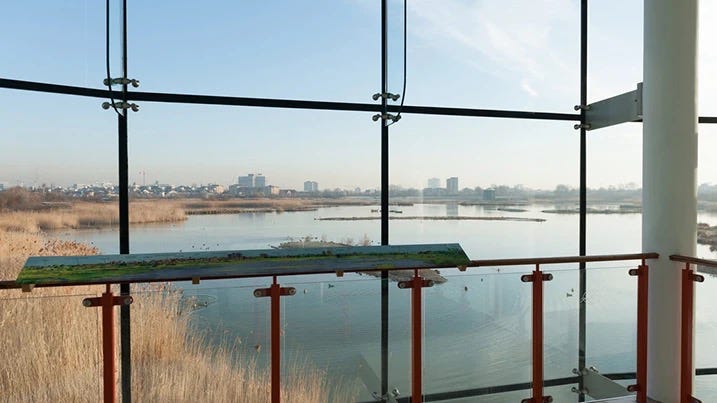
Look at the WWT Wetland Centre. A stunning re-purposing of four Victorian reservoirs, a substantial piece of Barnes. The choice was to turn them into a vast green-and-blue space rather than more intensive development.
The Wetland Centre opened in 2000. Today it is difficult to imagine Barnes without it. The benefits go beyond biodiversity. The centre attracts between 170,000 and 250,000 visitors annually, supporting the local economy too.
It is a reminder that decisions made when land becomes available can shape Barnes for generations.
Two live developments are worth calling out to which this principle must apply.
The first is the overhaul of the Vine Road Recreation Ground. Barnes2050 has argued that key is the Eco-Community Hub, a proposed climate refuge for anyone in Barnes SW13 in the event of extreme heat or flooding. An example of building for the climate we are about to have.
Further north Hammersmith Bridge is presenting a related opportunity. For more than seven years, it has been open to pedestrians and cyclists but not general motor traffic.
Even if the UK government changes its mind and decides to fund the restoration of the Bridge to vehicles, we will have lost a wonderful opportunity if we simply recreate what was there before: more than 20,000 vehicle crossings a day.
Keeping the Bridge primarily for walking, cycling and other low-emission transport would use one of Barnes’s rare infrastructure renewals to help reduce transport emissions. Vine Road asks the other half of the climate question: how do we prepare Barnes for the effects of climate change that are already coming?
We need to do both.
The key is being honest about the climate we are going to have. The Met Office have provided a useful guide.
Or we could just look at Barcelona today.
Continue exploring: Use major renewal to build for the climate we are going to have
When Barnes gets a rare opportunity to renew infrastructure, it should build for the climate of the coming decades rather than the climate of the past.
More stories about using developments to make sure we are climate-ready
‘By 2050, London’s climate is expected to be similar to present day Barcelona’

That potential major project?
Test how appropriate it would be in future Barnes by imagining how it might fare in Barcelona today.