

Occasionally, you get a glimpse of the future in the news: something that could be the start of a trend, an experiment, or decision that hints at how life might change.
Barnes2050 collects these.
They are not predictions. They are nudges. Signals.
I look for stories that might signal a change in direction, challenge our assumptions or offer clues about the choices facing Barnes between now and 2050.
What might this mean for Barnes SW13? What can we learn from them? Which should we resist?
Looking back at October, one theme keeps emerging: control.
Who controls our streets, our transport, our infrastructure and the money to pay for it? And how much control do we really have over a changing climate?
Four developments in particular might prove significant in the years ahead:
A grim climate milestone: crossing 1.5°C now appears inevitable.
A shift in political power: London’s Mayor gains new financial firepower while Richmond council struggles with cuts.
The beginnings of a push-back against robotaxis and anti-social e-bike riding.
Another triumph of London engineering: the Super Sewer is working, and Barnes is benefiting.
Welcome to Barnes2050, a place-based futures project asking: how do we help Barnes - the place and its people - thrive and be climate-ready by 2050? If this is your first visit, you might want to start here.
Climate
Crossing 1.5ºC now ‘inevitable’
We start with the climate because thats what frames this project
A temporary breach of the 1.5C global-warming limit is now ‘inevitable’ following ‘decades of insufficient climate action’, according to an UN Environment Programme reported Carbon Brief.
Current national policies also put the world on a trajectory towards approximately 2.8°C of warming this century, reports the Financial Times.
What might this mean for Richmond borough in 2050? The Met Office has a useful guide. TLDR: Hotter and wetter.
For Barnes, this is another reminder that adapting to a changing climate is becoming as important as trying to prevent further warming.
Simon Clarke on Instagram managed to find some hope in the global energy transition.
Summer 2026
Lorraine Whitmarsh and Bella Zanin published new survey data about the effect of the five heatwaves earlier this year:
High temperatures made more 50% of British people more fearful about the future, including how hot summers will affect children.
One poll found that 65% of the British public were now concerned about climate change
Polling shows that climate change and the environment shot up people’s lists of concerns in 2026, with 51% of people saying the recent heatwaves made them feel it’s more important that the UK government and businesses tackle climate change.
While we wait for the UK Government’s official total of excess deaths during the summer’s five heatwaves, researchers estimate that more than 50,000 people died across Europe, with two-thirds of those deaths attributable to climate change.
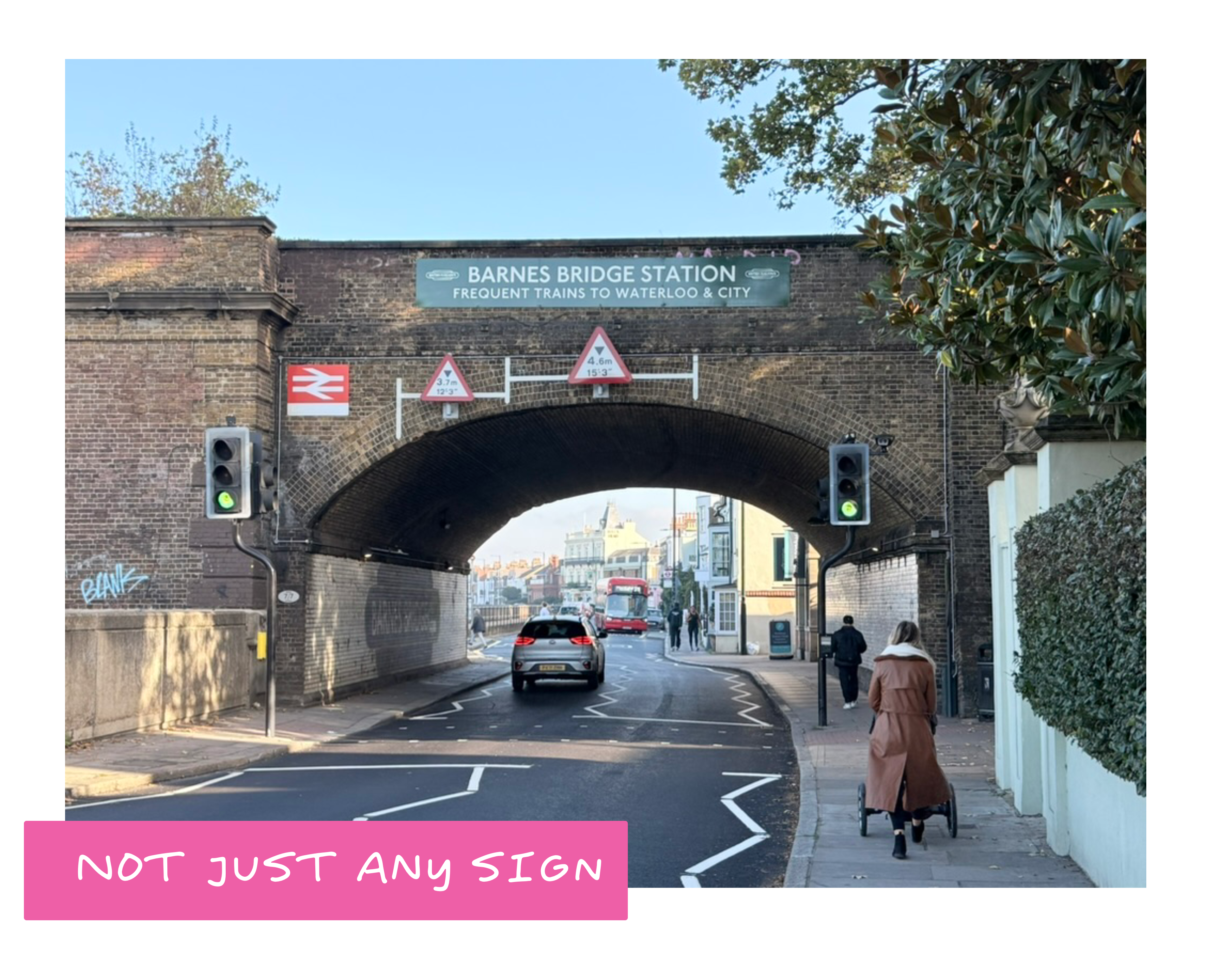
After half a century the Barnes Community Association (BCA) has restored the signs on Barnes Bridge are back.
The replicas use anti-graffiti paint. Fingers-crossed that works.
There’s a fine balance to be found between celebrating our heritage and restrictive nostalgia. BCA have once again found the sweet spot.
The one word that sets this sign apart?
Frequent.
#BarnesStyle
Infrastructure
Hammersmith Bridge
An old idea resurfaced this week. The Londoner suggests a new Hammersmith Bridge could be funded by the City Bridge Foundation, which currently funds five central London bridges, with unspent income going to charitable causes.
Nick Maini made a similar case in February 2026, arguing.
We could fund public transport on Hammersmith Bridge today for just £10 million.
Maini also proposed changing the Foundation’s charter, but with a twist: rather than restoring the Bridge for full vehicular access, he favoured investment in a new active travel bridge.
There is a bigger question here about who should be responsible for London’s bridges. As Richard Brown argued in OnLondon:
Responsibility for [London bridge’s] upkeep and enhancement is contested and their governance is split, in a characteristically London manner, between a medieval endowment, central government, a handful of local authorities and a city-wide transport body.
Allowing this mess to continue (or quite likely worsen) is risky: closing bridges damages business, impedes free movement and makes London look pretty shabby internationally.
Meanwhile, the future of Hammersmith Bridge continues to roil local councils. As Putney.news reported, Wandsworth Council, now under largely Conservative leadership, developed and then rejected a Bridge plan, before asking the council to approve it anyway.
The Bridge seems to do this to politicians.
Heathrow estimates the completion date for the third runway is now 2039. The new runway would need to be shuttered the moment it opened.
Otherwise, according to the government’s Climate Change Committee, ‘almost all CO2 emissions in 2050 will be from aviation’
George Monbiot, The Guardian
Do not touch that keyboard: Heathrow’s third runway is consulting, again
Yes, another consultation is underway. Unlike the earlier UK Government consultation on national policy for Heathrow expansion, this one is being run by Heathrow itself to gather views on its detailed proposals before submitting a formal planning application.
The deadline is 22 December.
This is such a consequential development, you should share your thoughts. Remember the Prime Minister description of Heathrow expansion as ‘a matter for London and Londoners’.
But not just yet.
Local civic societies and councils are currently developing advice on how to respond most effectively.
For Barnes, the big questions are what a third runway might mean for aircraft noise, flight paths and air quality. I plan to explore these before the consultation closes.
If you really can’t wait, then Putney.news has a useful summary.
There’s no shortage of coverage about Heathrow’s plans. You don’t need to read The FT’s briefing. The headline says enough,
The ever-shrinking case for expanding Heathrow
Instead, spend a few minutes with George Monbiot in The Guardian. Arguably the best single summary of the current situation and what it might mean by 2050.
Oxford Street pedestrianisation
Oxford Street is the nation’s high street. At the heart of the West End, it is one of the world’s most recognised commercial destinations.
So claims the Oxford Street Development Corporation. And after years of setbacks, Monday 26 October marked the first day of its pedestrianisation. The first stretch to change covered almost a kilometre between Orchard Street and Great Portland Street,
In its response The Guardian said,
Cities should be designed around people, not cars.
This is how it happened and this is how it felt on the first day.
The hullabaloo in W1 got me thinking about what might happen to Barnes High Street by 2050. More soon. My instinctive response surprised me.
Happy birthday Zebra Crossing!
75 years old on Saturday 31 October. The world’s first zebra crossing is associated with Slough High Street in Berkshire.
As Barnes moves from a car-first to people-first approach to developing, these and other crossings are going to become more common. Barnes needs more crossings: here and here and here, for example,
Flooding resilience
The return of the rain saw a useful reminder from Community BlueScapes that if you see a blocked drain, then please report it.
Staying with Barnes2050’s favourite infrastructure project, Community BlueScapes have been showing off their latest project at Castelnau Community Centre.
Mobile connectivity
Another take on our digital infrastructure: an attempt to map users’ real-world experience of mobile connectivity rather than the theoretical best.
London’s mobile connectivity is measured across four different metrics: upload speed, download speed, signal strength and latency.

At first glance this felt like third-order topic. So, what?
Except it wasn’t that long ago that SW13 had severe mobile signal blackspots.
Looking ahead, Barnes2050 imagines a world in which connectivity makes our built environment feel live and alive. Better connected data, signals and barriers could allow us to manage access dynamically.
Dynamic space management might allow our streets to respond to changing conditions, giving buses priority when services are delayed or redirecting traffic when flooding makes a road unsafe.
Transport
E-bikes
Oddly, for one of the most dynamic parts of London’s transport mix, there is still remarkably little information about how the shared e-bike market operates. As London Centric explains:
One of the great mysteries of London’s e-bike market is that no one — including Transport for London — really knows how the largely unregulated companies involved operate, let alone how many bikes are on the capital’s roads.
But for the first time in years of asking, we might be heading towards an answer.
October was notable for a series of stories suggesting that London, and other cities, are beginning to get tougher about how bikes are used and managed:
Ealing Council now has the power to seize shared e-bikes blocking pavements, reports the BBC.
Shared e-bike operators could face bans for failing to comply with parking rules, says The Times (££ paywall).
Also in The Times, Deliveroo is threatening sanctions against delivery riders who speed.
City of London Police have been ‘sin-binning’ cyclists who jump red lights at Bank.
Paris has started using speed-limiters to counter anti-social riding, according to Bob From Accounts on X.
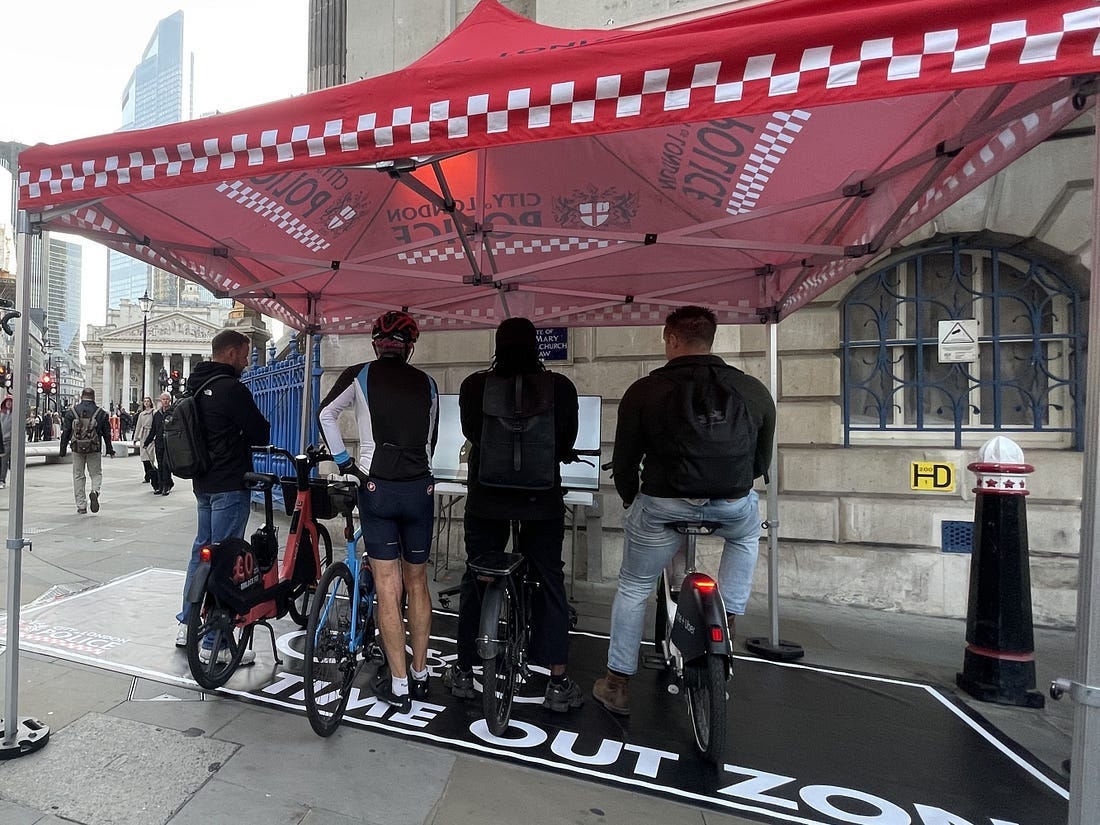
Different problems, different responses, but a common direction: greater control over how bikes are operated, ridden and parked.
Barnes2050 remains committed to the idea that e-bikes are key to reducing the number of cars on our roads. That will only happen when anti-social riding and parking are tamed.
Robotaxis
Transport for London (TfL) needs powers to cap autonomous vehicle numbers in the city, along with devolved powers to govern, and withdraw, future schemes.
That’s the conclusion of a new London Assembly Transport Committee report. One of their concerns is tracking the amount of ‘empty miles driven’ in order to understand the robotaxis’ impact on congestion.
Yep.
Buses and bikes
London’s 8,900 buses are getting a brain transplant, says James O’Malley.
Another piece of future infrastructure capable of making live data useful. Maybe every bus stop in Barnes could display live bus timings?
And a welcome reminder that transport other than cars can offer substantial returns on investment (ROI). BikeIsBest reports that Cycling UK’s The Route Forward says for every £1 spent, we all secure the equivalent of £5.62 in economic and social benefit.
A monthly digest of small stories and subtle signals
with one eye on the long horizon
Governance
Mayor of London finally gets real powers in the Budget
The 2026 Budget announced five significant financial powers for London’s Mayor:
Income tax: Receive an assigned share of London revenues from 2028
Business rates: Retain more locally generated revenue
Tourist tax: Authority to introduce a levy on overnight accommodation
Retention zones: Keep business-rate growth in two designated development areas.
Business rates supplement: Extend the existing levy to finance new infrastructure
Together these provide more predictable revenue to support borrowing for major transport and regeneration projects. Some of them will require legislation or implementation.
The short-term effect on Barnes will be minimal. But this might signal the beginning of a significant shift in power between London’s Mayor and its borough councils.
The distinction matters. More money does not automatically mean more legal powers. The Mayor is gaining greater financial firepower, while Richmond council faces growing pressure to fund its statutory services. Meanwhile, separate changes to planning rules could reduce the role of elected councillors in some local decisions.
Taken together, these developments raise an intriguing question for Barnes2050: by 2050, how much of our future will be shaped by decisions made in Richmond, and how much by City Hall?
After all, as The Standard puts it,
Fiscal devolution to make Lord Khan one of Europe’s most powerful mayors
This is a bigger story, one I intend to return to.
If you are hoping this might fund a new Hammersmith Bridge, remember it isn’t a priority for the UK Government or the Mayor of London. No surprise then, the next on the spending agenda for that money, according to reports in City AM, are the new West Orbital overground line, improvements to Stratford station, and, most importantly of all, the long-awaited Bakerloo line extension to Lewisham.
Richmond council also believes the UK Government is further reducing local democracy with changes to the planning process.
New planning rules due to come into force on 1 November 2026 will mean many smaller planning applications are decided by council officers under delegated powers, rather than by elected councillors at public committee meetings.
These include household extensions, developments of up to nine homes and minor commercial schemes.
More extensions, perhaps, as Barnes adapts to the needs of larger, multigenerational households?
Nature
Beverley Brook
The Community BlueScapes love-in with Barnes2050 continues.
This time, the Barn Elms Southside works are complete, potentially protecting more homes from flooding.
An earlier project is already producing results. Community BlueScapes reports that a European eel has been spotted Beverley Brook..
More good news from Thames
Something about Wet Wipes. or rather the lack of, caught the attention of the nation’s journalists.
Reports on the success of the Super Sewer have appeared in:
FulhamSW6 who report ‘The Thames foreshore beside Hammersmith Bridge is showing the strongest signs yet that one of the river’s most persistent pollution problems may finally be easing, report’
Palms and Parks
Kew Gardens is looking for £1m to save its famous Palm House, as Londonist reports
There are several ways to help, from making a simple donation, to sponsoring a pane of glass (£25 for a small pane; £100 for a large pane), or even a species of plant (from £25 for a traveller’s palm, up to £500 for the critically endangered Clay’s hibiscus from Hawaii) within the restored Palm House. Your name won’t appear at Kew, but you’ll receive a personalised digital certificate.
Kew is leading the way: the development at Vine Road aims to follow. Kew wants to use renewal to build for the climate we are going to have.
We do love a (new) park. Bloomberg (££ paywall) report from Boston. Or read about Castelnau Park for free.
Maybe in twenty years you’ll be able to visit it, too.
This map defies description. It is called Tiny London. Here is an the usual view of the peninsula.
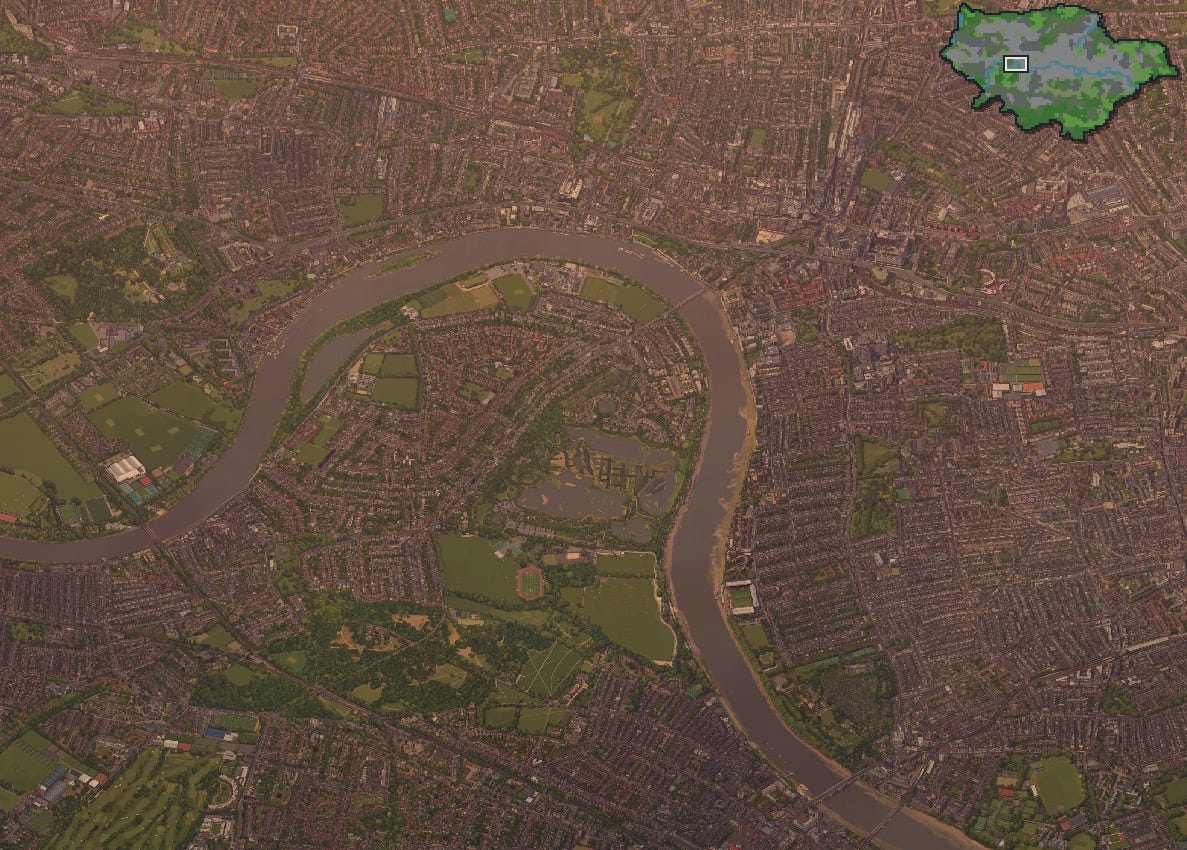
Now zoom in. An unusual treatment.
Do you recognise where this is?
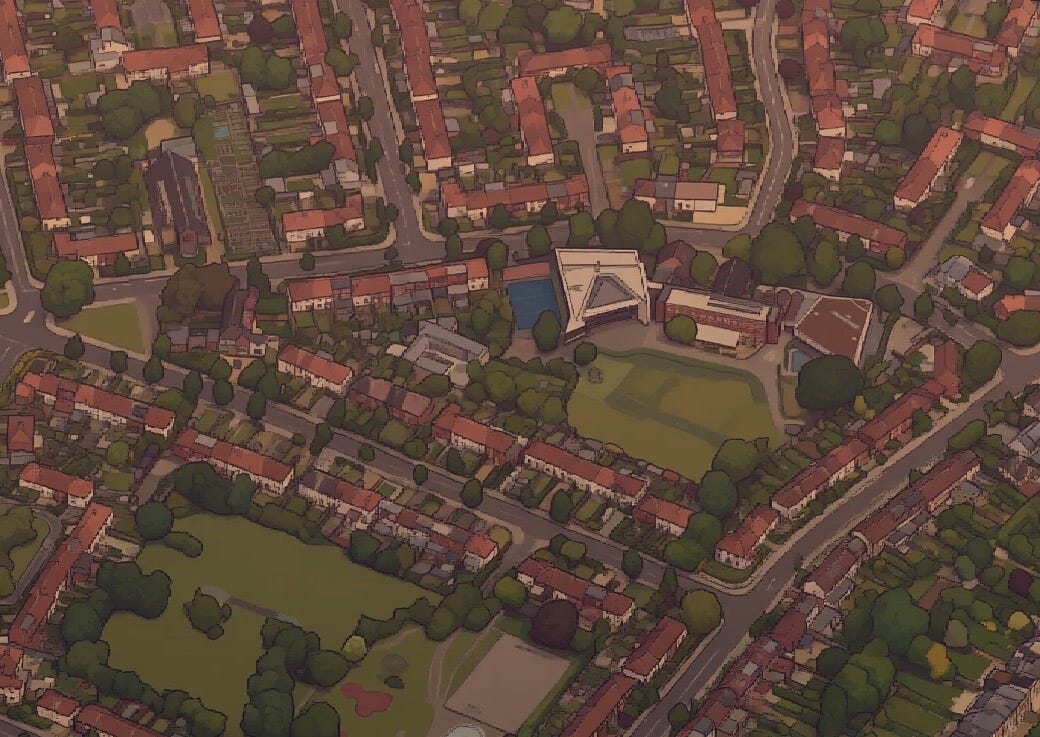
Designed to please rather than be useful, maybe. Explore and read about it at tiny.london
Lifestyle
Richmond is the fourth best place in England for children to grow up
The Childhood Lottery report by the Children’s Commissioner spans health, education, care, family life and communities.
Richmond scored 707 out of a possible 960. It performed particularly well on education, with 70 per cent of children in the borough achieving a good pass in both English and maths GCSEs, compared with around 45 per cent nationally.
The question for Barnes2050 is whether Richmond can maintain this standard as the borough’s population ages and the demands on public services change.
Prepping in Barnes
Not quite the panic-buying of the Covid pandemic, but loo roll, tinned beans, bottled water and FM radios have been flying off supermarket shelves since the UK Government urged us to be ‘emergency ready’.
It seems the advice to keep enough food, water and other essential supplies to last at least three days is having an impact. Walk through Sainsbury’s or Tescos in Barnes to see for yourself.
If you haven’t stocked up, the Government has published its Be Ready checklist to help prepare for storms, power cuts, transport disruption, supply-chain problems and other unexpected emergencies.
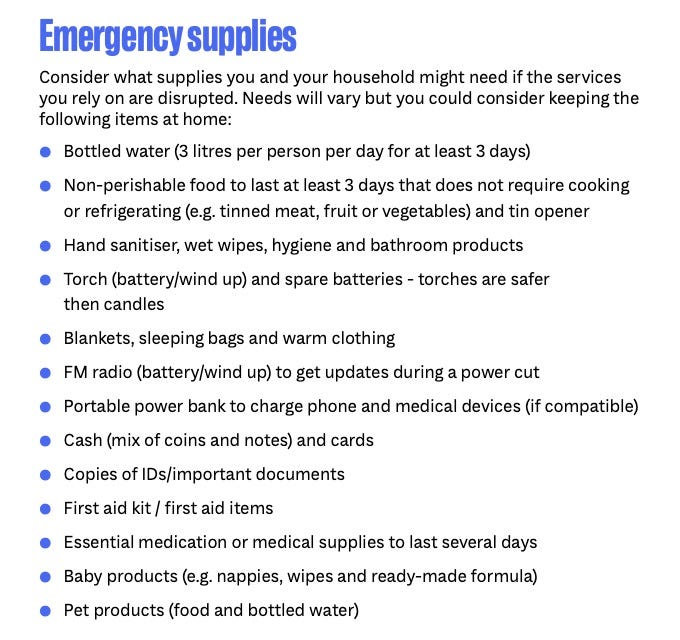
Officials say being prepared for three days can help people stay safe and self-sufficient while emergency services and support are directed to those most in need.
Those very nice people at the UK Government have even produced printable checklist.

Maybe that’s a fitting way to end October’s collection of signals.
We cannot know what the future holds, but we can make choices today that leave Barnes - place and people - better prepared for whatever comes next.
So Ai, who am I?

The machine has a view.
It will read these words, so there's nowhere to hide.
This was a good assessment.