

Occasionally, you get a glimpse of the future in the news: something that could be the start of a trend, an experiment, or decision that hints at how life might change.
Barnes2050 collects these.
They are not predictions. They are nudges. Signals.
What might this mean for Barnes SW13? What can we learn from them? Which should we resist?
Horizon scanning, the name given to this process, is standard practice in many businesses and organisations. There are many different approaches. The Canadian government, for example, offers a useful rule of thumb: three related weak signals from different sources are a reasonable indication that change may be occurring.
Bear that in mind with this selection of stories from a scorching August at the end of the UK’s hottest summer on record,
e-bikes are the quickest way to travel and now come insured, some for free
Generate your own electricity, even under grey skies - plug-in solar now available
But let’s start with the climate.
Climate: Heatwave 5
The clue is that number.
The rain may have arrived before the month closed, but by then the landscape was hurting. Another ‘false autumn’.
Barnes2050 has argued since launch that heat and water are equally threatening to Barnes.
But only now is the scale becoming clear.
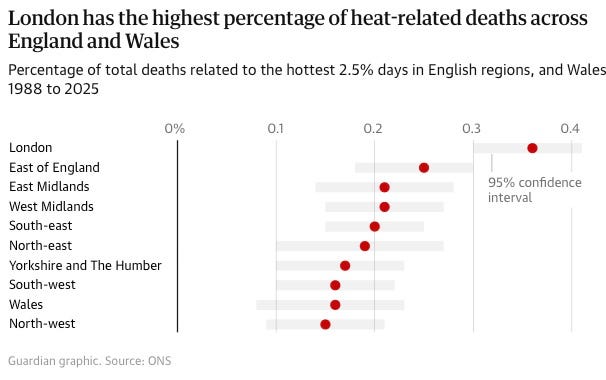
The Guardian reported ONS estimates that more than 40,000 deaths were associated with England’s hottest days between 1988 and 2025. The figures do not include 2026. London had the highest proportion of heat-associated deaths of any English region.
Gulp.
‘Most of these cold- and heat-related deaths are preventable’
Bob Ward of the Grantham Research Institute on Climate Change, LSE
Barnes is an ageing village in an ageing borough. That does not make everyone here especially vulnerable to heat, but it surely makes the consequences worth understanding.
James Tucker at the ONS reported,
Our results show that the gap between heat- and cold-related deaths has narrowed in recent years as the proportion of heat-related deaths has increased.
Insight from the Met Office suggests these temperatures should no longer surprise us. We have a reasonable idea of the direction of the local climate by 2050.
The question is whether Barnes is changing quickly enough to live comfortably, and safely, in it.
By month end, attention had turned to the tragedy in Nepal.
Jonathan Watts has explained explained the between the human-induced climate crisis and the glacier collapse that caused the massacre,
Two days before the collapse, the ground temperature hit its highest point in the last two years, according to Dr Hamish Pritchard, a glaciologist with the British Antarctic Survey, whose team had sensors 6 miles (10km) away from the site.
‘These high temperatures would have weakened the snowpack, filled crevasses with water and thawed the bonds between ice and rock that hold these glaciers in place,’ he told the Science Media Centre.
Nepal contributes less than 0.1% of global greenhouse gas emissions, while its neighbours India and China are among the world’s biggest emitters. The Himalayas, which span India, China, Nepal and Bhutan, have been warming at a rate nearly 50% faster than the global average.
Bill McKibben did the maths,
.. On average, Nepalis produce about four-tenths of a ton of carbon emissions annually, compared with about 14 tons for an American. More than 99 percent of the country’s electricity comes from hydropower (though much of that capacity was wiped out in last week’s floods).
He ends,
They are not causing the crisis that is killing them: we are.
Meteorologists have warned us 2027 could be wetter and could be hotter because of El Niño. As Jason Rowlatt reported on BBC News, this could be a the strongest in decades.
Another reminder that climate adaptation is not something to begin in 2049.
Infrastructure: H&F bid for Structures fund
UK government deadlines and heatwaves came together neatly this month.
It was hot weather that eventually did for Hammersmith Bridge. Yet loud demands continue for its restoration to carry private vehicles, despite transport being the second-largest source of greenhouse-gas emissions in Richmond borough.
August was a critical month for the UK Government’s £1 billion Structures Fund for major local infrastructure, including bridges, flyovers and tunnels.
Hammersmith & Fulham (H&F) council along with many others, submitted a bid to fund phased repairs to Hammersmith Bridge. It had earlier put the estimated cost at £128 million, aimed at keeping the bridge operational for pedestrians and cyclists and keeping the river beneath it open.
The Government now has to weigh this bid alongside many others from across England. In many ways they face the same choice as they did when asked to fund a full restoration - 40% HB options open to UKG
If H&F does not secure the money it needs, the future of the Bridge becomes uncertain again. H&F council leader Stephen Cowan has repeatedly stressed the extent of repairs still required.
Maybe no cash, no Bridge.
But certainly no repair programme and no confidence about the Bridge’s long-term future. And no point designing clever new ways of getting people across it if the underlying structure cannot be secured.
So maybe no pod.
The UK Government says Structures Fund decisions are expected in autumn 2026.
Meanwhile the Finns, not trolling us but it feels like, have just built a gorgeous, epic bridge.
Supporters of London’s premier active-travel bridge* are always keen to see others spring up around the world.
Helsinki’s new Kruunuvuori Bridge is the longest bridge in Finland and cars will not use it. It has been designed for trams, cycling and walking as part of the wider Crown Bridges project.
The point here is not that *Hammersmith Bridge should imitate Helsinki’s.
Rather cities elsewhere are still building major infrastructure around public transport, walking and cycling. That is a useful reference point when we decide what sort of bridge Barnes needs for the next 25 years.
Infrastructure: Richmond’s digital environment
This is a curious story.
Or rather, it prompted a curious response about which I am still not sure.
Richmond council has installed a new safety speaker at Teddington Lock to deter dangerous jumping into the Thames.
Despite public notices, extra physical barriers and warnings, people continue to jump from the bridge into the river.
The new speaker plays a short message when CCTV operators see anyone approaching the edge.
Why does that feel different?
We are already surrounded by technology that watches, senses or responds to us.
Traffic lights change. Zebra crossings bleep. Cameras monitor roads and buildings. Images from private doorbells and security cameras circulate around neighbourhood WhatsApp groups after an incident.
The Metropolitan Police now uses live facial recognition elsewhere in London.
Autonomous vehicles, already on London’s streets in small numbers, are are covered in sensors.
The environment is becoming live and alive, if not sentient.
Now add the human in the loop: someone at a remote location observes behaviour through a machine and speaks directly into the physical space.
That feels like a signal from the future.
For Barnes, the question is how comfortable we will be as public space becomes increasingly monitored and responsive, and what rules govern it.
Governance: Lessons from Ulez and car-free days
Where are the ‘blade runners’ now?
Sadiq Khan, writing in the The Guardian, said
There is now a mountain of evidence to show that the Ulez has slashed air pollution and improved air quality across London, and research published by Imperial College London earlier this year showed that this is already saving lives.
A new, independent study published by Queen Mary University of London today goes further still, showing how – by helping to clean up the capital’s air – the Ulez is improving the lungs and lives of London’s children
But this is not really a story about Ulez.
It is about politicians.
Christian Wolmar, also writing in the Guardian, argued,
We need politicians to explain why the unrestricted use of cars in urban centres is damaging to the local economy as well as to the environment, to people’s health and to the overall feel of a place.
And
Brave politicians need to take on opponents without compromise.
That is what Khan did with Ulez.
He came under huge pressure to backtrack, including after the Uxbridge by-election. He stuck to the policy. London subsequently recorded substantial reductions in nitrogen dioxide and other pollutants.
Other politicians occasionally show the same willingness.
Richmond council leader, Gareth Roberts is rightly proud of his early move to implement 20 mph speed limit across the borough.
We need more of this. And maybe there are signs.
Richmond council is becoming more willing to manage road space flexibly.
It continues to experiment with School Streets, including the trial around Barnes Primary. Roads already close for exceptional events. And this September the council invited residents to ‘turn our road into a Play Street for a day’.
None of this amounts to wholesale pedestrianisation.
That is the point.
Barnes2050 has made the case for a pedestrian pop-up along The Terrace on Boat Race day. Something similar could happen around Barnes Pond during Barnes Fair.
Roads do not have to perform exactly the same function every hour of every day.
Perhaps the emerging signal is simply this: we are becoming more comfortable with temporarily reallocating public space for public purposes.
By 2050 that may seem considerably less radical than it does today.
Transport: Mitigation - reducing contrails
Responses to climate change are usually divided into two broad categories.
Mitigation reduces the causes of climate change. Adaptation is how we adjust to its effects.
In the month when debate continued about Heathrow expansion came news of an attempt to tackle a less visible part of aviation’s climate impact.
Contrails.

Operation Blue Skies is a £5 million programme involving NATS, Google, the Met Office, Cambridge and Imperial universities and other organisations.
The idea is surprisingly simple.
Aircraft sometimes create persistent contrails which trap heat in the atmosphere. Researchers believe that relatively small changes in altitude could allow aircraft to avoid some of the atmospheric conditions in which the most warming contrails form.
Trials are due to take place across North Atlantic airspace during this winter and next.
This matters because contrails are thought to account for roughly a third of aviation’s total climate impact, as Simon Clarke explains.
There is an intriguing bigger point.
Some of the response to climate change may not involve giving something up or replacing an entire technology. It may come from changing how existing systems operate, using better data to remove some of their worst consequences.
In this case for Barnes, sitting beneath the flight paths of one of the world’s great airports, that is worth watching.
Transport: e-bikes fastest way round London and some of them are now insured
Barnes2050 believes in the e-bike generation.
For the renters there are so many benefits but one of them is speed.
New research, according to CyclingElectric.com, shows
cycling is the fastest inner city rush hour transport, with new findings from London showing that two wheels beats the tube and cars for most trips.
Terra who did the research
.. analysed 2,168 weekday bike trips where a wearable device was worn, and a key finding emerged; the bike beat 92% of matched trips aligned to TfL services, as well as 75% of rush hour driving trips.
That does not prove that a bicycle is always the fastest way around London, but it suggests cycling is extremely competitive for many everyday urban journeys.
Meanwhile Forest has introduced third-party insurance for riders. According to The Times (££ Paywall)
Forest, which operates in 20 of London’s boroughs, will have third-party insurance to protect people injured and property damaged by cyclists on their e-bikes starting in September.
Critically this will be adopted at no added cost to riders. Lime, Bolt and Santander offer similar cover but charge riders.
This may sound like administrative detail.
It is actually part of normalisation.
E-bikes are becoming an increasingly established part of the transport system around them: quicker, regulated, insured and, eventually, perhaps better integrated.
Small steps towards making an important, flourishing form of transport feel ordinary.
Welcome to this regular digest of stories and signals about future Barnes.
Economy - Income tax and Mansion Tax
Richmond borough is the sixth largest contributor of income tax in London, according to LondonCentric, contributing more income tax than any of the UK’s 15 largest cities outside London and more than Glasgow and Manchester combined.
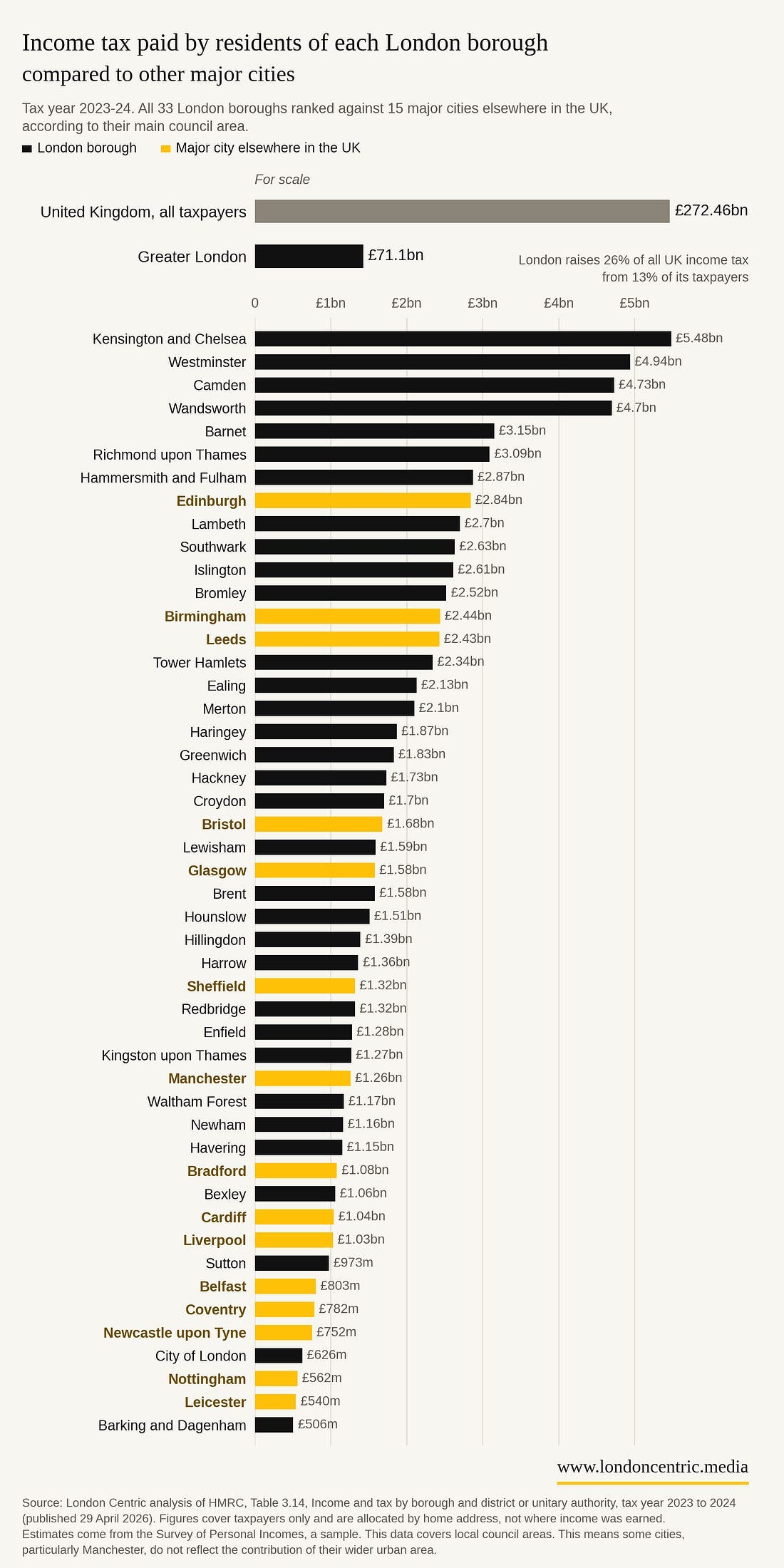
That tells you something about the peninsula.
It’s against that background that discussion in August continued around another potential tax, commonly called the Mansion Tax. Its proper name is the High Value Council Tax Surcharge.
Unsurprisingly, in a borough, and especially a place such as Barnes, with an extraordinary concentration of expensive property, the impact would be substantial.
More than half the expected national revenue from the surcharge is estimated to come from properties in Richmond, Kensington and Chelsea, Westminster and Wandsworth.
Around 5,730 Richmond properties are expected to be affected.
The leaders of the four councils have written to the Government urging it to rethink the scheme.
This complex and complicated.
The UK Government’s argument is understandable. Council tax remains based on 1991 property valuations, so a very expensive house can therefore attract a remarkably small annual property tax relative to its current value.
But Barnes exposes the complications too.
In the immediate future, Barnes risks becoming London’s ‘largest gated community’.
Not because of the Bridge. This statement would stand even if cars were restored to Hammersmith Bridge.
The extreme concentration of wealth in property creates the gate.
Take that far enough and you arrive at a strange Barnes in 2050: an ageing village in an ageing borough where only people who already possess considerable housing or pension wealth can afford to remain.
In today’s terms that would mean ‘Boomers with defined-benefit pensions and City bonuses’.
Is that what we want?
We may be approaching the political limits of relying so heavily on earned income as the tax base. Wealth and particularly property wealth, is an obvious place governments will continue to look.
That will force some people to think differently about where and how they live.
Conversation at the Barnes Community Association Barnes Tuesday Local has turned more than once to downsizing during retirement or converting homes for multigenerational living.
By 2050 both may become more common.
And perhaps Barnes would be better for it. A place where a larger house does not automatically mean one or two older people occupying it until the end of their lives.
That transition may be uncomfortable for individuals.
But the alternative could be a village steadily pricing out its own future.
Economy - more small and independent traders opening
The four retail parades in Barnes play an outsized role in creating and maintaining this community.
My working assumption, which Barnes2050 intends to test properly, is that part of this comes from the unusually high proportion of small and independent traders and relatively few long-term empty units.
They provide Barnes some of its distinctive character, alongside the green and blue landscape.
The important thing is to maintain all three by 2050.
For the moment, the next generation of retailers is taking its place.
Greenfield Artisan Butchers are at 189 Castlenau.

This is the second new opening recently on Castlenau. Fat Goose Bakery already seems popular. The shop was busy on the two mornings I cycled past.
Head towards the Pond and you’ll notice the former Cote site will soon be the home of the Little Navigators nursery for children aged between 9 months and 5 years. Founder Celine Stonex-Kennedy lives locally and plans to open in early 2027. You can register your here.
Head towards the river and where the High Street ends, you find work is underway at Alison, a coffee shop and patisserie opposite The Watermans.
And Church Road has openings coming too. One Church Road - guess the address - will be a high-end menswear shop. Dee Cafe at 153 Church Road will offer ‘Fine coffee, fresh food, inspired by art and nature’.
Individual shops will always come and go.
The signal worth watching is whether Barnes can continue replacing them with distinctive, viable local businesses rather than allowing vacancies to accumulate or every parade to become interchangeable with every other affluent London neighbourhood.
There’ll be much more on this topic in the coming months.
Housing: Plug-in solar now available from Argos
Look the roofs in Barnes and you will find solar panels.
Not many, but on most streets there seems to have one house with a shiny roof, panel-clad.
Until now installing solar has generally meant making quite a substantial intervention in your house.
That may be changing, as the BBC reported,
They are significantly cheaper than roof panels, can be installed without an electrician and are suitable for properties with outdoor space, including some balconies.
The UK Government hopes they will help households save money and reduce reliance on imported fuel.
Approved systems can supply up to 800W. The UK Government estimates they could provide up to a fifth of an average household’s electricity and save up to £110 a year.

The Evening Standard reported that Argos became the first major retailer to sell them, with other large retailers expected to follow.
Prices are still substantial: current Argos kits start at around £600. That should fall in the years ahead.
The important point is what happens when generating some of your own electricity changes from being a building project to something approaching a consumer purchase.
Barnes has thousands of homes, gardens, terraces, balconies and outbuildings where conventional rooftop solar may be expensive, complicated or inappropriate.
By 2050, will generating at least some electricity at home feel as unremarkable as installing broadband?
That suddenly looks a little more plausible.
Which of these stories will matter in five years?
Most weak signals disappear. A few turn out to have been early glimpses of something much bigger.
The useful thing is to notice them.
You can read back-issues of this take on the recent news relevant to future Barnes here.